The 2023 Mexican Congress 'Alien Bodies' Hearing in a U.S. Embassy Cable
A routine weekly political roundup from the U.S. Embassy in Mexico City gave one paragraph to Jaime Maussan's 'alien corpses' hearing, and closed it by noting that scientists had already discredited his earlier bodies.
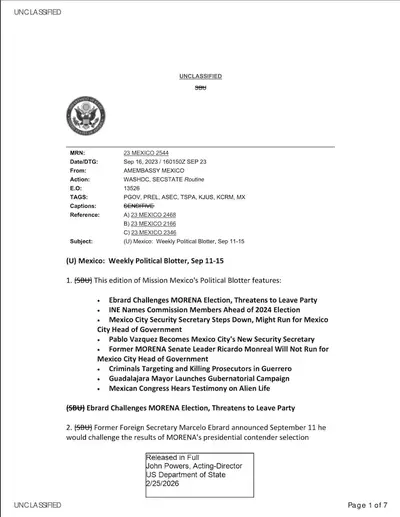
The paragraph sits eighth of eight. Before it, the U.S. Embassy in Mexico City worked through a week of hard politics: Marcelo Ebrard contesting MORENA’s presidential selection, new commissions at the National Electoral Institute, the resignation of Mexico City’s security chief, two prosecutors murdered in Guerrero. Then comes a short item headed “Mexican Congress Hears Testimony on Alien Life.” It is the only reason this document is in a UAP collection at all.
What the record is
The document is cable 23 MEXICO 2544, “Mexico: Weekly Political Blotter, Sep 11-15,” sent from the embassy to the Secretary of State on 16 September 2023. It is marked Sensitive But Unclassified, runs to seven pages and carries the signature “SALAZAR,” the name of the then ambassador, Ken Salazar. Beyond Washington it went, at routine precedence, to the National Security Council, the Vice President’s office, the DNI, CIA, DIA, NORTHCOM, SOUTHCOM, Homeland Security, Justice and every U.S. consulate in Mexico. That list is the standard distribution for a political summary of this kind, not a sign of special interest in the UFO item. The State Department stamped the cable “Released in Full” in 2026, and it now sits in the National Archives’ Record Group 615 series of State Department UAP records. An earlier version of this page dated it to 2003 because of a misreading of its date line; the cable is from 2023, and so is everything it describes.
What the cable says
The UFO paragraph is short and plain. On 12 September, it reports, Congress heard testimony on unidentified aerial phenomena from experts including the Mexican journalist Jaime Maussan and the former U.S. Navy pilot Ryan Graves, “who previously testified before the U.S. Congress.” The hearing was held to debate UAP language in an “Aerial Space Protection Law” which, the embassy wrote, “if approved, would make Mexico the first country to formally acknowledge the presence of alien life on Earth.” The experts asked legislators to recognize UAP, guarantee airspace security and allow the phenomena to be studied. They also showed videos of Mexican pilots’ encounters with fast-moving objects and presented “two alleged alien corpses.”
The embassy then did something a news wire might not have bothered to do. It recorded that Graves, after the hearing, complained that the display had taken attention away from his and other pilots’ experiences, and quoted him calling it Maussan’s “unsubstantiated stunt.” Its last sentence reads: “Scientists have discredited previous alleged alien corpses Maussan presented as evidence of alien life.” A Reuters photograph of Maussan with the remains is captioned below it. That is the whole of it. There is no analysis, no comment section of the kind the cable gives to Ebrard and Ricardo Monreal, and no reference cable.
The hearing and the bodies
The session in the Chamber of Deputies was Mexico’s first public congressional hearing on UFOs. Maussan, who has promoted UFO claims on Mexican television for decades, unveiled two small, three-fingered figures with elongated heads lying in glass cases. He said they had been recovered near the Nazca Lines in Peru in 2017 and were about a thousand years old, citing carbon dating by the National Autonomous University of Mexico (UNAM). José de Jesús Zalce Benítez, a Mexican Navy physician, told the session that X-rays, 3-D reconstruction and DNA work had been carried out.
UNAM reissued a 2017 statement within days. Its accelerator mass spectrometry laboratory had only dated a sample it was sent; it drew no conclusions about the origin of the material, ran no other tests and never handled the complete specimens. A radiocarbon date, in any case, gives the age of the tissue sampled, not what the object was or how it was put together. The Chamber made no declaration about alien life, whatever social media claimed afterwards.
The bodies belonged to a family of objects already notorious. The same Nazca finds had been promoted since 2017, and that year a Peruvian prosecutor’s report described similar figures as recently made dolls covered in a mix of paper and synthetic glue to imitate skin. In October 2023 Peruvian customs seized two more figures at a DHL office at Lima airport, reportedly addressed to a Mexican citizen. On 12 January 2024 the forensic archaeologist Flavio Estrada, presenting the prosecutor’s analysis, called them “dolls” made from bones of this planet, human and animal, joined with modern synthetic glue. The longer background is set out on our page on the Nazca mummies.
This was not Maussan’s first set of bodies either, which is the history the embassy’s closing sentence points to. In May 2015 he hosted the “Be Witness” event in Mexico City to unveil the “Roswell slides,” colour photographs of a small corpse he called undeniable proof of alien life. Within days, independent researchers used deblurring software on the museum placard visible beside the body. It read “Mummified body of two year old boy”: a Puebloan child from Mesa Verde, photographed on display in Colorado.
What the cable establishes, and what it does not
The cable shows that the embassy noticed the hearing and reported it accurately and briefly as part of Mexico’s political week. It also shows that the drafting officers had enough background to flag Maussan’s record and Graves’s public rebuke. It does not show that any U.S. agency examined the remains, received samples, took a view on the pilot videos, or treated the episode as anything more than a curiosity in the domestic news. None of the addressees on the distribution list is recorded as responding. Its inclusion in a UAP records collection reflects a keyword, not a finding. Read on its own terms, the most useful thing it preserves is the tone of the people who wrote it: they gave the corpses one sentence and their debunking another.
Sources
- National Archives Catalog: 23 Mexico 2544, “Mexico: Weekly Political Blotter, September 11-15” (NAID 651326432)
- Original release on war.gov
- NPR: A ufologist claims to show 2 alien corpses to Mexico’s Congress (13 September 2023)
- Smithsonian Magazine: Alleged Alien Corpses Displayed to Mexican Congress Did Not Convince Scientists
- Mexico News Daily: UFO expert presents “alien corpses” in Mexican Congress
- CBS News: “Aliens” found in Peru are actually dolls made of bones, forensic experts declare
- Global News: Peru “alien corpses” made of human and animal bones and glue
- Open Minds: Roswell alien slides placard deciphered, says it is a mummy