Dechmont Law UFO Encounter
Forester Robert Taylor encountered a UFO and was attacked by smaller spheres in Dechmont Woods. Police treated it as an assault case, finding physical evidence at the scene.
The morning of November 9, 1979, was unremarkable in every way that mattered. The Scottish sky hung low and grey over West Lothian, the air carried the damp chill of approaching winter, and Robert Taylor went about his work as he had done for decades. A forestry worker employed by the Livingston Development Corporation, Taylor was a quiet, methodical man of sixty-one years who spent his days walking the woodlands around Dechmont Law, checking on young trees and monitoring the health of the plantations under his care. He was not a man given to imagination, not someone who read science fiction or followed stories about flying saucers. He was, by every account of those who knew him, the last person on earth likely to report a UFO encounter. And yet, on that grey November morning, something happened in a clearing in Dechmont Woods that would make Robert Taylor the central figure in Scotland’s most famous UFO case—and the only UFO incident in British history to be investigated as a criminal assault.
The Man in the Woods
To understand why the Dechmont Law encounter carries such weight among UFO researchers, one must first understand the man at its center. Robert Taylor was not merely credible; he was the embodiment of the reliable Scottish working man. Born in 1918, he had spent virtually his entire adult life working outdoors in forestry, developing an intimate knowledge of the landscape and its natural phenomena. He knew the woods around Livingston as well as anyone alive, having walked them in every season and every kind of weather for years.
His colleagues at the Development Corporation regarded him as steady, honest, and completely dependable. He was not a drinker, not prone to flights of fancy, and had no history of mental illness or neurological conditions. He had never expressed any interest in UFOs or the paranormal, and his personality was of the sort that actively resisted attention and publicity. In the years following his encounter, Taylor would consistently refuse to capitalize on his experience, declining interview requests, turning down offers to appear on television programs, and expressing visible discomfort whenever the subject arose. He maintained his account without embellishment or variation until his death in 2007, never seeking money or fame from what had happened to him.
This bedrock of personal credibility is what gives the Dechmont Law case its particular power. Skeptics who might readily dismiss the testimony of a self-proclaimed UFO enthusiast or a publicity seeker found themselves confronting a witness who wanted nothing more than to be left alone—a man whose account was bolstered not by his eagerness to tell it but by his manifest reluctance.
Into the Clearing
On the morning of November 9, Taylor parked his pickup truck on a forest track at the base of Dechmont Law, a volcanic hill that rises above the town of Livingston. His red setter, Lara, accompanied him as usual. He set off on foot through the trees, following a path he had walked many times before, heading toward a clearing where young trees had been planted and needed inspection.
The walk was routine, the woods quiet save for the usual sounds of wind in the branches and the occasional call of a bird. Taylor pushed through a gap in the trees and stepped into the clearing. What he saw there stopped him in his tracks.
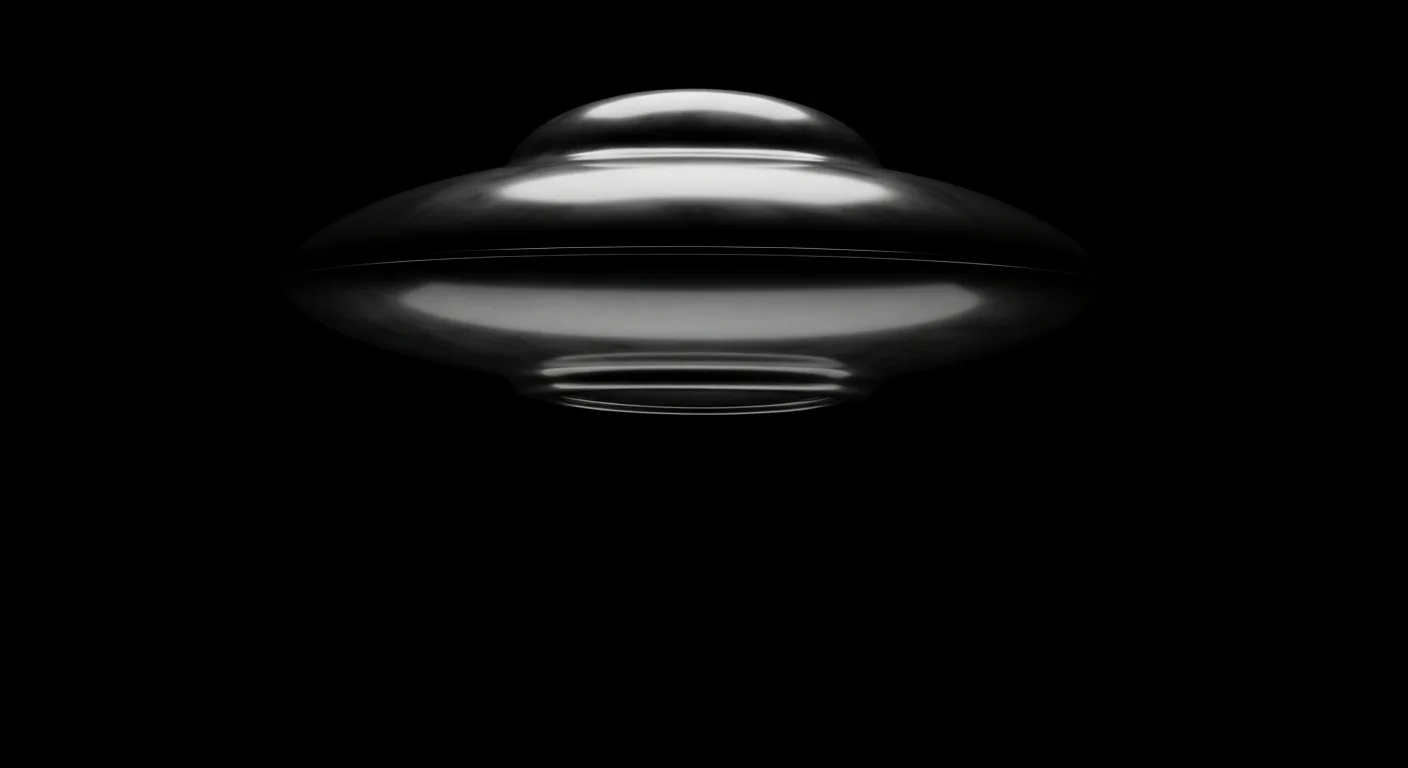
Hovering above the ground in the center of the clearing was an object unlike anything Taylor had ever seen or imagined. It was roughly circular, perhaps twenty feet in diameter, with a dome-like upper section and a narrow rim or flange around its middle. The surface appeared dark grey and metallic, but with a curious quality—it seemed to shimmer slightly, as if the air around it were disturbed. Taylor would later describe the surface as having a rough texture, almost like sandpaper, and noted that portions of the object appeared to become transparent at intervals, as though the craft were attempting to camouflage itself against the sky.
The object made no sound. It simply hung in the air, motionless and silent, a few feet above the grass. Taylor stood staring at it, trying to make sense of what he was seeing. His rational mind searched for explanations—a weather balloon, some kind of military equipment, an optical illusion caused by the light—but nothing fit. The thing in the clearing was solid, structured, and clearly manufactured, yet it corresponded to nothing in his experience.
The Attack
What happened next elevated Taylor’s experience from a sighting to something far more disturbing. As he stood watching the hovering object, two smaller spheres emerged from beneath it. These objects were roughly the size of large footballs, dark in color, and covered in protruding spikes or appendages that gave them a mine-like appearance. They dropped to the ground and began rolling toward Taylor across the grass, making a soft plopping or sucking sound as their spikes contacted the earth.
Before Taylor could react or retreat, the two spheres reached him. They attached themselves to his trouser legs, one on each side, gripping the fabric with their spike-like projections. He felt a tugging sensation as they began to pull him toward the larger craft. At the same moment, a powerful, acrid smell filled the air—a choking, chemical odor that Taylor would later compare to burning rubber or braking material. The smell was overwhelming, and Taylor felt himself losing consciousness.
He tried to resist, tried to pull away from the spheres, but his legs would not respond properly. The last thing he remembered was being dragged forward across the grass toward the hovering dome, the chemical stench filling his lungs, his vision darkening. Then everything went black.
Aftermath in the Clearing
When Taylor regained consciousness, he was lying face down on the wet grass of the clearing. The object was gone. The spheres were gone. The acrid smell lingered faintly in the air but was dissipating. His dog, Lara, was barking frantically, running back and forth near where he lay.
Taylor tried to stand but found his legs weak and uncooperative. He attempted to call Lara but discovered that his voice would not work—he could form the words in his mind but could not make his throat produce them. His head ached, and he felt disoriented and nauseous. He managed to crawl and then stagger to his feet, but walking was difficult. His trousers, he noticed, were torn—ripped at the sides where the spheres had gripped them.
He tried to reach his truck but could not manage the rough terrain in his weakened state. Eventually, he half-walked and half-crawled back to the track where his vehicle was parked. He attempted to drive but was too shaken and confused to operate the vehicle properly, running it into a ditch. Unable to drive, he abandoned the truck and walked the remaining distance to his home, arriving in a state of visible distress.
Mary Taylor’s Response
When Taylor arrived home, his wife Mary immediately recognized that something was seriously wrong. Her husband was disheveled, mud-stained, and visibly shaken. His trousers were torn, his legs bore red marks, and he was having difficulty speaking. He smelled strongly of the chemical odor that had accompanied his encounter. He was also experiencing a powerful thirst that would persist for hours.
Taylor managed, with difficulty, to describe what had happened to him. Mary Taylor, alarmed by his physical state and the strangeness of his account, wanted to call the police immediately. Robert resisted this suggestion, perhaps already sensing the scrutiny that would follow, but Mary insisted that whatever had happened to her husband amounted to an assault and needed to be reported. She contacted the police, and the wheels of an unprecedented investigation began to turn.
A Crime Scene in the Woods
What makes the Dechmont Law case unique in the annals of UFO history is the response of Lothian and Borders Police. When officers arrived at the Taylor home and heard his account, they did not dismiss it as the ravings of an eccentric. They assessed the situation through the lens of their training: a man had been physically attacked, his clothing had been torn, and he bore injuries consistent with his account. The identity of the attacker was unknown and extraordinary, but the fact of the assault was evident.
The police treated the clearing in Dechmont Woods as a crime scene. A forensic team was dispatched to examine the area, and what they found provided striking corroboration of Taylor’s story. In the grass where Taylor said the object had hovered, investigators discovered two parallel tracks of holes punched into the earth. Each track consisted of roughly forty holes, arranged in a ladder-like pattern. The holes were deep and regular, consistent with some heavy object having rested on or near the ground with protruding supports or landing gear.
In addition to the ladder-pattern tracks, the forensic team found a second set of marks in the grass—circular scrape marks or gouges that radiated outward from the area where the tracks were located. These marks were consistent with Taylor’s description of the two spiked spheres rolling across the ground toward him. The pattern of disturbance in the grass matched the trajectory he described: from the area of the hovering object outward toward the position where he said he had been standing.
Taylor’s trousers were taken as evidence. Examination confirmed that the tears in the fabric were consistent with something gripping and pulling the material—the pattern of damage was not consistent with snagging on branches or fencing, which would have produced different types of tears. The damage was on both legs, at approximately the same height, consistent with Taylor’s account of the two spheres attaching simultaneously.
The police file on the incident was classified as an assault by an unknown assailant. It was, and remains, the only case in Scottish legal history where a UFO encounter was treated as a criminal matter. The file has never been closed.
Medical Evidence
Taylor was examined by his personal physician, Dr. Gordon Adams, on the day of the incident. Dr. Adams found his patient to be in a state of shock but otherwise clearheaded and coherent. Taylor’s vital signs were elevated, consistent with a significant physical and emotional trauma. The red marks on his legs corresponded to the areas where he said the spheres had gripped him. There was no evidence of any pre-existing medical condition that might explain the experience—Taylor had no history of epilepsy, no history of hallucinations, and had not been drinking or taking any medication.
The persistent thirst that Taylor experienced after the encounter was noted as unusual and potentially significant. Some researchers have speculated that it might indicate exposure to some form of radiation or electromagnetic energy, though no definitive explanation has ever been established. Taylor’s headache and temporary loss of voice were also consistent with exposure to an irritant substance, supporting his description of the acrid chemical smell.
Dr. Adams found Taylor’s account entirely believable, not because of any predisposition toward UFO phenomena but because of his long acquaintance with Taylor’s character. This was not a man who fabricated stories, and the physical evidence of his distress was undeniable.
Seeking Explanations
In the years following the encounter, various skeptical explanations were proposed. The most prominent suggested that Taylor had experienced an epileptic seizure, with the UFO sighting being a hallucination produced by the episode and the physical damage being caused by his fall during the seizure. This theory had a certain superficial plausibility—temporal lobe epilepsy can indeed produce vivid hallucinations, and a fall might account for some of his injuries.
However, the epilepsy theory encountered significant difficulties. Taylor had no prior history of seizures, and he experienced no subsequent episodes in the remaining twenty-eight years of his life. Temporal lobe epilepsy typically produces a pattern of recurring seizures, not a single isolated episode. Moreover, the theory could not account for the physical evidence in the clearing—the ladder-pattern tracks, the circular gouges, and the damage to Taylor’s trousers. An epileptic seizure might cause a man to fall and tear his clothing, but it cannot punch forty holes into the ground in a regular pattern.
Ball lightning was another proposed explanation, particularly for the two smaller spheres. Ball lightning is a poorly understood atmospheric phenomenon that might, under unusual circumstances, produce luminous spheres of ionized gas. However, ball lightning has never been observed to physically interact with human beings in the manner Taylor described, and its existence as a consistent, repeatable phenomenon remains debated among atmospheric scientists. The theory also failed to account for the larger hovering object.
Some skeptics suggested more mundane explanations—that Taylor had encountered some piece of military or industrial equipment and, in his confusion, had embellished the experience. But no such equipment was ever identified in the area, and the physical evidence at the scene was not consistent with any known machinery.
Taylor’s Later Years
Robert Taylor returned to work at the Livingston Development Corporation after recovering from his encounter and continued in his forestry role until his retirement. He remained a private man, uncomfortable with the attention his experience brought him and reluctant to discuss it publicly. When he did speak about the incident, his account never varied in its essential details—he described the same object, the same spheres, the same physical sensations, the same sequence of events, year after year, decade after decade.
He turned down money, declined television appearances, and avoided UFO conferences and enthusiast gatherings. His consistent refusal to profit from his experience is perhaps the strongest argument for his sincerity. A hoaxer or attention seeker would have found ample opportunity to exploit the case; Taylor wanted only to be believed and then left alone.
Robert Taylor died on March 14, 2007, at the age of eighty-eight. He went to his grave maintaining that what happened to him in Dechmont Woods on November 9, 1979, was exactly as he had described it—a genuine encounter with something unknown that had attacked him and left evidence of its presence.
The Site Today
The clearing in Dechmont Woods where Taylor’s encounter took place has become something of a pilgrimage site for UFO enthusiasts and curious visitors. In 1992, a cairn was erected near the spot, marking the location with a plaque that describes the incident in measured, factual terms. The site is part of a walking trail through Dechmont Woods, and visitors can follow the approximate route that Taylor walked on that November morning, passing through the trees and emerging into the clearing where the most extraordinary event of his life occurred.
The Livingston community has largely embraced the encounter as part of its local heritage. Annual commemorations have been held, and the case features in local history publications and tourist information. The acceptance of the story by Taylor’s neighbors—people who knew him personally and could judge his character firsthand—speaks volumes about the credibility they assigned to his account.
A Case That Endures
The Dechmont Law encounter endures as one of the most compelling UFO cases in British history for a constellation of reasons that, taken together, create something approaching an airtight argument for the reality of Taylor’s experience. The witness was unimpeachable—a man of proven honesty with no motive to fabricate. The physical evidence was documented by professional forensic investigators using standard crime scene procedures. The police investigation was conducted with the same rigor applied to any assault case. The medical examination found a man in genuine distress with injuries consistent with his account. And every proposed skeptical explanation has failed to account for the totality of the evidence.
The case also occupies a unique legal position. Because it was investigated as a criminal assault, it carries an official status that no other UFO case in Scotland can claim. The police file remains open, an unresolved case of assault by persons—or entities—unknown. In the dry, procedural language of the law, something attacked Robert Taylor in Dechmont Woods, something that has never been identified and never been brought to justice.
Whatever entered that clearing on a grey November morning in 1979 left traces that science and law enforcement have been unable to explain. It left marks in the earth, tears in a man’s clothing, and an indelible impression on a witness whose character was beyond serious question. The Dechmont Law encounter asks us to consider the possibility that Robert Taylor, a man who had no reason to lie and every reason to stay silent, told the simple truth about what he experienced—and that the truth, in this case, was something that defies our comfortable understanding of what is possible in a quiet Scottish woodland on an ordinary working day.
Sources
- CIA UFO/UAP Reading Room — Declassified CIA documents on UAP
- UK National Archives — UFO Files — MoD UFO investigation records
- British Newspaper Archive — UK press archive