Broad Haven School UFO Sighting
Fourteen schoolchildren at Broad Haven Primary School independently described and drew a UFO they saw behind their school. Their consistent accounts sparked the 'Welsh Triangle' UFO wave.
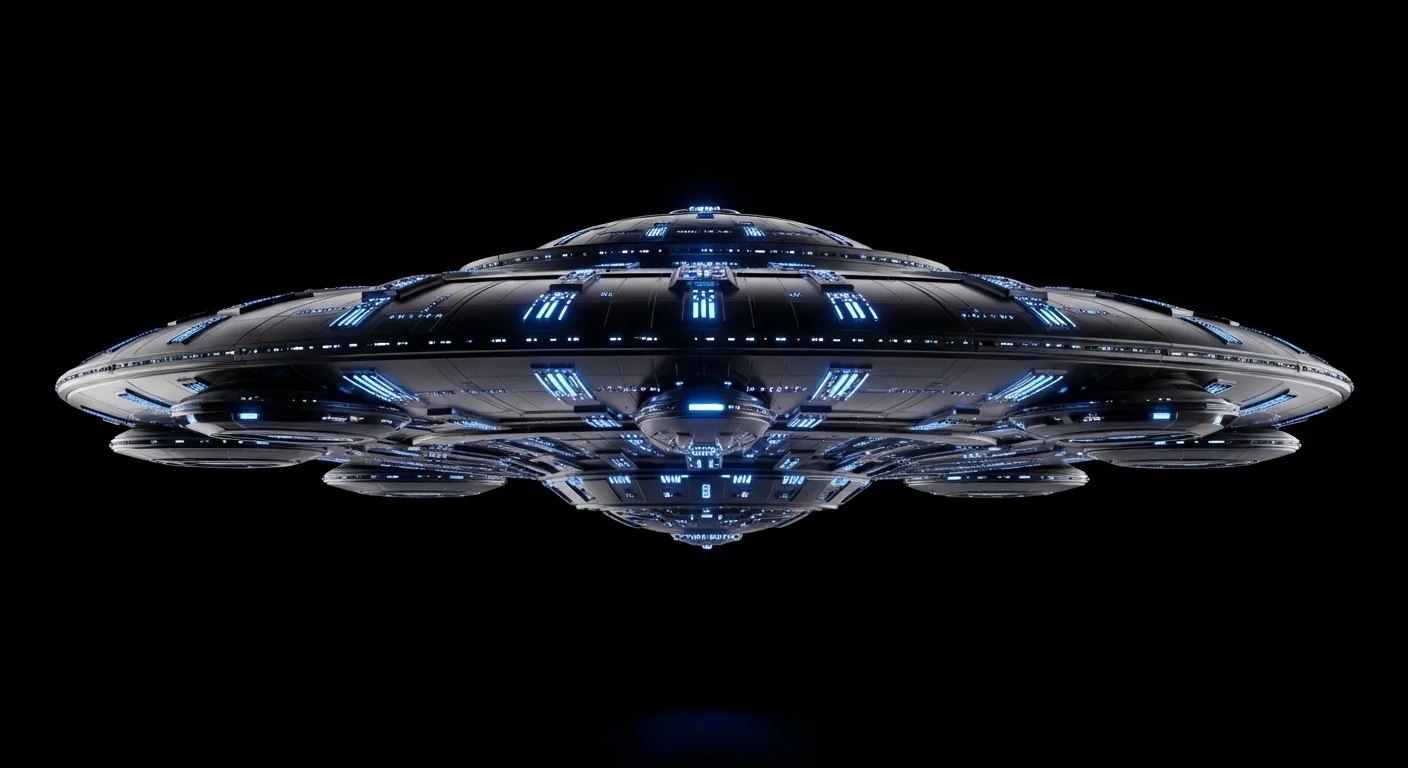
In the quiet village of Broad Haven, tucked into the Pembrokeshire coast of southwestern Wales, the fourth of February 1977 began as an unremarkable winter Friday. The children at Broad Haven Primary School ate their lunches, pulled on their coats, and went outside for the midday break, exactly as they did every other day. What happened during that lunch period would transform a sleepy coastal village into the epicenter of one of Britain’s most celebrated UFO cases, ignite a wave of sightings across the region that journalists would dub the “Welsh Triangle,” and produce a body of evidence, in the form of children’s drawings made independently and without collaboration, that remains one of the most compelling pieces of documentation in UFO history.
The Village
Broad Haven sits on St. Bride’s Bay in Pembrokeshire, a county that occupies the southwestern tip of Wales, jutting out into the Irish Sea and the Atlantic beyond. The landscape is one of rolling farmland, dramatic sea cliffs, and small villages connected by narrow lanes that wind between hedgerows and stone walls. In 1977, Broad Haven was a community of perhaps a few hundred people, sustained by farming, fishing, and the modest tourism that the beautiful coastline attracted during summer months. It was the sort of place where everyone knew everyone, where news traveled by word of mouth over garden fences, and where the most exciting event in a typical week might be a church fete or a rugby match.
Broad Haven Primary School served the children of the village and surrounding farms, a small school with a handful of teachers and a student body that encompassed most of the community’s children between the ages of five and eleven. The school buildings overlooked playing fields that backed onto open farmland, a patchwork of fields bounded by hedges and fences that stretched toward the coast. It was in one of these fields, just beyond the school boundary, that the children saw the object that would change their village’s reputation forever.
The Sighting
The events of February 4 unfolded during the lunchtime break, which at Broad Haven Primary ran from approximately noon to one o’clock. The children were playing outside on the school field when several of them noticed something unusual in the field beyond the school boundary. The object appeared to be sitting on the ground or hovering just above it, partially obscured by trees and hedgerows but clearly visible to those who looked in the right direction.
The children who first noticed the object called to their classmates, and soon a group of approximately fourteen children were watching the thing in the field. Their descriptions, given independently in the days that followed, were remarkably consistent. The object was silver or metallic grey in color, cigar-shaped or elongated, with a dome or raised section on its upper surface. It appeared to be roughly the size of a bus or larger, solid and clearly manufactured rather than natural. Some of the children reported seeing a figure near the object, a humanoid shape that appeared to be wearing a silver suit.
The children watched the object for a period that various witnesses estimated at between a few minutes and the duration of the lunch break. The object did not move dramatically during this period but appeared to remain stationary or nearly so. Before any adult could be summoned to witness the phenomenon, the object departed, either flying away or simply vanishing from the spot where it had been resting. By the time the children’s excited reports reached their teachers, there was nothing in the field to see.
The Headmaster’s Test
The initial adult reaction to the children’s reports was predictable skepticism. Children are imaginative, and the idea that a flying saucer had landed in the field behind the school seemed, to the teachers, far more likely to be a product of youthful fancy than a genuine observation. The children were told to settle down and return to their lessons, and the matter might have ended there had not one educator had the foresight to conduct a simple but elegant test.
Ralph Llewellyn, the headmaster of Broad Haven Primary School, separated the children who claimed to have seen the object and asked each one, individually and without the opportunity to confer with the others, to draw what they had observed. This was a masterstroke of informal investigation. Children’s drawings are direct and unfiltered, reflecting what the child actually perceived rather than what they think they should have perceived. By isolating the children, Llewellyn eliminated the possibility that they were copying each other’s accounts or arriving at a consensus through discussion.
The results were striking. The drawings produced by the fourteen children showed remarkable consistency in their depiction of the object. The basic shape, an elongated body with a dome on top, appeared in drawing after drawing, with variations in detail that reflected individual perspectives and artistic abilities but agreement on the fundamental form. The color was consistently described as silver or grey. The dome was present in most of the drawings. Some included the humanoid figure, others did not, but those who depicted the figure placed it in approximately the same position relative to the object.
The consistency of the children’s drawings impressed Llewellyn, who had expected to find the kind of wild variation that would indicate imagination rather than observation. Instead, he found what appeared to be fourteen independent depictions of the same object, drawn from different angles and with different levels of detail but agreeing on the essential characteristics. This was not proof of an extraterrestrial visitation, but it was strong evidence that the children had genuinely seen something unusual in the field, something real enough and distinctive enough to produce consistent representations when drawn independently.
The Investigation
News of the Broad Haven sighting spread quickly, first through the local community and then through the regional and national media. The story of fourteen schoolchildren who had seen a UFO and drawn matching pictures was compelling enough to attract journalists from across the country, and Broad Haven suddenly found itself at the center of a media circus that the quiet village was entirely unprepared for.
Researchers and investigators followed the journalists. Among the most significant was Randall Jones Pugh, a local veterinarian and UFO enthusiast who became the primary investigator of the Pembrokeshire sightings. Pugh conducted detailed interviews with the children and their families, visited the site of the sighting, and attempted to identify any conventional explanation for what the children had seen.
The BBC also became involved, sending a crew to Broad Haven to film a segment about the sighting. The reporters interviewed the children, examined their drawings, and visited the field where the object had been seen. The resulting coverage brought the story to a national audience and cemented the Broad Haven sighting in the public consciousness.
Investigators found the children to be credible witnesses. They were not attention-seekers or fantasists but ordinary schoolchildren who had been genuinely startled by what they had seen. They told their stories consistently over multiple interviews, without embellishment or contradiction, and their emotional responses, a mixture of excitement and unease, were consistent with genuine experience rather than fabrication.
No evidence of a hoax was found. There was no obvious conventional explanation for the object. Some skeptics suggested that the children had seen a sewage tanker or agricultural vehicle in the field and misidentified it as something more exotic, but this explanation was difficult to reconcile with the children’s descriptions of a silver, domed object that departed the field by either flying or vanishing. Sewage tankers do not fly, and they are not silver, and they do not have domes.
The Welsh Triangle
The Broad Haven school sighting proved to be not an isolated incident but the opening event in a series of UFO reports from across Pembrokeshire that would continue throughout 1977 and into the following years. The pattern of sightings was concentrated in an area of southwestern Wales that journalists christened the “Welsh Triangle” or the “Dyfed Enigma,” in reference to the old county name for the region.
The reports came from a diverse array of witnesses, including farmers, hotel owners, motorists, and military personnel. The descriptions varied but shared common elements: silver or metallic objects, unusual lights, and in several cases, humanoid figures in silver or pale suits. The volume and consistency of the reports suggested either a genuine phenomenon affecting the region or an extraordinary outbreak of collective misidentification and suggestion.
Among the most significant related cases was that of Rosa Granville, the owner of the Haven Fort Hotel near Broad Haven. In April 1977, Granville reported seeing a large, dome-shaped object in a field near her hotel, with two humanoid figures visible near it. The object reportedly emitted a bright light that frightened cattle in nearby fields. Granville was a respected local businesswoman with no history of making unusual claims, and her account was treated seriously by investigators.
Other reports included strange lights over the countryside, vehicle interference effects in which car engines and electrical systems failed in proximity to unusual aerial objects, and encounters with tall, silver-suited figures who appeared on country roads before vanishing. The cumulative effect was to create a sense that something genuinely unusual was happening in southwestern Wales, a localized wave of activity that defied easy explanation.
The Children, Decades Later
One of the most compelling aspects of the Broad Haven case is the consistency of the witnesses’ accounts over time. Unlike many UFO cases, where witnesses recant, embellish, or gradually distance themselves from their stories, the children of Broad Haven Primary School have, as adults, consistently maintained the truth of what they saw that February day.
Documentaries produced decades after the original sighting have revisited the now-adult witnesses and found their accounts unchanged in their essentials. They describe the same object, express the same puzzlement, and maintain with quiet conviction that they saw something real in the field behind their school. There have been no recantations, no confessions of hoax, and no retractions. Whatever the children saw, they continue to believe they saw it, and the passage of time has not weakened their certainty.
This long-term consistency is significant. A hoax perpetrated by schoolchildren would be unlikely to survive decades without at least one participant breaking ranks, particularly given the complete absence of any motivation for maintaining a falsehood. A misidentification of a mundane object might similarly be expected to collapse under the weight of adult reflection and accumulated knowledge. The fact that the witnesses’ accounts have remained stable suggests that they are reporting a genuine memory of a genuine experience, whatever the nature of the object they observed.
The Drawings as Evidence
The children’s drawings remain the single most important piece of evidence in the Broad Haven case. They represent a form of documentation that is both immediate and independent, produced within hours of the sighting by witnesses who had not had the opportunity to coordinate their accounts. In the hierarchy of UFO evidence, they occupy an unusual position, more objective than verbal testimony alone but less definitive than a photograph or physical trace.
What makes the drawings particularly valuable is the methodology by which they were produced. Headmaster Llewellyn’s decision to separate the children and have them draw independently created a natural controlled experiment. If the children had been making up a story, one would expect their drawings to diverge significantly, reflecting individual imaginations rather than a shared observation. If they had been observing a real object, one would expect a core of consistency with individual variation reflecting different vantage points and artistic abilities. The drawings are consistent with the latter pattern.
The drawings are not identical, which is itself significant. Perfect identity would suggest copying or coordination rather than independent observation. The variations, in size, proportion, and detail, are exactly what one would expect from a group of children describing the same object from different positions and with different levels of attention to detail. The agreement on fundamental shape, color, and key features, combined with variation in secondary details, is the hallmark of multiple independent observations of the same phenomenon.
Theories and Explanations
The Broad Haven sighting has been the subject of extensive analysis and debate over the decades since it occurred. Proposed explanations range from the mundane to the extraordinary, and none has achieved universal acceptance.
The most commonly cited skeptical explanation is that the children saw a conventional vehicle or structure in the field, possibly agricultural equipment or a sewage tanker, and misidentified it as something more exotic. Proponents of this theory note that the field in question was used for various agricultural purposes and that a vehicle parked there would not have been unusual. However, this explanation struggles to account for the children’s descriptions of a silver, domed object, the reported departure of the object from the field, and the humanoid figure seen by some witnesses.
Another skeptical explanation attributes the sighting to the power of suggestion. Once one child claimed to have seen something unusual, the theory goes, others may have been influenced to see, or believe they saw, the same thing. This explanation is weakened by the independent drawing exercise, which demonstrated a level of consistency difficult to attribute to mere suggestion, and by the fact that the children’s accounts included both agreements and disagreements in detail, a pattern more consistent with independent observation than with group conformity.
A more exotic explanation accepts the children’s accounts at face value and proposes that they witnessed a genuine unidentified object of unknown origin, whether an extraterrestrial craft, an experimental military vehicle, or some other anomalous phenomenon. This interpretation is supported by the consistency of the testimony, the quality of the witnesses, and the broader context of the Welsh Triangle wave, but it lacks the physical evidence that would be needed to confirm so extraordinary a claim.
Legacy
The Broad Haven school sighting occupies a unique position in British UFO history. It is one of the few cases involving a large group of witnesses who provided independently corroborating evidence, and it is the event that triggered one of the most concentrated UFO waves in the British Isles. The children’s drawings have become iconic images in UFO literature, reproduced in countless books and documentaries as examples of how independent witnesses can provide mutually supportive documentation of an unusual event.
The village of Broad Haven has embraced its association with the case, and the sighting has become part of the community’s identity, a memorable event that set it apart from the many other quiet coastal villages of Pembrokeshire. For the witnesses themselves, now middle-aged adults with families and careers of their own, the sighting remains a vivid and significant memory, an experience that marked them in ways that time has not erased.
Whatever sat in the field behind Broad Haven Primary School on that February afternoon in 1977, it left an impression that endures. The children saw it, drew it, and have never stopped believing in it. Their drawings, simple and direct, speak across the decades with a clarity that more sophisticated evidence often lacks. Fourteen children, fourteen drawings, fourteen accounts that agree on the essential facts: something was there. It was real. And after nearly fifty years, no one has explained what it was.
Sources
- CIA UFO/UAP Reading Room — Declassified CIA documents on UAP
- UK National Archives — UFO Files — MoD UFO investigation records
- British Newspaper Archive — UK press archive