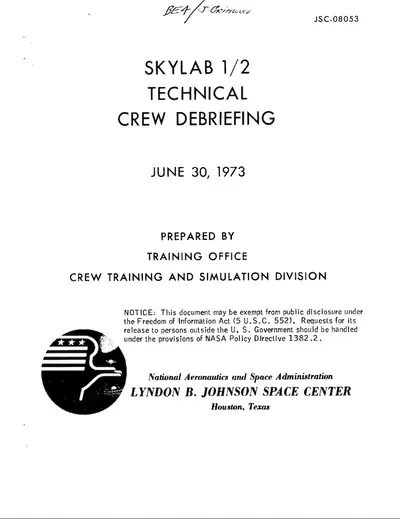
Skylab Techincal Crew Debriefing 1973
Declassified records from the 1973 Skylab missions detail unidentified object sightings observed by three separate space station crews in Low Earth Orbit.
Background
In 1973, within the vacuum of Low Earth Orbit, U.S. government investigators recorded an unidentified-object incident that remained classified for decades. The documentation regarding this event was eventually released to the public on May 8, 2026, as a component of the Presidential Unsealing and Reporting System for UAP Encounters (PURSUE). This specific case represents a significant entry in the modern era of post-Blue-Book civilian and military reports, serving as a bridge between the era of localized aerial sightings and the contemporary study of orbital anomalies. The case is preserved within declassified U.S. government records, providing a rare glimpse into orbital observations during the height of the space race.
The era in which this sighting occurred was characterized by intense scrutiny of the upper atmosphere and orbital planes. During the mid-twentieth century, the study of Unidentified Flying Objects (UFOs) was often relegated to investigative programs like Project Blue Book, which focused primarily on atmospheric phenomena and potential Soviet technological incursions. However, as human presence expanded into Low Earth Orbit, the scope of potential observation shifted from the troposphere to the thermosphere and beyond. The Skylab incident is notable because it occurred during a period of established orbital presence, where the observers possessed the specialized training and instrumentation necessary to distinguish between known satellites and truly anomalous objects.
What the document records
The Skylab space station, launched on May 14, 1973, served as the United States’ first laboratory in space. This orbital outpost was a critical milestone in human spaceflight, designed to conduct scientific research in microgravity and study the effects of long-duration spaceflight on the human body. Between 1973 and 1974, the station was visited by three distinct crews, each tasked with maintaining the laboratory and performing complex orbital experiments.
The declassified document containing the technical debriefings includes excerpts from all three crews that visited the station during its operational lifespan. While the document provides detailed accounts of the observations made from the station, the specific number of witnesses involved in the sightings is not specified within the released text. The nature of the documentation suggests a focus on the technical observations made by the crew members during their mission durations, capturing the data as it was recorded in the official logs of the Skylab program.
Type of case
The classification of this case is categorized as a pilot or aircrew sighting, specifically observed from a cockpit or pressurized vessel during active flight. This type of sighting is distinct from ground-based observations, as the observers are moving at orbital velocities, providing a unique perspective on the trajectory and behavior of the observed object. Such sightings are often considered high-fidelity due to the lack of atmospheric distortion and the controlled environment of the spacecraft.
Status
Under the current regulatory framework, all records released under the PURSUE program are designated as unresolved by the All-domain Anomaly Resolution Office (AARO) by default. This designation reflects a strict adherence to scientific neutrality; the federal government has not concluded that the events recorded during the Skylab missions were anomalous, nor has it concluded that they were the result of conventional phenomena. The possibility of both extraterrestrial or unknown technology and known human-made objects remains open.
When evaluating such orbital sightings, investigators typically consider several conventional candidates. These include experimental aircraft or satellites, weather balloons, and atmospheric optical phenomena such as sundogs or lenticular clouds. Furthermore, astronomical objects like Venus, the Moon, or meteors appearing near the horizon can often be misidentified during orbital maneuvers. The Skylab technical debriefing remains a subject of ongoing study as researchers attempt to reconcile these orbital observations with the known orbital debris and satellite catalogs of the 1970s.
Sources
- Original release on war.gov
- Department of War UFO Disclosure Portal
- AARO (All-domain Anomaly Resolution Office)
- PURSUE record identifier: NASA-UAP-D007 (Release 01, May 8, 2026)