Gemini 7 Transcript, 1965
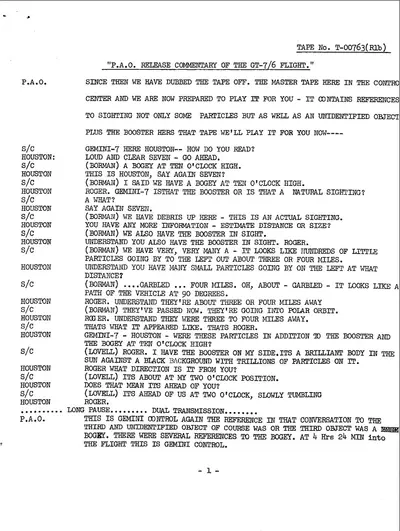
Declassified transcripts from the Gemini 7 mission reveal astronaut reports of a bogey and debris field encountered in Low Earth Orbit in December 1965.
Background
On December 5, 1965, while positioned in Low Earth Orbit, an unidentified-object incident occurred that would later become a significant component of the American aerospace anomalous phenomenon record. The event was documented by U.S. government investigators and remained classified for decades. It was eventually released to the public on May 8, 2026, as part of the Presidential Unsealing and Reporting System for UAP Encounters (PURSUE). This release was part of a broader governmental effort to provide transparency regarding historical aerial and orbital anomalies.
The incident occurred during the height of the Cold War, a period characterized by intense competition for orbital supremacy and heightened surveillance of the upper atmosphere. During this era, the United States Air Force maintained active programs, such as Project Blue Book, to investigate reports of unidentified flying objects. These investigations were often shaped by the geopolitical necessity of distinguishing between Soviet technological advancements and atmospheric or natural phenomena. The Gemini 7 case is preserved within declassified U.S. government records, providing a primary source for the study of orbital encounters during the early space age.
What the document records
Gemini 7 represented the tenth crewed American spaceflight, a mission critical to the development of rendezvous and docking procedures necessary for the later Apollo lunar missions. The primary source material for this case consists of a transcript of communications between the flight crew and the Manned Flight Center, now known as the Johnson Space Center, located in Houston, Texas. The crew involved in this specific encounter included Astronauts James “Jim” Lovell and Frank Borman.
The transcript begins with a report from Borman regarding the presence of a “bogey,” which was the contemporary military and aeronautical nomenclature used to describe an unknown or unidentified aircraft or object. In addition to the sighting of the bogey, the communication records the observation of a debris field. While the transcript captures the immediate reactions and technical data shared between the spacecraft and ground control, the released document does not specify the total number of witnesses to the event. The nature of the communication reflects the high-stakes environment of early manned spaceflight, where any deviation from expected orbital parameters required immediate reporting and analysis.
Type of case
The Gemini 7 incident is classified as a visual sighting reported by ground or air observers, or in this specific instance, by crew members within an orbital platform. Such cases are categorized by the observation of an object that cannot be immediately identified through standard tracking or optical means.
Status
Under the protocols of the All-domain Anomaly Resolution Office (AARO), all records released under the PURSUE program are designated as unresolved by default. The federal government has maintained a neutral stance regarding the Gemini 7 transcript, having reached no definitive conclusion as to whether the event was anomalous or conventional. The authorities have not confirmed the presence of non-human technology, nor have they ruled out the possibility of known technological or natural origins.
In the context of mid-century orbital and atmospheric sightings, several conventional candidates are often considered by investigators. These include the presence of experimental aircraft, high-altitude surveillance technology, or weather balloons, such as those used in the Project Mogul series during the late 1940s. Other possibilities include atmospheric optical phenomena, such as sundogs or lenticular clouds, which can create illusions of moving objects. Additionally, astronomical objects like Venus, the Moon, or meteors appearing near the horizon are frequently cited as potential sources of misidentification in orbital telemetry and visual reports. The Gemini 7 case remains part of the ongoing scientific and historical effort to categorize such encounters within the framework of known physical phenomena.
Sources
- Original release on war.gov
- Department of War UFO Disclosure Portal
- AARO (All-domain Anomaly Resolution Office)
- PURSUE record identifier: NASA-UAP-D003 (Release 01, May 8, 2026)