Adamski contactee claim Case (1967) — FBI Files (D1P75)
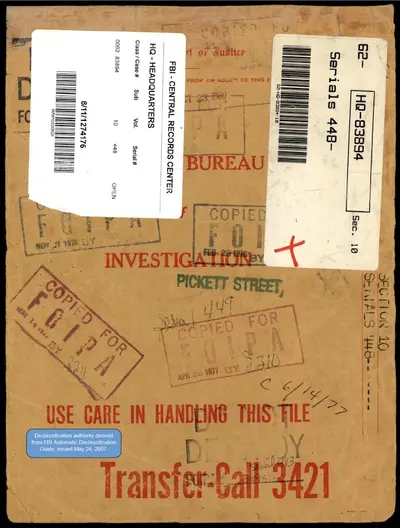
An investigation into a 1967 report involving a magazine sent to J. Edgar Hoover, documented within the FBI's archives regarding unidentified objects.
Historical Context
The year 1967 fell within a period of intense scrutiny regarding unidentified aerial phenomena in the United States. During the height of the Cold War, the presence of unidentified objects in domestic airspace was treated with significant gravity by federal agencies due to the potential for clandestine surveillance by foreign adversaries. The United States Air Force maintained Project Blue Book, a systematic study of UFO reports, which operated alongside various intelligence-gathering initiatives. While Blue Book focused on the aeronautical implications of sightings, the Federal Bureau of Investigation (FBI) maintained its own protocols for monitoring reports that might intersect with national security or the protection of vital installations.
During this era, the phenomenon of “contactee” culture was also prevalent in the American consciousness. This subculture involved individuals who claimed to have established communication with extraterrestrial beings. Such claims often circulated through specialized periodicals, which sought to bridge the gap between fringe science and mainstream reporting. The geopolitical tension of the late 1960s provided a backdrop where the distinction between atmospheric anomalies, experimental military technology, and extraterrestrial visitation was frequently blurred in both public discourse and government documentation.
The 1967 Incident
On August 19, 1967, in San Francisco, California, U.S. government investigators recorded an unidentified-object incident. This specific case was later released to the public on May 8, 2026, as part of the Presidential Unsealing and Reporting System for UAP Encounters (PURSUE). The documentation indicates that the case was investigated under the framework of the Air Force’s Project Blue Book or its predecessors. The reporting structure followed established Bureau protocols, where various field offices—including those in Knoxville, Albuquerque, and Los Angeles—routed UFO reports to FBI headquarters to ensure the monitoring of threats to critical infrastructure.
The specific contents of the released document focus on a communication sent to the Bureau’s leadership. Theodore Gray Hullett, a reporter for ‘UFO Contact’ magazine, sent a copy of his publication to J. Edgar Hoover. This correspondence was presented as a gift, with the intent of bringing the magazine’s specific message to the attention of prominent figures. Hullett’s underlying motivation included the potential desire to secure a position as a co-worker within the Bureau. In addition to the magazine, the letter included birthday wishes addressed to Hoover. While the document pertains to the Adamski contactee claim, the number of witnesses to any specific aerial sighting associated with this particular filing is not specified in the released record.
Classification and Analysis
The case is classified as a visual sighting reported by ground or air observers. In the landscape of mid-century aerial investigations, visual sightings were the most common form of reported anomaly, though they were often difficult to verify through secondary instrumentation. The nature of the report highlights the intersection of fringe media and official government record-keeping during the 1960s.
The status of the records released under the PURSUE program remains officially unresolved. By default, the All-domain Anomaly Resolution Office (AARO) has not issued a definitive conclusion regarding the nature of the events documented in this file. The federal government has not concluded that the events were anomalous, nor has it concluded that they were conventional. Within the broader scope of historical UAP research, conventional candidates for sightings during this period include experimental aircraft, weather balloons—specifically those related to the Project Mogul series—and atmospheric optical phenomena such as sundogs or lenticular clouds. Additionally, astronomical objects like Venus, the Moon, or meteors near the horizon are frequently cited as potential explanations for unidentified lights in the night sky.