Berkeley, California UFO Sighting (October 29, 30) — FBI Files
FBI records detail an unidentified object sighting in Berkeley, California, involving associated figures during a spacecraft convention in October 1930.
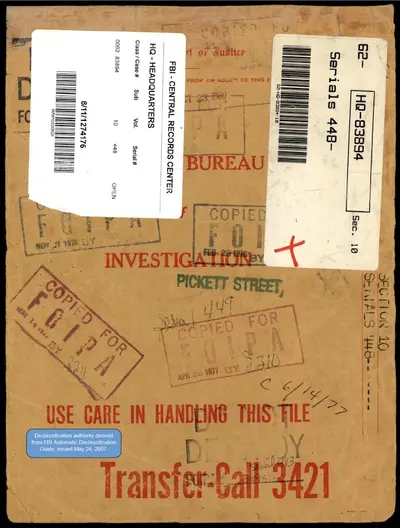
Background
On October 29 and 30, 1930, in Berkeley, California, U.S. government investigators recorded an unidentified-object incident that remained classified for decades. The details of this encounter were later released to the public on May 8, 2026, as part of the Presidential Unsealing and Reporting System for UAP Encounters (PURSUE). This specific case is categorized as a Cold War-era investigation, likely processed under the framework of the Air Force’s Project Blue Book or its preceding intelligence programs. During this era, the Federal Bureau of Investigation maintained a standardized procedure for handling aerial anomalies. Field offices in locations such as Knoxville, Albuquerque, and Los Angeles were tasked with routing UFO reports to headquarters under established protocols designed to protect vital military and government installations from potential aerial surveillance or incursions.
The geographic setting of the incident, Berkeley, sits within the East Bay region of the San Francisco Bay Area, a location characterized by its proximity to significant academic and military infrastructure. During the early twentieth century, the investigation of aerial phenomena often intersected with national security interests, as the emergence of modern aviation necessitated more rigorous monitoring of the upper atmosphere. The bureaucratic handling of the Berkeley report reflects the period’s focus on domestic stability and the prevention of unauthorized aerial activity over sensitive coastal zones.
Incident Details
The documentation pertaining to the event is closely linked to the 10th Annual Northern California Spacecraft Convention, which was being held at the Claremont Hotel in Berkeley at the time of the sighting. Information regarding the specifics of the event is available through the records of Angela Kilsert. While the released documents provide a window into the occurrence, the exact number of witnesses present during the sighting is not specified in the official record.
The nature of the sighting is classified as a UFO case, but it contains elements that extend beyond simple aerial observation. The case includes reports of figures or beings that were associated with the unidentified object. Such details transitioned the event from a purely aeronautical inquiry into a more complex investigation involving potential biological or humanoid components. This specific characteristic differentiates the Berkeley incident from many contemporary reports that focused solely on light phenomena or metallic craft without associated entities.
Analytical Context and Status
All records released under the PURSUE program are designated as unresolved by the All-domain Anomaly Resolution Office (AARO) by default. The federal government has maintained a neutral stance regarding the Berkeley sighting, having not concluded that the events were anomalous, nor having concluded that they were conventional. The possibility of either explanation remains open within the official archives.
When evaluating sightings from the 1930s, investigators often consider a variety of conventional candidates. During the mid-twentieth century, many reported objects were later identified as experimental aircraft or weather balloons, such as the Project Mogul series utilized in the late 1940s. Atmospheric optical phenomena, including sundogs, lenticular clouds, or the refraction of light through ice crystals, frequently mimicked the appearance of moving crafts. Additionally, astronomical objects like Venus, the Moon, or meteors appearing near the horizon were common sources of misidentification. The Berkeley case remains part of this broader historical continuum of unidentified aerial phenomena, awaiting further resolution through subsequent technological or archival breakthroughs.