Rex Heflin UFO Photos
A highway inspector took four Polaroid photos of a hat-shaped UFO near Santa Ana. The photos were confiscated by men claiming to be from NORAD, then mysteriously returned years later.
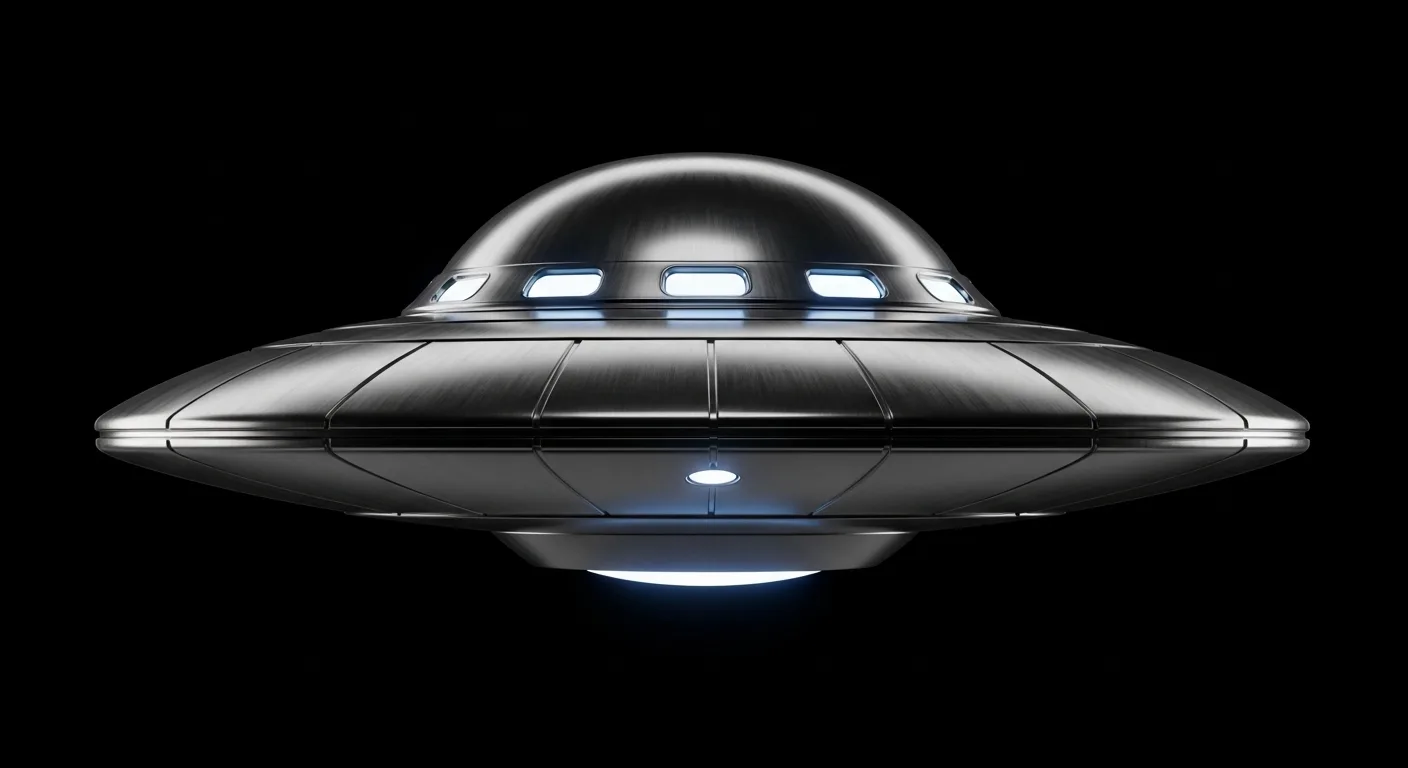
On the afternoon of August 3, 1965, Rex Heflin was sitting in his Orange County highway department truck on Myford Road near Santa Ana, California, doing paperwork between inspections, when he noticed something unusual in the sky to the northeast. What he saw was a dark, hat-shaped object hovering silently above the road at a relatively low altitude. Heflin, who happened to have his department-issued Polaroid camera on the seat beside him, did what any clear-thinking person might do under the circumstances: he picked up the camera and took photographs. In the span of approximately ninety seconds, he captured four images that would become some of the most famous, most analyzed, and most hotly debated UFO photographs in history. But the true strangeness of the Rex Heflin case did not end with the sighting itself. In the weeks that followed, mysterious visitors claiming to represent NORAD confiscated three of the four original photographs, and nearly three decades later, those same photographs reappeared just as mysteriously in Heflin’s mailbox. The case of the Heflin photos is not merely a UFO sighting; it is a story of evidence, its disappearance, and its inexplicable return, wrapped in layers of secrecy and intrigue that have never been satisfactorily unraveled.
The Man and His Camera
Rex Heflin was not the sort of person one would expect to become a central figure in UFO history. He was a highway inspector for Orange County, a practical, outdoors-oriented man whose job involved driving the roads of the county, inspecting conditions, and reporting problems. He was not a UFO enthusiast, had no particular interest in the subject, and had never reported seeing anything unusual in the sky before August 3, 1965. His colleagues knew him as reliable, steady, and not given to exaggeration or practical jokes.
As part of his job, Heflin carried a Polaroid Model 101 camera in his work truck, which he used to photograph road conditions, damage, construction progress, and other subjects relevant to his duties. The camera used self-developing film that produced a print within seconds of the shutter being pressed, a technology that was relatively new and somewhat remarkable in 1965. The Polaroid’s instant development process meant that the images Heflin captured that afternoon could not have been manipulated in a darkroom, a fact that has been cited by proponents of the photographs’ authenticity as evidence against sophisticated hoaxing.
Heflin’s position as a county employee also lent credibility to his account. He had nothing to gain and potentially much to lose by reporting a UFO sighting; public ridicule and professional embarrassment were very real risks in an era when UFO witnesses were frequently dismissed as cranks or attention-seekers. The fact that he came forward with his photographs despite these risks suggests either genuine conviction or an extraordinarily misguided sense of humor, and everyone who knew Heflin personally testified to the former.
The Sighting
The events of August 3, 1965 unfolded rapidly. At approximately 12:30 PM, Heflin was parked on Myford Road near the intersection with what is now the Santa Ana Freeway, completing paperwork in his truck. The day was clear and bright, typical of a Southern California summer, with excellent visibility in all directions.
Heflin’s attention was drawn to an object in the sky to the northeast. Through his truck windshield, he saw what he initially thought might be an aircraft, but its shape and behavior quickly dispelled that interpretation. The object was roughly hat-shaped or straw-hat-shaped: a flat bottom with a slightly domed top, similar to the crown and brim of a hat viewed from the side. It appeared dark or metallic, and it was hovering motionlessly at what Heflin estimated to be approximately one hundred and fifty feet above the ground.
Heflin grabbed his Polaroid camera and began taking photographs. He shot three images in quick succession, each from a slightly different angle as the object moved slowly and silently through the air. The photographs show a dark, disc-shaped object with a discernible structure, seen against the bright sky above the road and the surrounding landscape. The object is clearly silhouetted, and its shape is consistent across all three images, ruling out any suggestion that it was a random atmospheric phenomenon.
During the sighting, Heflin attempted to use his two-way radio to report what he was seeing to his dispatcher, but the radio was dead. He experienced nothing but static on the frequency, an electromagnetic interference that he had never encountered before in his years of using the equipment. This detail, reported by Heflin before he could have known that radio and electrical interference was a commonly reported feature of close UFO encounters, lends additional credibility to his account.
After a brief period of observation, the object began to move away, accelerating smoothly and silently toward the southwest. As it departed, Heflin took his fourth and final photograph, which captured something remarkable: a dark, ring-shaped formation in the air where the object had been, resembling a smoke ring or vapor trail. This ring appeared to be a physical trace left by the object’s propulsion system or by the disturbance its departure created in the atmosphere. The smoke ring dissipated within seconds, and the object vanished from sight.
The Four Photographs
The four Polaroid images that Heflin captured constitute the core evidence of the case, and they have been subjected to more analysis than almost any other UFO photographs in history.
The first three photographs show the object from slightly different angles and distances, as it moved slowly through the air above Myford Road. In each image, the object appears as a dark, structured, hat-shaped form against the bright sky. The landscape below provides reference points that have been used in subsequent analyses to estimate the object’s size, altitude, and distance from the camera. Various analysts have calculated the object’s diameter at anywhere from twenty to thirty feet, assuming it was at the altitude Heflin estimated, though these calculations depend on assumptions about distance that cannot be verified with certainty.
The consistency of the object’s appearance across the three photographs is significant. The shape, apparent size, and orientation of the object are compatible with a single, solid object viewed from slightly different positions, as would be expected if Heflin was photographing a real object from different angles as it moved through the air. This consistency would be difficult, though not impossible, to achieve with a small model suspended on a string or wire, which is the most common alternative explanation for the photographs.
The fourth photograph, showing the smoke ring or vapor trail, is in many ways the most intriguing of the set. It shows a clearly defined, dark, toroidal shape in the air, positioned approximately where the object had been when it departed. The ring is distinct and well-defined, not a vague smear or artifact, and it appears to be at a substantial altitude. If genuine, it represents physical evidence that the object disturbed the atmosphere during its departure, producing a visible trace that persisted long enough to be photographed.
Media Sensation and the Confiscation
Heflin initially shared his photographs with a few colleagues, who encouraged him to contact the local newspaper. The Santa Ana Register published the images, and they quickly spread through wire services to newspapers across the country. The photographs generated enormous public interest, both because of their apparent clarity and because of the credibility of the witness.
The publication of the photographs attracted attention from sources that Heflin had not anticipated. Within weeks of the images becoming public, Heflin received a visit at his home from two men who identified themselves as representatives of the North American Aerospace Defense Command. The men showed what appeared to be official credentials, explained that they were investigating the photographs as part of their responsibilities for monitoring North American airspace, and requested to examine the original Polaroid prints.
Heflin, a government employee accustomed to cooperating with official agencies, handed over three of the four original photographs. The men thanked him and departed, taking the originals with them. It was only afterward that Heflin began to have doubts about the encounter. The men had been formal but somewhat evasive about the specifics of their investigation, and their visit had a quality that, in retrospect, seemed more like an intelligence operation than a routine inquiry.
When researchers later contacted NORAD to follow up on the investigation, they received a startling response: NORAD denied any involvement. The organization stated that it had not sent agents to interview Heflin, had not confiscated any photographs, and had not conducted any investigation into the Santa Ana sighting. No record of the visit existed in NORAD’s files, and the credentials the men had shown could not be verified.
This denial transformed the Heflin case from a simple UFO sighting into something more sinister. If the men were not from NORAD, who were they? What organization had the resources and motivation to confiscate UFO evidence while impersonating a defense agency? The mystery of the “NORAD men” has never been solved, and the incident has become one of the most frequently cited examples of the Men in Black phenomenon, in which mysterious figures in dark suits appear after UFO sightings to intimidate witnesses or confiscate evidence.
Analysis and Controversy
In the decades following the sighting, the Heflin photographs were subjected to extensive analysis by both proponents and skeptics, with results that satisfied neither camp entirely.
Computer-enhanced analysis of the photographs, conducted by various researchers using increasingly sophisticated technology as it became available, produced mixed results. Some analyses concluded that the object in the photographs was consistent with a large, distant structure and showed no evidence of support strings, wires, or other indicators of a hoax. Other analyses, using different methodologies, suggested that the object might be a small model photographed at close range, with the apparent distance and altitude created by the perspective of the camera angle.
The string hypothesis, which holds that Heflin photographed a small model suspended from a string or wire attached to the truck’s rearview mirror or some other overhead point, has been the primary skeptical explanation for the photographs. Proponents of this theory point to certain features of the images that they interpret as consistent with a nearby model rather than a distant object. Opponents note that careful analysis has failed to detect any visible string or support structure in the photographs, and that the smoke ring in the fourth image would be extremely difficult to fake with a model-and-string setup.
Heflin himself submitted to a polygraph examination regarding the authenticity of the photographs, which he passed. While polygraph results are not considered scientifically conclusive, Heflin’s willingness to undergo the test and his consistent performance reinforced the impression that he genuinely believed he had photographed an anomalous object. He maintained the authenticity of the photographs throughout his life, never wavering in his account of what he had seen and never profiting financially from the images.
The Mysterious Return
Perhaps the strangest chapter in the Heflin case occurred in 1993, twenty-eight years after the original sighting and confiscation. Heflin discovered the three missing original Polaroid prints in his mailbox, returned anonymously without any note of explanation or return address.
The photographs appeared to be the same originals that had been confiscated in 1965. They showed signs of age and handling consistent with nearly three decades of storage, but they had not been damaged or altered in any obvious way. Who had held them for twenty-eight years? Why were they returned? And why now? These questions have never been answered.
The return of the photographs opened them up to analysis using technologies that had not existed in 1965. Digital scanning and computer enhancement provided more detailed information about the images than had previously been possible, though the results remained subject to interpretation. The photographs had also degraded somewhat over the intervening decades, which complicated analysis but did not render it impossible.
The timing of the return has itself been the subject of speculation. The early 1990s saw a resurgence of public interest in UFOs, driven in part by the Roswell case, which received renewed attention through books and television programs. Whether the return of the photographs was connected to this broader cultural moment, or whether it was motivated by entirely unrelated factors, remains unknown.
The Legacy of Rex Heflin
Rex Heflin died in 2005, carrying the memory of his August afternoon encounter to the grave. He never retracted his account, never admitted to any hoax, and never profited significantly from the photographs that made him famous in UFO circles. To the end of his life, he maintained that he had simply photographed what he saw, using the camera he happened to have at hand, and that the subsequent events, including the confiscation and mysterious return of the photographs, were as baffling to him as they were to everyone else.
The Heflin photographs endure as some of the most important and contested pieces of evidence in the history of ufology. They occupy a middle ground between the obviously fraudulent and the indisputably authentic, resisting definitive classification in either category. The object in the photographs looks real; the witness was credible; the electromagnetic interference corroborated the sighting; and the smoke ring in the fourth image suggests a physical phenomenon. But the possibility of a sophisticated hoax, however unlikely it may seem given Heflin’s character and circumstances, cannot be entirely ruled out.
What elevates the Heflin case beyond a simple question of photographic authenticity is the surrounding mystery. The confiscation by men who were not who they claimed to be, the decades-long disappearance of the evidence, and the anonymous return of the photographs all point to something deeper and more disturbing than a simple sighting of an unusual object. Someone, or some organization, took an active interest in suppressing the evidence and then, for reasons that remain entirely opaque, chose to give it back.
The Heflin photographs remind us that the UFO phenomenon is not merely about lights in the sky or objects on film. It is also about the human response to the unknown, the institutional impulse to control information, and the strange twilight zone where official secrecy and genuine mystery intersect. Rex Heflin pointed his camera at something he could not explain and pressed the shutter. The reverberations of that simple act are still being felt six decades later.
Sources
- Project Blue Book — National Archives — USAF UFO investigation files, 1947–1969
- CIA UFO/UAP Reading Room — Declassified CIA documents on UAP