Exeter UFO Incident
A teenager and two police officers watched a large, red pulsating object hover over a field in rural New Hampshire, inspiring the book 'Incident at Exeter' and becoming one of the best-documented cases of the 1960s.
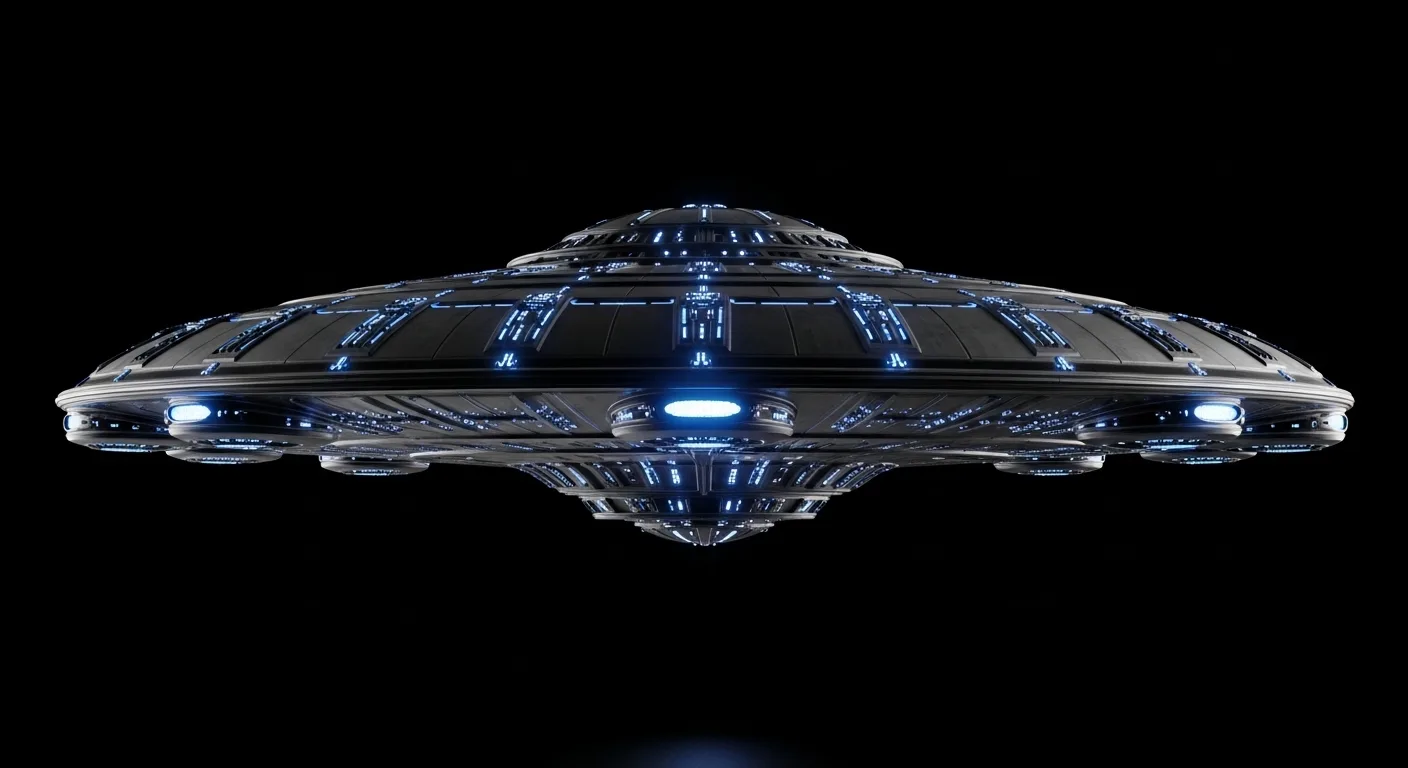
In the early morning hours of September 3, 1965, an eighteen-year-old hitchhiker, terrified and barely coherent, stumbled into the Exeter, New Hampshire police station and told a story that would change the course of UFO investigation in America. Norman Muscarello had just spent the most frightening minutes of his life diving into a roadside ditch to escape a massive, silent object bristling with pulsating red lights that had risen from behind the trees along Route 150 and approached him at a distance of barely a hundred feet. Within the hour, two police officers would return with Muscarello to the site and witness the same object themselves—a vast, dark shape hovering over an open field, its lights cycling in a deliberate, hypnotic sequence that none of them could explain. The incident would inspire one of the most important books of the UFO era, confound the United States Air Force, and establish Exeter as a landmark case study in the documentation of the unexplained.
The Road at 2 AM
Norman Muscarello was not looking for adventure on the night of September 2-3, 1965. He was doing something entirely mundane—hitchhiking home to Exeter from Amesbury, Massachusetts, where he had been visiting his girlfriend. The eighteen-year-old had recently enlisted in the Navy and was due to report for active duty in a matter of days. He was walking along Route 150, also known as the Kensington Road, through the quiet farmland between Kensington and Exeter, hoping to flag down a passing car in the sparse late-night traffic.
The stretch of road Muscarello was walking was typical of rural New Hampshire—dark, flat, bordered by fields and stands of trees, with scattered farmhouses set back from the road. The Carl Dining property lay to his left, an open field running back from the road toward a distant tree line. It was approximately 2:00 AM, and the night was clear and quiet.
The first sign that something was wrong was a light. Muscarello noticed a brightness in the sky beyond the tree line to his left, a glow that at first he took for the headlights of a car on a distant road or perhaps the landing lights of an aircraft approaching the small municipal airport several miles away. But the light was not behaving like headlights or landing lights. It was rising, moving upward and outward from behind the trees, and it was getting brighter.
Then the object cleared the tree line, and Muscarello understood that he was looking at something entirely outside his experience.
The Object Over the Field
What rose from behind the trees and moved over the Dining field was enormous. Muscarello would later estimate its size at eighty to ninety feet in diameter, though he acknowledged the difficulty of judging dimensions at night. It was dark—a solid, structured shape blacker than the surrounding sky—and it carried five brilliant red lights arranged in a straight line along what appeared to be its lower surface or leading edge.
The lights were extraordinary. They pulsated in sequence, cycling from left to right—1, 2, 3, 4, 5—and then back from right to left—5, 4, 3, 2, 1—in a steady, deliberate rhythm. Each light in turn blazed to an almost unbearable brightness before dimming as the next in sequence reached its peak. The effect was hypnotic and deeply unsettling, a display that seemed purposeful rather than random, controlled rather than chaotic.
The object moved with a rocking, oscillating motion that witnesses would later compare to a falling leaf—not the smooth, linear trajectory of an airplane but an irregular, almost organic movement that seemed to defy the physics of conventional flight. Despite its size, it was completely silent. No engine noise, no rush of air, no mechanical sound of any kind accompanied its passage over the field.
Muscarello was terrified. The object approached to within approximately one hundred feet of his position on the road, close enough that its red lights illuminated the surrounding landscape and cast shifting shadows across the field and farmhouse. He threw himself into a shallow ditch beside the road, pressing himself flat against the ground as the object loomed above him. He could feel no heat, no vibration, no wind from the object’s passage—only the raw, animal panic of a human being confronted with something vast, incomprehensible, and close.
After what felt like an eternity but was probably only minutes, the object retreated, pulling back toward the tree line from which it had emerged. Muscarello scrambled to his feet and ran. A car approached on Route 150, and he flagged it down frantically. The couple inside drove him to the Exeter police station, where he arrived shaking, pale, and struggling to articulate what he had seen.
Officer Bertrand Returns to the Scene
At the Exeter police station, the desk officer listened to Muscarello’s account with the measured skepticism of a professional accustomed to unusual reports during the late-night shift. The teenager was clearly frightened—genuinely frightened, not performing—and his distress was sufficient to convince the desk officer to take the report seriously.
By coincidence, Officer Eugene Bertrand had returned to the station shortly before Muscarello’s arrival. Earlier that evening, Bertrand had responded to a call from a woman parked on Route 101 who reported that a large, brilliantly lit object had followed her car for several miles before departing at high speed. Bertrand had found the woman in a state of considerable agitation but had been unable to observe the object himself. He had noted the report and moved on.
Now, hearing Muscarello’s account of a large, red-lit object over a field less than five miles from the Route 101 sighting, Bertrand recognized a potential connection. He volunteered to drive Muscarello back to the location on Route 150 to investigate.
The two arrived at the Dining field shortly after 2:30 AM. Bertrand parked his cruiser on the shoulder of the road, and the two men walked into the field. The night was quiet, the sky clear. Muscarello pointed out the area from which the object had risen and the approximate position from which he had observed it. For several minutes, nothing happened. Then Bertrand noticed the horses in a nearby corral beginning to stamp and whinny, and dogs in the area erupting into frantic barking.
The object returned.
Rising from behind the trees at the far edge of the field, exactly as Muscarello had described, the object cleared the tree line and moved toward the two men with the same rocking, leaf-like motion. Its five red lights pulsated in the same left-to-right, right-to-left sequence, each blazing to brilliant intensity in turn. The object was enormous, silent, and very close.
Bertrand was a military veteran. He had served in the Air Force and had spent four years as a refueling operator, working in close proximity to aircraft of all types. He knew what airplanes looked like, how they sounded, how they moved. What he was seeing over the Dining field was not an airplane, not a helicopter, not a flare, not a star. It was something he had never seen before and could not identify.
The two men backed toward the cruiser as the object approached, its red lights casting an eerie glow over the field and the surrounding farmhouses. Bertrand later described the light as so intense that he could read the lettering on his uniform sleeve. He reached for his service weapon instinctively before thinking better of it. Both men felt an overwhelming sense of awe mixed with fear—the primal response of human beings confronted with something beyond their frame of reference.
Officer Hunt Confirms
As Bertrand and Muscarello watched the object from the edge of the field, the radio in Bertrand’s cruiser crackled. Officer David Hunt, who had been dispatched as backup, was approaching the scene. Within moments, Hunt arrived, stepped out of his car, and saw the object himself.
Now three witnesses—two of them trained law enforcement officers—stood watching a massive, unidentified object hover over a New Hampshire field. Hunt’s independent observation was critical. He had not been briefed on the details of Muscarello’s account beyond the bare fact that an unusual aerial object had been reported. His description of what he saw would match the others’ in every significant detail—the size, the shape, the red lights, the pulsating sequence, the silence, the rocking motion.
The three men watched the object for several minutes before it began to move away, drifting slowly toward the southeast in the direction of the Atlantic Ocean. It maintained its rocking motion and its light sequence throughout its departure, growing gradually smaller until it was lost to distance and the darkness. The entire encounter, from the object’s reappearance to its departure, had lasted approximately ten minutes.
Bertrand and Hunt filed detailed reports of the incident. Their accounts were precise, specific, and consistent with each other and with Muscarello’s original description. There was no disagreement on any significant detail among the three witnesses, and there would be no significant changes to their accounts in the years that followed.
The Air Force Investigation
The Exeter sighting was reported to the United States Air Force through Project Blue Book, the official military program tasked with investigating UFO reports. The case was assigned to investigators who reviewed the witness statements, the officers’ reports, and the physical conditions at the site.
The Air Force’s initial explanation was spectacularly unsatisfying. They attributed the sighting to aircraft from a Strategic Air Command KC-97 refueling operation, designated “Big Blast,” that had been conducted in the region during the relevant period. According to this theory, what Muscarello and the officers had seen was not an unknown object but rather a formation of military aircraft engaged in mid-air refueling, their lights creating an unusual visual impression in the dark sky.
This explanation collapsed almost immediately upon examination. Investigation revealed that the Big Blast operation had been concluded well before the time of the Exeter sighting. No military aircraft were operating in the Exeter area at 2:00 AM on September 3. The characteristics described by the witnesses—the enormous size, the complete silence, the rocking motion, the sequential pulsation of lights—bore no resemblance to the appearance of refueling aircraft at any distance.
Officers Bertrand and Hunt formally objected to the Air Force explanation in a letter that combined professional courtesy with unmistakable firmness. They detailed the reasons the aircraft theory was untenable and reiterated the accuracy of their observations. The Air Force eventually reclassified the case as “unidentified” in its files—an admission that the official investigation had failed to produce a satisfactory explanation.
John Fuller and “Incident at Exeter”
The Exeter case might have faded into the archives of Project Blue Book were it not for journalist John G. Fuller, a writer for the Saturday Review who had been developing an interest in UFO reports. Fuller learned of the Exeter sighting and traveled to New Hampshire to investigate, anticipating a short article. What he found was far more extensive than a single incident.
Fuller discovered that the September 3 sighting was not an isolated event but part of a concentrated wave of UFO reports from the Exeter area that had been building throughout the summer and fall of 1965. Dozens of local residents had reported unusual aerial phenomena—bright lights, structured objects, and unexplained aerial activity—over a period of weeks. Many of these witnesses were reluctant to speak publicly, fearing ridicule, but Fuller’s patient and respectful interview technique drew out their accounts.
The resulting book, “Incident at Exeter,” published in 1966, became a bestseller and one of the foundational texts of modern UFO literature. Fuller’s careful, journalistic approach—emphasizing witness credibility, physical evidence, and the inadequacy of official explanations—established a template for UFO investigation that influenced researchers for decades. The book brought the Exeter case to national and international attention and cemented its status as one of the most important UFO incidents of the 1960s.
Fuller’s investigation also highlighted a disturbing pattern of official dismissiveness toward UFO reports. The Air Force’s initial misattribution of the Exeter sighting to a refueling operation that had ended hours earlier demonstrated either incompetence or a willful desire to close cases regardless of the evidence. This pattern of inadequate explanation, repeated across hundreds of Project Blue Book cases, would contribute to the growing public skepticism about the government’s handling of the UFO phenomenon.
The Wave Continues
Fuller’s research revealed that the September 3 sighting, dramatic as it was, occurred within a broader context of sustained UFO activity in the Exeter area. Beginning in the summer of 1965, residents of Exeter and surrounding communities reported an unusual frequency of aerial sightings, many of them sharing characteristics with the Muscarello-Bertrand-Hunt encounter.
A woman driving on Route 101 had reported a large, lit object following her car earlier on the same evening as the main incident—the report that Officer Bertrand had investigated before Muscarello’s arrival at the station. In the days and weeks surrounding September 3, additional witnesses came forward with accounts of large, silent objects over fields and forests, bright lights performing impossible maneuvers, and an overall increase in unusual aerial activity that seemed concentrated in a specific geographic area.
The concentration of sightings raised intriguing questions. Was the Exeter area being visited repeatedly by the same object or objects? Was there something about the geography, the population, or the environment that attracted whatever was responsible for the phenomena? Or was the wave simply the result of heightened awareness—once the initial sighting became public, did people begin noticing and reporting things they might previously have dismissed?
These questions were never answered. The wave subsided by the end of 1965, the public attention moved on, and the skies over Exeter returned to normal. But the core incident—three witnesses, two of them police officers, watching a massive and unexplained object hover silently over a New Hampshire field—remained as inexplicable as ever.
Why Exeter Matters
The Exeter incident is considered a cornerstone of UFO research for several reasons that extend beyond the mere fact that something unusual was seen in the sky. The case possesses qualities that elevate it above the vast majority of UFO reports and give it enduring significance for researchers seeking to understand the phenomenon.
First, the witness credibility is exceptional. Officers Bertrand and Hunt were trained observers with professional incentives to report accurately. Their careers depended on their reliability, and filing a fraudulent or exaggerated report would have carried serious consequences. Muscarello, though a civilian, was a young man about to enter military service—not the profile of someone likely to fabricate an elaborate hoax that would bring him public scrutiny and potential ridicule.
Second, the case involves multiple independent witnesses whose observations are mutually consistent. The woman on Route 101, Muscarello on Route 150, and Officers Bertrand and Hunt all described similar phenomena in the same geographic area on the same night. This pattern of independent corroboration is difficult to explain through misidentification, hallucination, or hoax.
Third, the physical effects reported by the witnesses—the disturbance of animals, the illumination of the surrounding landscape, the apparent displacement of air and vegetation—suggest a physical presence rather than an optical illusion or psychological phenomenon. The horses’ reaction and the dogs’ barking provide independent, non-human corroboration that something unusual was occurring in the field.
Fourth, the case withstood official investigation. The Air Force examined the incident, proposed an explanation, and was forced to withdraw it when it proved untenable. The final classification of “unidentified” represents an official acknowledgment that the case could not be explained within the framework of known phenomena.
Finally, the case was documented with exemplary rigor by John Fuller, whose book preserved the witness testimony, the official records, and the investigative process in detail sufficient to allow subsequent researchers to evaluate the case on its merits. The Exeter incident is not a vague story passed down through oral tradition but a thoroughly documented event supported by official records, witness statements, and professional journalism.
The Legacy of a September Night
More than sixty years after Norman Muscarello dove into a ditch on a New Hampshire back road, the Exeter incident remains exactly what it was on that September night—unexplained. No subsequent investigation has identified the object that hovered over the Dining field. No technological development has produced a vehicle matching its described characteristics. No natural phenomenon has been identified that could account for what three witnesses independently observed.
The town of Exeter has embraced its place in UFO history with a mixture of pride and bemusement. The incident is commemorated locally, and the case continues to attract researchers, historians, and the simply curious to this quiet New Hampshire community. The field where the object appeared is still there, the trees have grown taller, and Route 150 still carries its modest traffic through the rural landscape where, one September night, something remarkable appeared above the trees and changed the lives of everyone who saw it.
Whatever hung in silence over that New Hampshire field—whatever moved with its rocking, leaf-like motion and displayed its cycling red lights for three awestruck witnesses—it remains unknown. The Air Force could not identify it. The skeptics could not explain it away. The witnesses never wavered. And the night sky above Exeter, quiet and ordinary on ten thousand other evenings, keeps its secrets still.
Sources
- Project Blue Book — National Archives — USAF UFO investigation files, 1947–1969
- CIA UFO/UAP Reading Room — Declassified CIA documents on UAP
- UK National Archives — UFO Files — MoD UFO investigation records
- British Newspaper Archive — UK press archive