Edwards AFB Landing
Multiple military personnel at Edwards Air Force Base observed a UFO land on the dry lake bed, remain for a period, then depart. Chuck Yeager was reportedly among those who investigated.
Edwards Air Force Base occupies a vast expanse of the Mojave Desert in southern California, a landscape of sun-blasted rock, Joshua trees, and dry lake beds that stretches to the horizon in every direction. For decades, it has served as the premier flight test facility of the United States military, the place where experimental aircraft push the boundaries of speed, altitude, and aerodynamic design. It was at Edwards that Chuck Yeager broke the sound barrier in 1947. It was at Edwards that the X-15 reached the edge of space. The base has been synonymous with the cutting edge of human aviation, a place where the impossible becomes routine and where test pilots are trained to observe and evaluate aerial phenomena with a precision that borders on the scientific. On October 7, 1965, according to multiple military witnesses, something landed on one of Edwards’ dry lake beds that exceeded even this storied institution’s definition of the impossible—an unidentified craft that descended from the sky, rested on the desert floor, and then departed, leaving behind a collection of shaken witnesses, classified reports, and questions that remain unanswered more than half a century later.
The Premier Test Facility
To grasp the significance of a UFO event at Edwards Air Force Base, one must understand what Edwards represents in the world of military aviation. The base, originally known as Muroc Army Air Field, has been the center of American flight testing since the 1940s. Its location was chosen for practical reasons—the vast, flat dry lake beds of Rogers and Rosamond provide natural runways miles in length, the desert weather offers clear flying conditions for the majority of the year, and the sparse population of the surrounding Mojave ensures that experimental flights can be conducted away from civilian observation.
The personnel stationed at Edwards are among the most experienced and technically sophisticated in the military. Test pilots undergo years of specialized training in aircraft evaluation, and the engineering and technical staff who support flight test operations are experts in aerospace technology. The base is equipped with advanced radar, tracking systems, and instrumentation designed to monitor every aspect of experimental flights. In short, Edwards is one of the least likely places on Earth for experienced observers to mistake a conventional phenomenon for something extraordinary—and one of the most significant locations imaginable for a genuine anomalous event.
The security environment at Edwards adds another layer of significance. As a facility where classified aircraft are developed and tested, the base maintains stringent security protocols. Unauthorized aircraft in the airspace above Edwards would be detected by radar, challenged by air traffic control, and investigated immediately. The appearance of an unknown object in this controlled environment would trigger security responses far more intensive than those available to civilian observers.
The Event
The events of October 7, 1965, as reconstructed from witness accounts and the limited documentation that has emerged over the decades, unfolded during the daylight hours at the base. Multiple military personnel—estimates range from twelve to more than twenty, depending on the source—observed an unusual object in the sky above the base. The object descended toward one of the dry lake beds and, according to witnesses, landed on the desert surface.
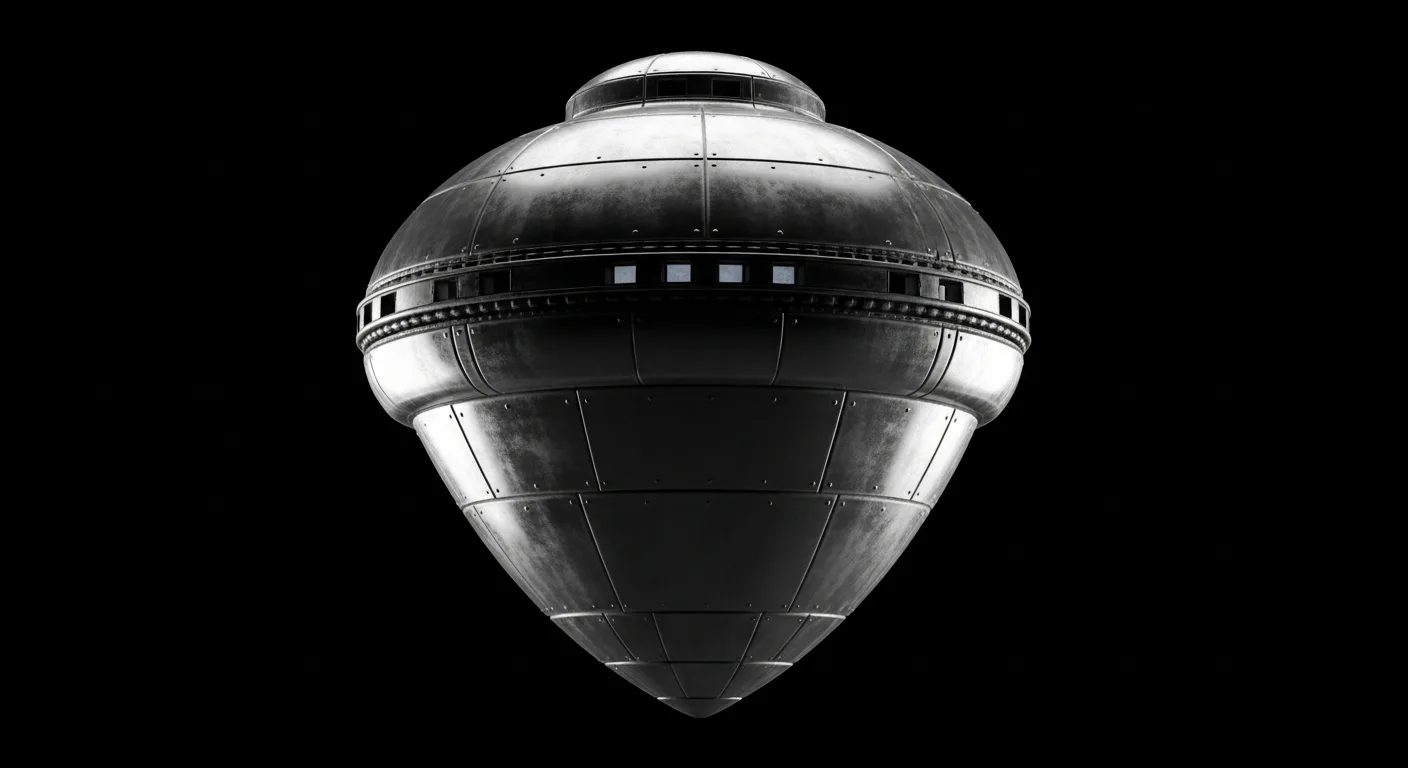
The descriptions of the object varied in detail but converged on several key characteristics. Witnesses described a disc-shaped or oval craft with a metallic appearance, reflecting the harsh desert sunlight. Some accounts mention that the object appeared to extend landing gear or supports of some kind as it descended—three legs or struts that made contact with the dry lake bed surface. The object rested on the ground for a period variously estimated at several minutes to as long as an hour, depending on the witness, before rising silently from the surface and departing at high speed.
The landing site was on one of the vast dry lake beds that serve as natural runways for the base’s flight test operations. These lake beds are flat, hard-packed surfaces of clay and silt, largely featureless and extending for miles. An object sitting on such a surface would be visible from considerable distance, and the flat terrain would provide no cover or concealment. Multiple witnesses observed the object from different positions around the base, providing observations from various angles and distances.
The Chuck Yeager Connection
The most tantalizing aspect of the Edwards AFB incident is the reported involvement of Brigadier General Charles “Chuck” Yeager, the most famous test pilot in American history. Yeager, who had broken the sound barrier at Edwards in 1947 and had continued his career at the base in various capacities, was reportedly stationed at Edwards at the time of the incident and was among those who responded to or investigated the event.
The specifics of Yeager’s involvement are shrouded in the same classification that covers the rest of the incident. Some accounts indicate that Yeager personally went to the landing site to investigate. Others suggest that he was involved in the official response and debriefing process. Yeager himself never publicly confirmed or denied his involvement in the incident in any detail, maintaining the discretion that characterized his approach to classified matters throughout his career.
The significance of Yeager’s potential involvement cannot be overstated. If the most experienced and respected test pilot in American history examined a landed UFO at the nation’s premier flight test facility and found it to be genuinely anomalous, that assessment would carry more weight than virtually any other testimony in the field. Yeager’s entire career was built on the precise observation and evaluation of aircraft performance, and his judgment on what constituted a conventional aircraft versus something unknown would be essentially unimpeachable.
However, the absence of direct public confirmation from Yeager means that his involvement, while widely reported in UFO literature, remains in the category of credible but unverified claims. The connection adds luster to the case but cannot be treated as established fact.
Ground Traces
Several accounts of the Edwards incident mention that physical traces were found at the landing site. The dry lake bed surface, while hard-packed, is soft enough to record impressions from heavy objects, and witnesses reported that marks consistent with landing gear or supports were visible in the lake bed material after the object departed.
These traces were reportedly photographed and documented by base personnel as part of the official investigation. The photographs, along with other documentation related to the incident, were classified and have never been released to the public. Freedom of Information Act requests related to the Edwards incident have either been denied or have returned documents so heavily redacted as to be uninformative.
The existence of ground traces, if genuine, would be significant for several reasons. Physical evidence of a UFO landing—impressions in soil, radiation readings, chemical changes in surface material—is exceedingly rare in the UFO literature, and when it does occur, it provides a basis for scientific analysis that eyewitness testimony alone cannot offer. The Edwards lake bed, as a known and well-characterized surface, would provide an ideal substrate for such analysis, as the baseline properties of the material are well documented and any anomalies would be readily identifiable.
The Official Response
The response of the base authorities followed a pattern familiar from other military UFO encounters of the era. The area of the reported landing was secured. Witnesses were debriefed individually. Reports were filed through official channels. And the entire matter was classified, with personnel involved reportedly instructed not to discuss the event publicly.
This pattern of classification and silence has been the single greatest obstacle to understanding the Edwards incident. Unlike civilian UFO cases, where witnesses are free to share their experiences and investigators can examine evidence relatively freely, military cases exist behind a wall of official secrecy that is extremely difficult to penetrate. The witnesses at Edwards were bound by their security obligations, and the documentation generated by the investigation was absorbed into the classified record where it remains inaccessible.
The classification of the Edwards case is consistent with standard military procedure for incidents involving unidentified intrusions into restricted airspace. Whether the object was a UFO in the popular sense or a misidentified conventional phenomenon, the fact that something had penetrated the airspace of one of America’s most sensitive military installations would have triggered security protocols that mandated classification regardless of the object’s nature.
The 1965 Context
The Edwards incident occurred during a period of intense UFO activity across the United States. The year 1965 saw numerous significant UFO reports from both civilian and military sources. The Kecksburg, Pennsylvania incident, in which an acorn-shaped object allegedly crashed in the woods outside a small town, occurred just two months after the Edwards event. The Exeter, New Hampshire sightings, involving multiple witnesses including police officers, had made national headlines earlier that year. The wave of 1965 UFO reports was among the most concentrated in the history of the phenomenon, and the Edwards incident fits within this broader pattern of increased activity.
The military’s handling of UFO reports in 1965 was governed by Air Force Regulation 200-2, which established procedures for reporting and investigating unidentified aerial phenomena. Under this regulation, all military UFO sightings were to be reported through the chain of command to Project Blue Book, the Air Force’s official investigation program. However, cases involving classified installations or personnel were often handled through separate channels, and it is unclear whether the Edwards incident was ever formally processed through the Blue Book system.
Project Blue Book, by 1965, was widely regarded as inadequate even by some within the Air Force. The program had come under increasing criticism for its tendency to explain away sightings with implausible conventional explanations, and its credibility with both the public and the scientific community was waning. The handling of a case from Edwards AFB—America’s most prestigious flight test facility—would have presented Blue Book with a particularly difficult challenge, as the quality of the witnesses would have made dismissive explanations even less tenable than usual.
The Pattern of Military Base UFO Activity
The Edwards AFB incident is part of a broader pattern of UFO activity at military installations that spans decades and crosses international boundaries. Nuclear missile sites, weapons storage facilities, air bases, and naval installations have reported UFO encounters at rates that some researchers argue exceed those of civilian locations.
The Malmstrom AFB incidents of 1967, in which UFOs were observed over nuclear missile silos as multiple missiles simultaneously went offline, represent perhaps the most alarming examples of this pattern. The Rendlesham Forest incident of 1980, at a dual US-UK air base in England, is another high-profile case involving military witnesses at a sensitive installation. The pattern suggests that whatever is behind UFO phenomena demonstrates a particular interest in military capabilities and installations—a pattern that has obvious implications for national security.
Edwards, as the center of American aerospace development, would be a logical target for surveillance by any intelligence—terrestrial or otherwise—interested in the state of human aviation technology. The base has been the development site for some of the most advanced aircraft in history, and its operations represent the cutting edge of aerospace capability. If the objects reported in UFO encounters are operated by an intelligence interested in human technology, Edwards would be among the most attractive targets for observation.
What Remains
The Edwards AFB landing of October 7, 1965, remains one of the most significant and most frustrating cases in the UFO literature. Its significance derives from the quality of the witnesses—military personnel at America’s premier flight test facility, possibly including the most famous test pilot in history—and from the nature of the event itself, an alleged landing that left physical traces on the ground. Its frustration derives from the classification that has locked the evidence behind walls of official secrecy that show no sign of crumbling.
The dry lake beds of Edwards still stretch to the horizon under the bleaching Mojave sun, and experimental aircraft still push the boundaries of the possible in the skies above them. The base continues to test the most advanced aerospace vehicles in the American inventory, and its personnel continue to represent the best-trained observers of aerial phenomena that the military can produce. Whether any of them have witnessed events comparable to what reportedly occurred on that October day in 1965 is unknown, buried in the same institutional silence that has guarded the original incident for decades.
The Edwards case reminds us that the most compelling UFO evidence may be precisely the evidence we cannot access—the reports filed by trained military observers at sensitive installations, classified not because they describe something mundane but because they describe something that defies explanation. Until the documentation of the Edwards AFB landing is released, the case will remain in the uncomfortable space between credible report and unverifiable claim, tantalizingly suggestive but forever incomplete. Something landed in the desert that day, watched by men whose profession was the observation and evaluation of aircraft, and whatever it was exceeded their expertise. The desert, as always, keeps its secrets.
Sources
- Project Blue Book — National Archives — USAF UFO investigation files, 1947–1969
- CIA UFO/UAP Reading Room — Declassified CIA documents on UAP