Lonnie Zamora Socorro Incident
A police officer witnessed an egg-shaped craft with two small beings land outside town. The case, investigated by Project Blue Book, left physical traces and remains one of the most credible sightings.
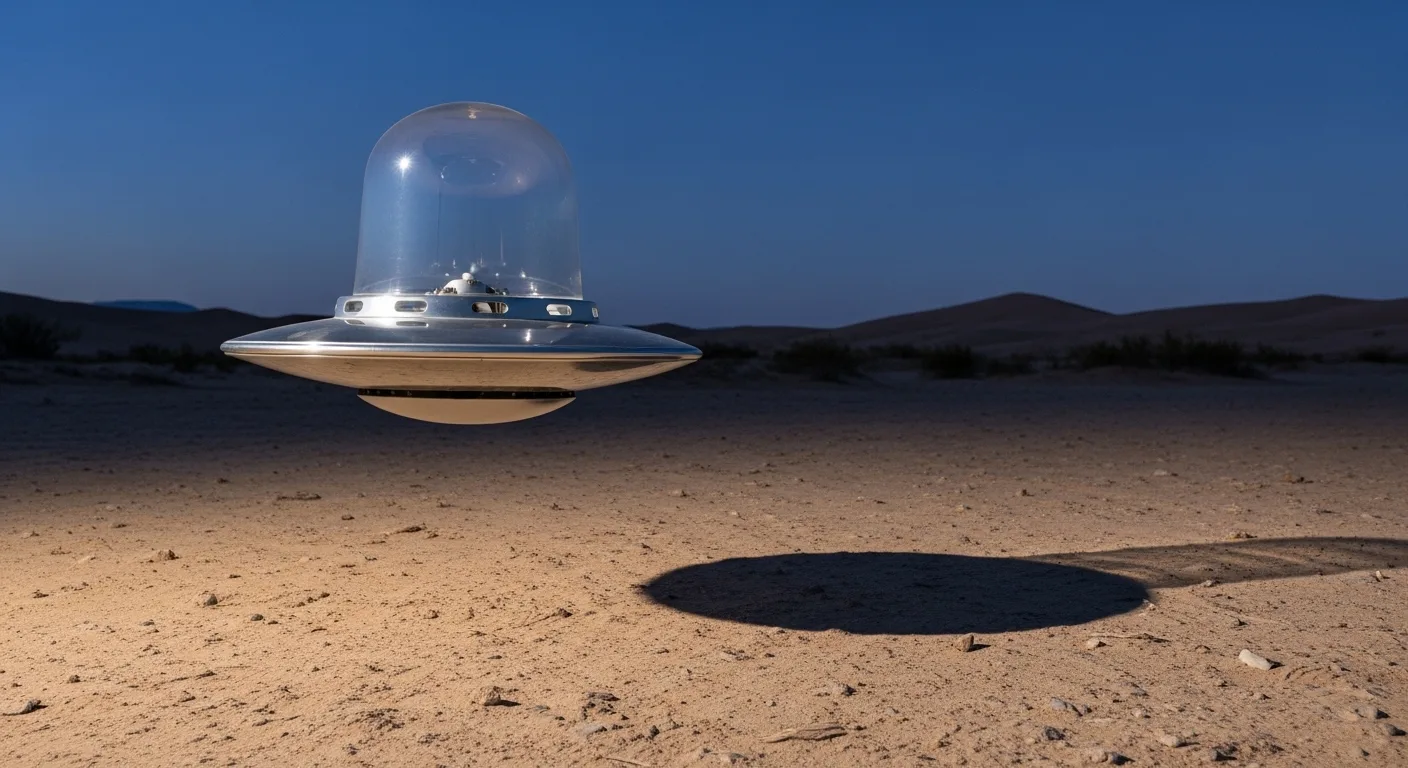
On the afternoon of April 24, 1964, in the small desert town of Socorro, New Mexico, a police sergeant named Lonnie Zamora was doing something entirely unremarkable. He was chasing a speeding car south along the Old Rodeo Street, performing the sort of routine law enforcement duty he had carried out hundreds of times in his career. What happened in the next few minutes would transform this ordinary officer into one of the most important witnesses in UFO history, generate investigations by the FBI, the Air Force, and the CIA, leave physical evidence that scientists could not explain, and alter the trajectory of how the United States government approached the UFO phenomenon. The Socorro landing, as it came to be known, is widely regarded as one of the most credible close encounter cases ever documented, a distinction it owes almost entirely to the unshakeable character of the man who witnessed it.
The Officer
Lonnie Zamora was thirty-one years old in the spring of 1964, a solid, unimaginative, deeply respected member of the Socorro Police Department. He was not a man given to flights of fancy. Colleagues described him as methodical, conservative, and relentlessly practical, the kind of officer who wrote detailed reports, followed procedure scrupulously, and viewed the world through the lens of evidence and common sense. He had no interest in science fiction, no history of unusual claims, and no desire whatsoever for the attention that his experience would bring him.
Socorro itself was a quiet town of roughly 4,500 people, situated along the Rio Grande in central New Mexico. The surrounding landscape was classic high desert: scrubby vegetation, rocky arroyos, and vast expanses of open ground stretching toward distant mountain ranges. The New Mexico Institute of Mining and Technology was located in town, giving Socorro a slightly more educated population than the average small desert community, but it remained fundamentally a place where people minded their own business and expected others to do the same.
Zamora had been born and raised in the area. He knew every road, every gully, every landmark in the terrain around Socorro. This intimate familiarity with his environment would prove significant, because when he encountered something that did not belong in that landscape, his recognition of its wrongness was immediate and visceral.
The Chase and the Roar
At approximately 5:45 PM on April 24, Zamora was in his police cruiser pursuing a black Chevrolet that was speeding south on Old Rodeo Street. The chase was routine, the sort of minor enforcement action that constituted the bread and butter of small-town policing. But as Zamora drove south, he was startled by a sudden loud roar and a flash of light in the sky to the southwest.
The roar was not like anything Zamora had heard before. It was not the sound of a jet aircraft, which he was familiar with from nearby military installations. It was not thunder, though the sky was clear. It was a powerful, descending tone, like a rocket engine but somehow different, and it was accompanied by a bluish-orange flame that Zamora could see descending toward the ground behind a small mesa to the southwest.
Zamora’s first thought was that a dynamite shack in the area might have exploded. There was a small storage facility for mining explosives in that general direction, and an explosion would explain both the roar and the flame. Abandoning the pursuit of the speeding car, which was forgotten entirely in the chaos that followed, Zamora turned his cruiser off the road and headed southwest toward the source of the disturbance.
The terrain was rough, and Zamora struggled to get his car up a steep gravel road leading toward the mesa. He made several attempts, his tires spinning on the loose surface, before finally cresting the rise and getting his first look at the gully beyond.
What He Saw
In the gully below him, perhaps 150 to 200 yards away, Zamora saw something that stopped him cold. Sitting on the desert floor was a white, egg-shaped object, smooth and metallic in appearance, roughly the size of a car. It was resting on what appeared to be legs or landing gear, elevated slightly above the ground. The object gleamed in the late afternoon sunlight, and on its surface Zamora could see a red insignia, a distinctive symbol that he would later sketch from memory.
Near the object, Zamora saw two figures. They were small, roughly the size of children, and appeared to be wearing white coveralls. They were standing near the base of the craft, and one of them seemed to turn and notice Zamora’s approaching car. The figure appeared startled, as if it had not expected to be observed.
Zamora radioed the dispatcher, telling him he was investigating a possible accident. He then drove closer, parking his cruiser and getting out on foot. As he approached, the roar began again, starting low and increasing rapidly in volume and intensity. The blue flame reappeared beneath the object. Zamora, now genuinely frightened, turned and ran, stumbling and losing his glasses in his haste to get away from what he instinctively perceived as an imminent explosion.
He dove behind his cruiser and looked back. The egg-shaped object was rising from the ground, the blue flame pulsing beneath it, the roar filling the desert air. It rose to a height of perhaps fifteen to twenty feet, then the roar stopped. The object hung silently for a moment before accelerating away to the southwest, moving rapidly until it disappeared over the distant mountains. The entire sequence, from the beginning of the ascent to the object’s disappearance, took perhaps thirty seconds.
Zamora stood in the desert, shaken and bewildered, his glasses lying somewhere in the scrub behind him. He was alone with the evidence of what he had just witnessed.
The Physical Evidence
Zamora immediately radioed for backup and began examining the site where the object had rested. What he found was as compelling as what he had seen.
The desert brush at the landing site was burning in several places, the creosote bushes smoldering from the intense heat of the blue flame. The ground bore four distinct impressions, arranged in a roughly trapezoidal pattern, each impression several inches deep and consistent with the marks that heavy landing gear would leave in the sandy soil. The impressions were fresh, their edges sharp and clean, and they corresponded precisely with the locations where Zamora had seen the object’s legs making contact with the ground.
When Sergeant Sam Chavez arrived minutes later, he found Zamora pale, agitated, and entirely unlike his normally calm and composed self. Chavez examined the landing site and confirmed the physical evidence: the burned brush, the landing impressions, and what appeared to be additional markings in the soil. Both officers noted that the evidence was consistent with Zamora’s account and inconsistent with any conventional explanation they could imagine.
The site was quickly secured and became the focus of an investigation that would eventually involve multiple federal agencies. Soil samples were collected from the landing impressions and the burned areas. Photographs were taken of the site from multiple angles. Measurements were made of the distances between the impressions, the depth of the marks, and the extent of the burned vegetation.
The Symbol
One of the most intriguing details of Zamora’s account was the red insignia he had seen on the side of the craft. Immediately after the incident, Zamora sketched the symbol from memory. It appeared to be an inverted V with three horizontal lines extending from it, topped by an arc or curved line. The symbol was distinctive enough that Zamora was confident in his rendering, and it became one of the case’s most debated elements.
The Air Force, concerned that publicizing the actual symbol might allow hoaxers to fabricate corroborating evidence, took the unusual step of releasing a modified version of the insignia while keeping Zamora’s original sketch classified. This decision, while understandable from an investigative standpoint, has created decades of confusion about the precise nature of the marking and has fueled conspiracy theories about government suppression of evidence.
Various researchers have attempted to identify the symbol, comparing it to corporate logos, military insignia, alchemical symbols, and other graphic devices. None of these comparisons has produced a convincing match, and the symbol remains one of the enduring mysteries of the case.
The FBI Investigation
The FBI became involved in the Socorro case almost immediately. Special Agent D. Arthur Byrnes Jr. of the Albuquerque field office was dispatched to Socorro to investigate, arriving the day after the incident. Byrnes examined the physical evidence, interviewed Zamora extensively, and produced a detailed report that was transmitted to FBI headquarters in Washington.
Byrnes’s report is notable for its straightforward presentation of the facts and its implicit assessment of Zamora’s credibility. The agent made clear that Zamora was a reliable witness with no motivation to fabricate a story that had caused him considerable embarrassment and unwanted attention. The physical evidence, Byrnes noted, was consistent with Zamora’s account and was not easily explained by conventional means.
The FBI’s involvement elevated the case beyond the routine handling that most UFO reports received. It signaled that at least some elements of the federal government took Zamora’s account seriously enough to commit investigative resources to it, a significant departure from the dismissive approach that characterized most official responses to UFO sightings.
Project Blue Book and J. Allen Hynek
The Air Force’s investigation was conducted under the auspices of Project Blue Book, the official USAF program for investigating UFO reports. The case was assigned to the program’s scientific consultant, Dr. J. Allen Hynek, an astronomer at Northwestern University who had been associated with Air Force UFO investigations since the late 1940s.
Hynek traveled to Socorro personally to investigate the case, an unusual step that reflected the seriousness with which he regarded the evidence. He spent several days in the area, examining the landing site, interviewing Zamora and other witnesses, and consulting with local officials. His assessment of Zamora was unequivocal: the officer was telling the truth as he understood it.
“I was very impressed with Officer Zamora,” Hynek later wrote. “He was not the type to concoct such a tale. He was a solid, down-to-earth officer who was genuinely puzzled and disturbed by what he had seen.” Hynek noted that Zamora had nothing to gain from the attention his story brought and much to lose, including his professional reputation and peace of mind.
The physical evidence impressed Hynek equally. The landing impressions were consistent with a heavy object resting on the ground, and their arrangement did not match any conventional vehicle or piece of equipment. The burned vegetation was genuine and had been caused by intense heat from above, not by a ground-level fire. Soil analysis revealed that the surface at the landing sites had been subjected to extreme temperatures.
Project Blue Book ultimately classified the Socorro incident as “unknown,” one of only a small percentage of cases that received this designation. The classification meant that the Air Force had investigated the case thoroughly and could not explain it through conventional means. It was a remarkable admission from an organization that worked diligently to provide conventional explanations for UFO reports.
The Impact on Hynek
The Socorro case was a turning point in J. Allen Hynek’s relationship with the UFO phenomenon. For nearly two decades, Hynek had served as the Air Force’s scientific debunker, providing conventional explanations for UFO sightings and helping to maintain the official position that the phenomenon had no scientific substance. His famous dismissal of a 1966 sighting as “swamp gas” had made him a figure of ridicule among UFO researchers and the public alike.
But the Socorro case, with its credible witness, physical evidence, and resistance to conventional explanation, helped to shift Hynek’s thinking. He could not in good conscience dismiss Zamora’s experience, and the effort to do so would have required him to impugn the character of a man he found entirely believable. Over the following years, Hynek gradually moved from skeptic to cautious advocate for scientific study of the UFO phenomenon, eventually founding the Center for UFO Studies in 1973.
Hynek later described the Socorro case as one of the strongest in the Blue Book files, noting that it possessed a combination of witness credibility, physical evidence, and official investigation that few other cases could match. He frequently cited it as an example of the kind of case that demanded scientific attention rather than dismissal.
Hoax Theories
Inevitably, skeptics have proposed that the Socorro incident was a hoax, most commonly suggesting that students from the New Mexico Institute of Mining and Technology, located just up the road from the landing site, orchestrated an elaborate prank involving a balloon, a pyrotechnic display, and perhaps a remote-controlled device.
The student hoax theory has several significant weaknesses. First, no student has ever come forward to claim responsibility, despite the passage of more than sixty years and the considerable fame that such an admission would bring. Second, the physical evidence at the landing site, particularly the deep landing impressions and the genuinely burned vegetation, would have required substantial resources and engineering expertise to fake. Third, Zamora’s description of the object’s departure, its silent, controlled flight away from the site, does not match the behavior of any balloon or pyrotechnic device. And fourth, Hynek, the FBI agent, and other investigators specifically considered and rejected the hoax theory after examining the evidence and interviewing Zamora.
A former New Mexico Tech president, Stirling Colgate, claimed in a private letter decades later that the incident was indeed a student prank, but he provided no evidence, no names, and no details about how the hoax was accomplished. His claim, unsupported and unverifiable, has done little to settle the question.
Zamora After Socorro
Lonnie Zamora spent the rest of his life wishing the incident had never happened. The publicity was unwelcome, the attention was disruptive, and the implied suggestion that he was either a liar or a fool was deeply hurtful to a man who prided himself on his integrity and professionalism.
He maintained his account without variation for the rest of his life, never embellishing, never retracting, never seeking to profit from his experience. He gave interviews reluctantly, declined most invitations to speak at UFO conferences, and continued to serve the Socorro Police Department with the same quiet dedication that had characterized his career before April 24, 1964.
Zamora died in 2009 at the age of seventy-six. His obituaries noted his long service to the community of Socorro and, inevitably, the incident that had made his name known around the world. Those who knew him best described a man who was troubled not by doubt about what he had seen but by frustration at his inability to explain it and his unwillingness to become a public figure in a debate he had never sought to join.
The Socorro Legacy
The Socorro landing occupies a singular position in UFO history. It is not the most dramatic case, not the most mysterious, not the most widely witnessed. But it may be the most credible. The convergence of a witness whose character has never been successfully impeached, physical evidence that has never been satisfactorily explained away, and investigations by multiple federal agencies that concluded the case was genuine creates a foundation that has withstood six decades of scrutiny.
The case changed how the American government approached UFO reports, at least temporarily. It demonstrated that a UFO case could be investigated with the same rigor applied to any other unexplained event and that such investigation could yield evidence worthy of serious attention. It helped to shift J. Allen Hynek from debunker to researcher, a transformation that had lasting consequences for the scientific study of the phenomenon.
And it left behind, in the desert outside a small New Mexico town, four marks in the sand and the scorched remains of desert brush, physical evidence that something landed there on a spring afternoon in 1964, something that an honest, practical, unimaginative police sergeant could not identify and that the combined resources of the FBI, the Air Force, and the scientific establishment could not explain. The marks have long since been erased by wind and weather, but the questions they raised remain, stubborn and unanswered, impressed as deeply in the record of the unknown as those landing legs were pressed into the desert floor.
Sources
- Project Blue Book — National Archives — USAF UFO investigation files, 1947–1969
- CIA UFO/UAP Reading Room — Declassified CIA documents on UAP