Socorro Landing
Police officer Lonnie Zamora witnessed an egg-shaped craft with two small beings near it land in the desert. Physical traces and the officer's credibility made this a landmark case.
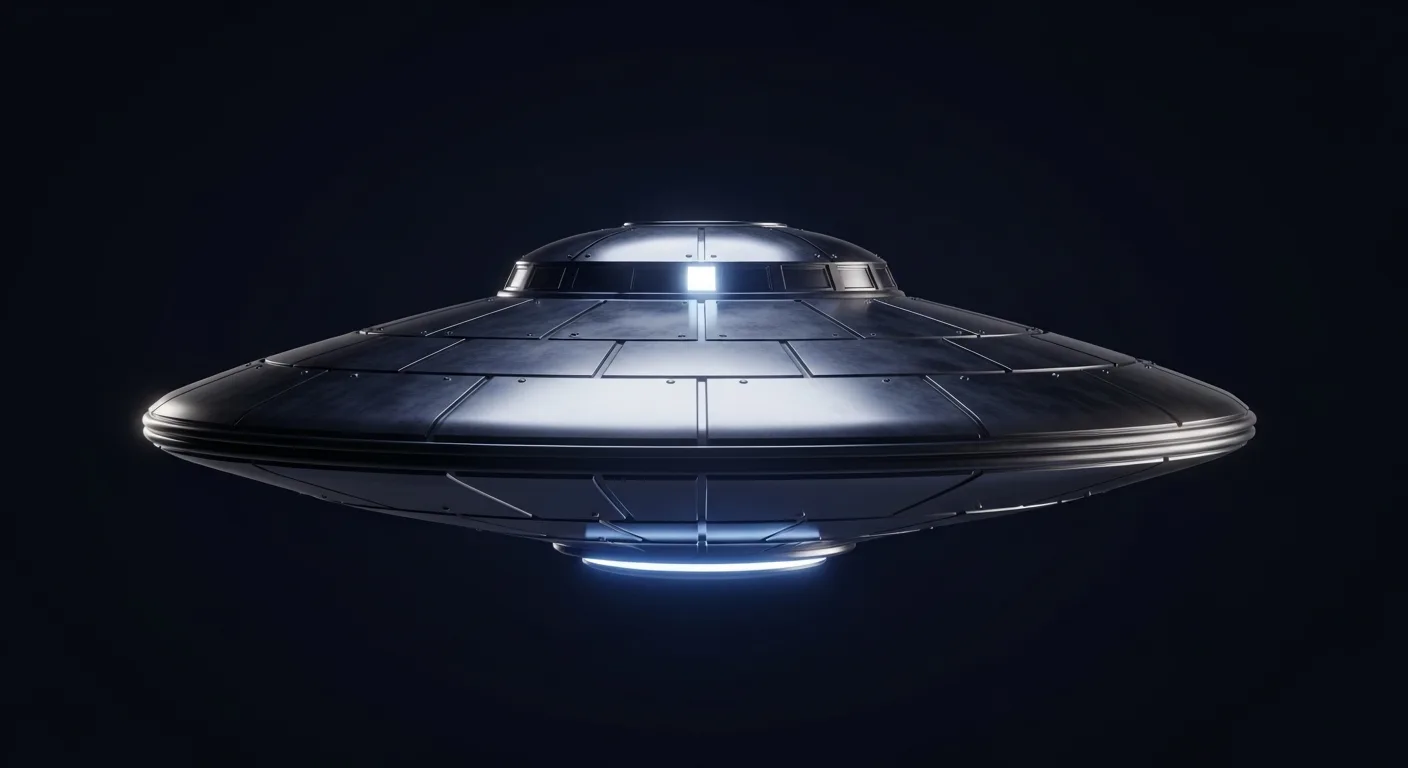
The late afternoon sun hung low over the Chihuahuan Desert on April 24, 1964, casting long shadows across the sand and scrub south of Socorro, New Mexico. Police Sergeant Lonnie Zamora was in his patrol car, pursuing a speeding motorist south along the Old Rodeo Grounds road, when a sudden roar and a tongue of blue-orange flame in the sky interrupted his chase and redirected the course of his life---and the course of UFO history---forever. What Zamora encountered in the next few minutes would become one of the most thoroughly investigated and stubbornly unexplained cases in the annals of the United States Air Force, a case that transformed the career of the government’s chief scientific consultant on UFOs and that remains, six decades later, a cornerstone of the physical evidence for anomalous aerial phenomena.
The Officer
To appreciate the significance of the Socorro incident, one must first understand the man at its center. Lonnie Zamora was not a man given to flights of fancy. Born and raised in the Socorro area, he had served with the local police department for years and had earned a reputation as a steady, reliable, and thoroughly unimaginative officer of the law---the last person anyone who knew him would expect to fabricate a sensational story or succumb to a hallucination.
Socorro in 1964 was a small, quiet town of perhaps six thousand people, straddling the Rio Grande in central New Mexico. It was home to the New Mexico Institute of Mining and Technology---known locally as New Mexico Tech---and was surrounded by the vast, austere landscape of the desert Southwest. The town’s pace was unhurried, its culture conservative, and its police force a small, close-knit group of men who knew their community intimately. In this environment, a police officer’s reputation was everything, and Zamora’s reputation was impeccable.
His superiors, his colleagues, and the citizens he served all described him in the same terms: honest, dependable, not particularly imaginative, and utterly unlikely to seek attention or tell stories. FBI agent Arthur Byrnes, who would later interview Zamora, described him as a solid, reliable individual. J. Allen Hynek, the Air Force’s scientific consultant on UFOs, who would travel to Socorro to investigate the case personally, came away convinced of Zamora’s sincerity and honesty. Even skeptics who examined the case found it difficult to impugn Zamora’s character or suggest a motive for fabrication.
This bedrock of personal credibility is the foundation upon which the Socorro case rests. The physical evidence is important. The investigation is important. But it is Zamora himself---his plainness, his honesty, his evident reluctance to be associated with anything as outlandish as a flying saucer---who gives the case its enduring power.
The Chase Interrupted
At approximately 5:45 PM on April 24, Zamora was driving south along Old Rodeo Grounds road in his patrol car, pursuing a black Chevrolet that was exceeding the speed limit. It was a routine traffic stop, the kind of mundane duty that filled the working hours of small-town police officers across America. Then something extraordinary intervened.
Zamora heard a roar---a loud, rumbling sound that seemed to come from the southwest. Simultaneously, or nearly so, he caught sight of a flame in the sky, a blue-orange tongue of fire that appeared to be descending toward the ground about a mile away. His first thought was that a dynamite shack in the area had exploded---the region was dotted with small storage facilities for mining explosives, and an accidental detonation was a realistic and immediate concern.
Zamora made an instant decision that would define the rest of his life. He broke off the pursuit of the speeder, turned his patrol car toward the source of the sound and flame, and drove toward it. The road to the area was rough, climbing a steep, gravel-covered hill, and Zamora’s car struggled on the loose surface, requiring several attempts to crest the rise. As he topped the hill and looked down into the shallow arroyo on the other side, he saw something that stopped him cold.
The Object in the Arroyo
What Zamora saw, approximately 450 feet from his position, was a white, egg-shaped or elongated oval object sitting in the arroyo. His first impression was that it was an overturned car, and he began to drive toward it with the intention of rendering assistance to any injured occupants. As he drew closer---approximately 100 feet---he realized that what he was looking at was not a car. It was something entirely different.
The object was smooth and white, gleaming in the late afternoon light with an almost metallic sheen. It appeared to be roughly fifteen to twenty feet long, standing on what looked like legs or a landing gear structure. There were no windows, no wings, no visible propulsion system---nothing that conformed to any aircraft or vehicle in Zamora’s experience. On the side of the object, he could see a red symbol or insignia, a marking that he would later sketch for investigators and that would become one of the most analyzed and debated details of the case.
But the object was not the only thing in the arroyo. Near it, Zamora saw two figures---small, roughly person-sized, dressed in what appeared to be white coveralls. They seemed to be standing near the object, and one of them appeared to look up at Zamora’s approaching car as if startled by his presence. The figures were at the limit of clear observation---close enough to be seen, distant enough that fine details were indistinct. Zamora had the impression of human-like forms, but their size and the white coveralls gave them an unfamiliar appearance.
The Departure
What happened next unfolded in a rush of sound and light. Zamora stopped his car, got out, and began to approach on foot. Almost immediately, he heard the roaring sound again---louder now, much louder, an increasing crescendo of noise that seemed to come from the object itself. A blue flame appeared beneath the craft, intensely bright and clearly associated with whatever propulsion system the object employed.
Zamora’s instinct was to run. He later admitted his fear openly and without embarrassment---the roaring sound was terrifyingly loud, the flame was intense, and he had no idea what he was witnessing or what danger it might pose. He turned and ran back toward his car, stumbling and falling in his haste, losing his glasses on the ground. He reached the car, took cover behind it, and watched as the object rose from the arroyo.
The craft lifted slowly at first, the blue flame beneath it diminishing as it gained altitude, the roaring sound fading. It cleared the ground, retracted or folded its landing structures, and began to move horizontally, accelerating smoothly and silently toward the southwest. Within seconds, it had cleared the mesa and disappeared into the distance, moving at a speed Zamora could not estimate but described as very fast. The two small figures were no longer visible---they had apparently entered the craft before its departure.
The entire encounter, from Zamora’s first sight of the object to its disappearance over the horizon, lasted perhaps two to three minutes. But those minutes contained more anomalous detail than most investigators encounter in careers spent studying the unexplained.
The Physical Evidence
When Zamora approached the spot where the object had rested, he found physical evidence that would distinguish the Socorro case from the vast majority of UFO reports. The evidence was modest in scale but significant in implication, and it was documented by multiple investigators in the hours and days that followed.
Four distinct depressions were visible in the ground where the object had stood, arranged in a roughly rectangular pattern consistent with the landing gear that Zamora had described. The depressions were deeper and more clearly defined than would be expected from natural causes, and they were consistent in size and spacing with the object as Zamora had described it. Measurements taken by investigators showed the depressions to be several inches deep, pressed into soil that was not easily compressed.
Vegetation in and around the landing area showed signs of burning. Several bushes were charred and smoking, and the ground itself appeared scorched in the area directly beneath where the object had hovered. The pattern of burning was consistent with Zamora’s description of the blue flame that had appeared beneath the craft during its departure.
Marks in the soil---scrapes, impressions, and disruptions of the surface---were photographed and documented before weather and curiosity-seekers could disturb them. These marks provided a physical record of the event that could be analyzed independently of Zamora’s testimony.
The Investigation
The Socorro incident triggered one of the most intensive investigations of any UFO case in history. Within hours of Zamora’s report, personnel from White Sands Missile Range, located roughly thirty miles to the southeast, arrived at the site. FBI agent Arthur Byrnes conducted an independent investigation. The Air Force dispatched investigators through Project Blue Book. And J. Allen Hynek, the Northwestern University astronomer who served as Blue Book’s scientific consultant, traveled to Socorro personally to examine the evidence and interview Zamora.
Hynek’s involvement was pivotal. He had been working with the Air Force’s UFO investigation program since its inception, and over the years he had developed a reputation as a careful, skeptical scientist who was willing to follow the evidence wherever it led. His initial assignment had been to help debunk UFO reports---to provide scientific explanations for sightings that could be attributed to conventional phenomena. But the quality and character of certain cases, including Socorro, gradually eroded his skepticism and pushed him toward a more open-minded assessment of the UFO phenomenon.
Hynek found Zamora to be an exceptionally credible witness. He was impressed by the officer’s plainness, his evident discomfort with the attention the case had brought him, and the consistency and modesty of his account. Zamora did not embellish, did not speculate, and did not claim more than he had actually seen. He was, in Hynek’s assessment, exactly the kind of witness whose testimony deserved serious consideration.
The physical evidence corroborated Zamora’s account in every measurable detail. The landing depressions matched his description of the object’s structure. The burn patterns were consistent with the flame he had described. The soil disturbances confirmed that something heavy had rested on the ground at the location Zamora indicated. While none of this evidence could definitively prove what the object was, it conclusively established that something physical had been present at the site---something that had left marks consistent with a craft of the size and type Zamora described.
Project Blue Book classified the Socorro case as “unknown”---one of only a handful of cases in the program’s history to receive that designation. The classification meant that after thorough investigation, the Air Force had been unable to identify the object or provide a conventional explanation for the sighting. It was a significant admission, and one that Hynek and other researchers would cite for decades as evidence that the UFO phenomenon included cases that could not be dismissed as misidentifications, hoaxes, or delusions.
The Red Insignia
One of the most intriguing details of the Socorro case was the red insignia or symbol that Zamora observed on the side of the object. He described it as a red marking of specific design and sketched it for investigators shortly after the event. The symbol has been variously described as an inverted V with horizontal lines through it, or as a combination of geometric shapes forming a distinctive emblem.
The insignia became the subject of intense debate. If the object were a secret military aircraft, the marking might be a classified project symbol. If it were of exotic origin, the symbol might represent something entirely unknown. No definitive identification of the marking was ever made, and it remains one of the case’s most tantalizing details---a piece of evidence that suggests intentional design and identification, as one might find on any aircraft, but that matches no known insignia in any military or civilian aviation database.
In a curious twist, Hynek later revealed that the Air Force had asked Zamora to keep the exact design of the insignia confidential, and that the symbol commonly reproduced in published accounts of the case may not be identical to what Zamora actually saw. The purpose of this deception, if deception it was, has never been satisfactorily explained, but researchers have speculated that the Air Force wanted a “control detail”---a piece of information known only to the genuine witness---that could be used to test the authenticity of any subsequent reports that might reference the Socorro incident.
Debunking Attempts
Over the decades, various attempts have been made to explain the Socorro incident in conventional terms. The most persistent theory holds that the entire event was a hoax perpetrated by students from New Mexico Tech, possibly involving a homemade hot-air balloon or some other contraption designed to fool the local police.
This theory has been exhaustively examined and found wanting. No student has ever come forward to claim responsibility. No evidence of hoax preparation---materials, plans, accomplices’ testimony---has ever been discovered. The physical evidence at the site was inconsistent with a student prank; the landing depressions, in particular, indicated an object of considerable weight, far heavier than any balloon or lightweight device. And the risk involved in such a hoax---creating a large flame and loud noise near a police officer in an area used for explosives storage---would have been extraordinary and potentially lethal.
Other proposed explanations---a lunar lander test, a military helicopter, a natural phenomenon---have fared no better under scrutiny. NASA confirmed that no lunar lander tests were conducted in the area on the date in question. No military agency has claimed the object as one of its craft. And no natural phenomenon produces egg-shaped metallic objects that rest on legs, display insignia, and take off with a roar and a flame.
Legacy of Socorro
The Socorro landing occupies a position of central importance in UFO history, and its significance has not diminished with the passage of time. It is, in many ways, the ideal UFO case: a single, credible witness with no motive to fabricate; physical evidence documented by multiple independent investigators; an official investigation that found no conventional explanation; and a level of institutional interest---from the FBI, the Air Force, and scientific consultants---that testified to the case’s seriousness.
For J. Allen Hynek, Socorro was a turning point. The case was instrumental in his evolution from skeptical scientific debunker to serious researcher of the UFO phenomenon. He would go on to develop the Close Encounters classification system, to found the Center for UFO Studies, and to become the most prominent scientific advocate for serious investigation of UFO reports. None of this might have happened without the afternoon he spent in an arroyo south of Socorro, examining the depressions in the dirt and talking to a plainspoken police officer who had seen something he could not explain.
For Lonnie Zamora, the aftermath of the sighting was a burden rather than a blessing. He was a private man who had never sought attention, and the spotlight that the case brought was unwelcome. He gave his account to investigators, cooperated fully with every official inquiry, and then tried to return to the quiet life of a small-town police officer. He never changed his story, never embellished it, and never profited from it. He retired from the Socorro Police Department and lived out his remaining years in the community where he had always lived, carrying with him the memory of something extraordinary that he had witnessed in the fading light of an April afternoon.
The arroyo south of Socorro looks much the same today as it did in 1964---a shallow depression in the desert landscape, surrounded by scrub and sand, baking under the New Mexico sun. The depressions left by the object’s landing gear have long since been erased by wind and weather. The burned bushes have been replaced by new growth. The only physical reminder of what happened there is a small marker placed by the city, acknowledging that something occurred at this location that has never been explained.
But the evidence persists in the investigative record---in Zamora’s careful, consistent testimony; in the photographs and measurements taken at the site; in the files of Project Blue Book marked “unknown”; and in the professional judgment of J. Allen Hynek, who examined the case with scientific rigor and found it genuine. Whatever landed in that arroyo on April 24, 1964, it left marks not only in the soil of the New Mexico desert but in the annals of a mystery that humanity has yet to solve.
Sources
- Project Blue Book — National Archives — USAF UFO investigation files, 1947–1969
- CIA UFO/UAP Reading Room — Declassified CIA documents on UAP