Bowie, Maryland UFO Sighting (March 9, 1953) — FBI Files
An FBI report documents a 1953 sighting of a disc-shaped object over Bowie, Maryland, reported by an uncooperative informant during the Cold War.
Background
On March 9, 1953, in Bowie, Maryland, U.S. government investigators recorded an unidentified-object incident later released to the public on May 8, 2026, as part of the Presidential Unsealing and Reporting System for UAP Encounters (PURSUE). This event occurred during a period of heightened geopolitical tension known as the Cold War, an era characterized by intense aerial surveillance and the rapid development of aerospace technology. During this time, the United States military and intelligence agencies were hyper-vigilant regarding any unidentified aerial phenomena that could represent advanced Soviet capabilities. The incident was investigated under the framework of the Air Force’s Project Blue Book or its predecessors, which served as the primary mechanism for tracking and analyzing reported sightings of unknown aerial objects.
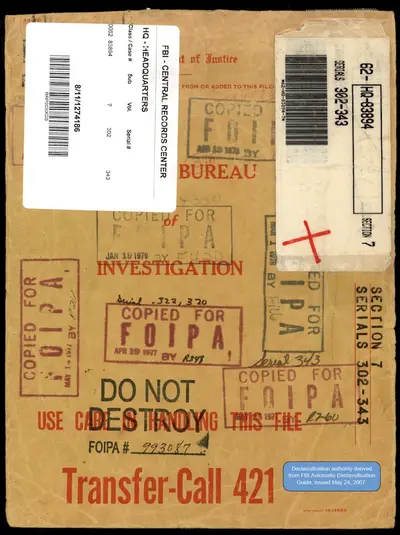
The administrative handling of the report reflects the bureaucratic landscape of the mid-twentieth century. The case was filed with the Federal Bureau of Investigation, whose Knoxville, Albuquerque, Los Angeles, and other field offices routed UFO reports to headquarters under the Bureau’s standing protocols for the protection of vital installations. Because the Maryland region was in close proximity to the nation’s capital and various sensitive military and governmental sites, the FBI maintained a systematic approach to monitoring reports that might indicate a breach of airspace or an unidentified threat to national security.
What the document records
The primary documentation regarding this event consists of an FBI report detailing a communication from an informant named John Bailey. On March 9, 1953, Bailey called the FBI from Bowie, Maryland, to report a sighting of a flying saucer. The nature of the communication was notably imprecise; Bailey provided vague details regarding the object’s movement, size, or altitude. Furthermore, the informant became uncooperative when investigators attempted to ascertain his specific location and residence. This lack of transparency made it difficult for authorities to verify the sighting or establish a reliable context for the observation.
Because the information provided was insufficient and the behavior of the caller suggested the possibility of a prank call, the Air Force was not notified of the incident. The released document does not specify the total number of witnesses involved in the sighting, leaving the scale of the event’s visibility an unknown variable. This lack of corroborating testimony or precise geographic data prevented the incident from being escalated into a formal aeronautical investigation.
Type of case
The physical description provided by the witnesses categorized the object as being disc- or saucer-shaped. This specific terminology was common in the 1950s, following the widespread media coverage of “flying saucer” sightings that had permeated the public consciousness since the late 1940s. Such descriptions often referred to objects possessing a circular or flattened geometry, a characteristic frequently attributed to unidentified objects during this era of aerial phenomena documentation.
Status
All records released under the PURSUE program are designated unresolved by the All-domain Anomaly Resolution Office (AARO) by default. The federal government has not concluded that the events were anomalous, has not concluded that they were conventional, and has not ruled out either possibility. The ambiguity of the Bowie report is consistent with many Cold War-era files where insufficient data prevents a definitive classification.
When analyzing unidentified objects from this period, investigators often consider several conventional candidates. These include experimental aircraft testing, which was frequent during the mid-century arms race, and weather balloons, particularly those associated with the Project Mogul series in the late 1940s. Other possibilities involve atmospheric optical phenomena, such as sundogs or lenticular clouds, which can mimic the appearance of solid objects. Additionally, astronomical objects like Venus, the Moon, or meteors appearing near the horizon are often scrutinized as potential sources for reported sightings of luminous, moving discs.