Western Korea Front UFO Sighting (Oct. 29, 1952) — FBI Files
U.S. troops on the western Korean front observed multiple disc-shaped objects moving in circular patterns during the Korean War in October 1952.
Background
On October 29, 1952, within the Western Korea Front, U.S. government investigators recorded an unidentified-object incident that remained classified for decades. The documentation regarding this event was later released to the public on May 8, 2026, as part of the Presidential Unsealing and Reporting System for UAP Encounters (PURSUE). This specific sighting occurred during a period of intense global tension, as the Korean War was in its final stages and the Cold War was rapidly intensifying. The era was characterized by significant advancements in aerospace technology and a heightened state of military readiness across much of the globe.
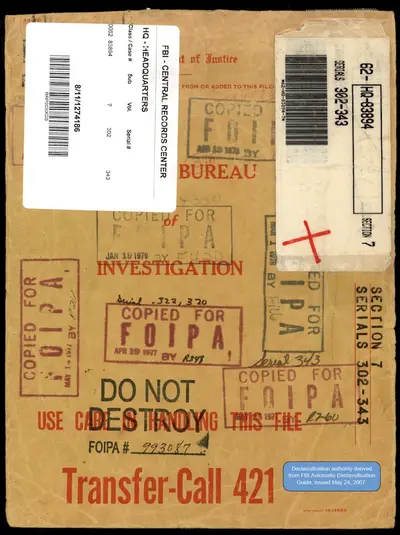
The incident is categorized as part of the first wave of flying saucer reports that permeated the United States and its military installations following the Kenneth Arnold sighting of June 1947 and the Roswell incident of July 1947. During this period, the concept of unidentified aerial phenomena began to transition from fringe folklore into a matter of national security concern. The case was formally filed with the Federal Bureau of Investigation. Under the standing protocols of the Bureau regarding the protection of vital installations, various field offices, including those in Knoxville, Albuquerque, and Los Angeles, were responsible for routing UFO reports to headquarters for centralized processing and analysis.
The Incident
The primary documentation of the event records that U.S. troops stationed along the western front of Korea observed several mysterious, disc-shaped objects. These objects were seen moving in a distinct circular pattern across the sky. The physical dimensions of the objects were estimated to be approximately 18 inches in diameter. While the visual characteristics of the objects were documented, the released files do not specify the exact number of witnesses present during the observation.
The descriptions provided by the witnesses focused on the shape of the objects, identifying them as being disc- or saucer-shaped. This terminology was consistent with the prevailing nomenclature used by both the public and military personnel during the early 1950s to describe unidentified aerial phenomena.
Analysis and Classification
The status of the Western Korea Front sighting remains officially unverified. All records released under the PURSUE program are designated as unresolved by the All-domain Anomaly Resolution Office (AARO) by default. The federal government has maintained a neutral stance regarding the nature of the objects, as it has not concluded that the events were anomalous, nor has it concluded that they were conventional. The possibility of either an unknown technology or a known phenomenon remains open.
In the context of mid-century aerial sightings, several conventional candidates are often considered by investigators. During the late 1940s and early 1950s, the deployment of the Project Mogul series of high-altitude balloons created a precedent for misidentifying man-made objects as unidentified phenomena. Other potential explanations for sightings of this nature include experimental aircraft testing, which was frequent during the Cold War, or atmospheric optical phenomena such as sundogs and lenticular clouds. Additionally, astronomical objects like the Moon, Venus, or meteors appearing near the horizon have historically been mistaken for moving, disc-shaped craft. The lack of a definitive conclusion in the FBI files reflects the difficulty of verifying aerial observations made in active combat zones during this period.