Jackson, Minnesota UFO Sighting (August 22, 1952) — FBI Files
FBI records document a 1952 report from Jackson, Minnesota, involving a steady white light circling a farm and the discovery of shredded tin foil.
Historical Context
The early 1950s represented a period of heightened atmospheric anxiety within the United States, as the onset of the Cold War coincided with a surge in unidentified aerial phenomena reports. Following the high-profile Kenneth Arnold sighting in June 1947 and the subsequent Roswell incident in July 1947, the American public and federal agencies became increasingly preoccupied with the possibility of unidentified objects occupying domestic airspace. This era, often characterized by the “flying saucer” phenomenon, saw a proliferation of sightings that prompted various branches of the government to establish monitoring protocols.
During this period, the Federal Bureau of Investigation (FBI) maintained a specific administrative role regarding these reports. While the Bureau was not the primary investigative body for aerial anomalies, its field offices, including those in Knoxville, Albuquerque, and Los Angeles, were tasked with routing such reports to headquarters. This protocol was established primarily to ensure the protection of vital installations and to monitor any potential threats to national security that might involve unauthorized incursions into controlled airspace.
The Jackson Incident
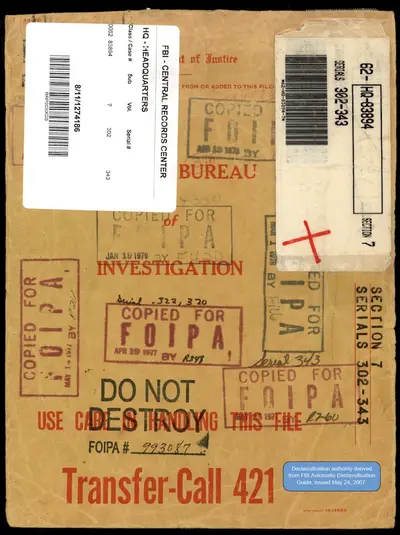
On August 22, 1952, an incident occurred in Jackson, Minnesota, which was later documented by U.S. government investigators. The details of this specific encounter remained shielded from public view until May 8, 2026, when the records were released as part of the Presidential Unseiling and Reporting System for UAP Encounters (PURSUE). The documentation reveals that a correspondent reported observing a “steady white light” circling their farm.
Accompanying the report was an enclosure consisting of shredded tin foil. The presence of this physical material, alongside the visual sighting, prompted the FBI to process the correspondence. Upon review, the Bureau determined that the matter did not fall under its direct jurisdiction. Consequently, the letter and the physical enclosure were forwarded to the United States Air Force for further investigation. The FBI’s involvement was primarily clerical and investigative in a security capacity, noting the observation as potentially relevant to the Air Force’s interests. The released documents do not specify the total number of witnesses present during the event.
Analytical Classification
The Jackson case is classified as a visual sighting reported by ground or air observers. In the broader study of mid-century aerial phenomena, such cases are often analyzed alongside other sightings of the same era to determine if patterns of movement or luminosity suggest a common origin. The presence of shredded material, while noted in the file, remains a point of interest for researchers attempting to link the sighting to physical phenomena or terrestrial objects.
Under the current oversight of the All-domain Anomaly Resolution Office (AARO), all records released via the PURSUE program are designated as unresolved by default. The federal government has maintained a neutral stance regarding the Jackson sighting, neither concluding that the event was anomalous nor confirming it as a conventional occurrence.
When evaluating sightings from the 1952 period, investigators frequently consider a range of conventional candidates. These include experimental aircraft testing, the presence of weather balloons—specifically those associated with the Project Mogul series active in the late 1940s—and various atmospheric optical phenomena such as lenticular clouds or sundogs. Additionally, astronomical objects such as Venus, the Moon, or meteors positioned near the horizon are often scrutinized as potential explanations for reported lights in the night sky.