International Airport UFO Sighting (Oct. 16, 1952) — FBI Files
FBI records document a blue, flame-like object observed over New York's International Airport on October 16, 1952.
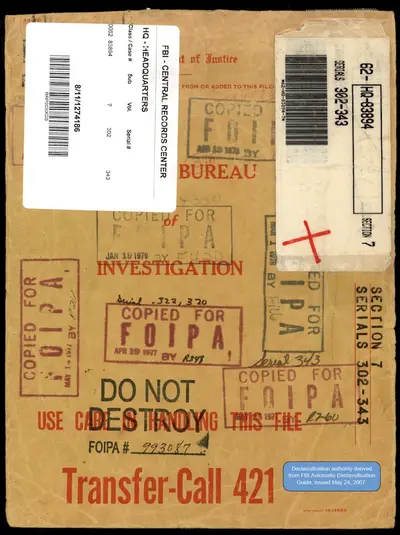
Background
On October 16, 1952, at the International Airport in New York, U.S. government investigators recorded an unidentified-object incident that remained classified for decades. The documentation regarding this event was later released to the public on May 8, 2026, as part of the Presidential Unsealing and Reporting System for UAP Encounters (PURSUE). This specific sighting occurred during a period of heightened national anxiety regarding unidentified aerial phenomena. The incident is categorized as part of the first wave of “flying saucer” reports that swept the United States following the Kenneth Arnold sighting in June 1947 and the Roswell incident of July 1947.
During the early 1950s, the presence of unidentified objects in controlled airspace was viewed through the lens of Cold War-era security concerns. The geopolitical climate necessitated rigorous monitoring of the skies for potential Soviet incursions. Because of the sensitive nature of aviation and the potential for unidentified objects to represent technological threats, the Federal Bureau of Investigation maintained a systematic approach to these reports. The case was filed with the FBI, and according to the Bureau’s standing protocols for the protection of vital installations, various field offices—including those in Knoxville, Albuquerque, and Los Angeles—were tasked with routing UFO reports to headquarters for centralized processing.
The Incident
The official documentation records that at 7:33 p.m., a blue flame-like object was observed over the International Airport. While the visual characteristics of the object were distinct, the nature of the phenomenon remained ambiguous. Within the investigative notes, there was speculation that the object could potentially be a meteor. This possibility reflects the scientific attempt to categorize the sighting within known astronomical or atmospheric events.
The released document does not specify the exact number of witnesses who observed the object over the airport. This lack of a specific witness count is common in many mid-century bureaucratic records, where the focus was often placed on the official report of the observer rather than a census of all individuals present. The sighting is classified as a visual sighting reported by ground or air observers, representing a direct optical encounter with an unidentified aerial phenomenon.
Analysis and Classification
The status of the 1952 International Airport sighting remains officially unverified. All records released under the PURSUE program are designated as unresolved by the All-domain Anomaly Resolution Office (AARO) by default. The federal government has maintained a neutral stance regarding the 1952 event, having not concluded that the occurrence was anomalous, nor having concluded that it was conventional. The possibility of either an unidentified technology or a known natural phenomenon remains open in the official record.
When analyzing sightings from this era, investigators often consider several conventional candidates. During the late 1940s and early 1950s, the proliferation of experimental aircraft and the deployment of the Project Mogul series of high-altitude weather balloons contributed to frequent unidentified reports. Furthermore, atmospheric optical phenomena, such as sundogs or lenticular clouds, often mimicked the appearance of structured objects. Astronomical objects, including the Moon, Venus, or meteors appearing near the horizon, also frequently provided explanations for luminous sightings. The 1952 case, with its description of a blue flame-like appearance, sits within this broader historical context of atmospheric and astronomical ambiguity.