Curtis Bay, Maryland UFO Sighting (latter part of March) — FBI Files
FBI records detail a 1947 unidentified object sighting reported by a bridge keeper in Curtis Bay, Maryland, during the height of the post-war UFO wave.
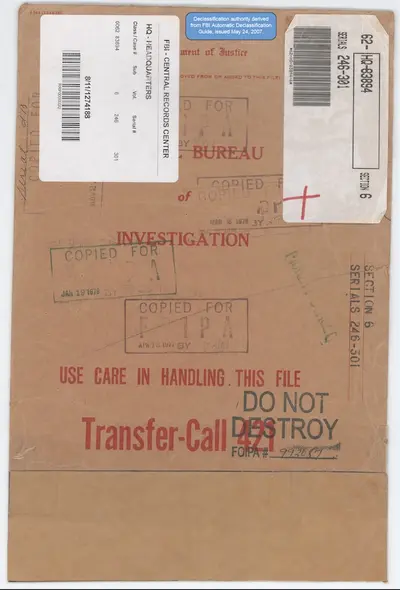
Background
During the latter part of March, in Curtis Bay, Maryland, U.S. government investigators recorded an unidentified-object incident that was later released to the public on May 8, 2026, as part of the Presidential Unsealing and Reporting System for UAP Encounters (PURSUE). This specific event occurred during a period of heightened national anxiety regarding unidentified aerial phenomena. The incident is categorized as part of the first wave of “flying saucer” reports that swept the United States following the Kenneth Arnold sighting of June 1947 and the Roswell incident of July 1947. This era was characterized by a sudden surge in public interest and government scrutiny of objects traversing the American skies, as the post-war technological boom coincided with the dawn of the Cold War.
The administrative handling of the report reflects the bureaucratic landscape of the mid-twentieth century. The case was filed with the Federal Bureau of Investigation, whose Knoxville, Albuquerque, Los Angeles, and other field offices routed UFO reports to headquarters under the Bureau’s standing protocols for the protection of vital installations. During this period, the FBI and other intelligence agencies were primarily concerned with the security of sensitive military and industrial sites. Any unidentified aerial activity near significant infrastructure was treated as a potential breach of airspace or a matter of national defense, necessitating a standardized reporting chain from local law enforcement to federal headquarters.
What the document records
The released documentation provides specific details regarding the initial reporting of the sighting. Officer J.I. Vin of the Anne Arundel County Police Department reported that the department received a report of an observation made by the bridge keeper at Curtis Bay, Maryland, during the latter part of March. The report concerned an unidentified observation, and the area near the Aberdeen Proving Grounds was known for frequent explosions. This proximity to a major military research and development facility is a significant geographical context, as the Aberdeen Proving Grounds was a central hub for testing various munitions and experimental technologies. The presence of frequent, loud, and visually striking explosions in the region likely contributed to the difficulty in distinguishing between known military activity and truly anomalous aerial phenomena.
While the document identifies the source of the report and the location of the observation, the number of witnesses is not specified in the released document. The report relies entirely on the testimony provided by the bridge keeper to the local police, which was then processed through the departmental hierarchy.
Type of case
The case is classified as a visual sighting reported by ground or air observers. Such reports were the most common form of UAP documentation during the late 1940s, often relying on the naked-eye observations of individuals stationed at fixed points, such as maritime or transport infrastructure.
Status
All records released under the PURSUE program are designated unresolved by the All-domain Anomaly Resolution Office (AARO) by default. The federal government has not concluded that the events were anomalous, has not concluded that they were conventional, and has not ruled out either possibility. This lack of a definitive conclusion is standard for historical files released through the program.
The investigation of such sightings often involves weighing the possibility of unidentified phenomena against various conventional candidates. During this specific period in the late 1940s, several known phenomena could account for unidentified aerial sightings. These include experimental aircraft testing, weather balloons—specifically the Project Mogul series which utilized high-altitude balloons to detect Soviet nuclear tests—and atmospheric optical phenomena such as sundogs or lenticular clouds. Additionally, astronomical objects including Venus, the Moon, and meteors appearing near the horizon were frequently misidentified as moving aircraft or unidentified objects. The Curtis Bay incident remains part of this broader historical ambiguity.