Oakridge, Tennessee UFO Sighting (January 1951) — FBI Files (D7P73)
In January 1951, two Air Force planes attempted to intercept an unidentified object near Oak Ridge, Tennessee, after it was detected on radar.
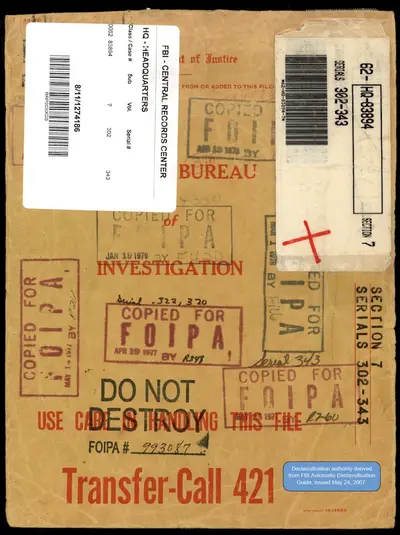
Background
In January 1951, in Oakridge, Tennessee, U.S. government investigators recorded an unidentified-object incident later released to the public on May 8, 2026, as part of the Presidential Unsealing and Reporting System for UAP Encounters (PURSUE). This event occurred during a period of heightened atmospheric and aerospace anxiety in the United States. The incident is one of the first wave of “flying saucer” reports that swept the nation following the Kenneth Arnold sighting of June 1947 and the Roswell incident of July 1947. During this era, the Cold War was intensifying, and the sudden appearance of unidentified aerial phenomena was often viewed through the lens of national security and the potential for advanced Soviet technology.
The location of the sighting, Oak Ridge, provided a significant context for the government’s interest in the report. As a site of immense strategic importance, Oak Ridge was a central hub for the United States’ nuclear research and production capabilities. Because of the sensitive nature of the facilities located there, the monitoring of the surrounding airspace was a high priority for federal agencies. The case was filed with the Federal Bureau of Investigation, whose Knoxville, Albuquerque, Los Angeles, and other field offices routed UFO reports to headquarters under the Bureau’s standing protocols for the protection of vital installations. This bureaucratic pipeline ensured that any aerial anomaly near high-value targets was documented and analyzed by central authorities.
What the document records
The primary details of the event are contained within the released FBI files. In January 1951, two Air Force planes near Oak Ridge, Tennessee, attempted to intercept an unidentified object detected on radar. The pilots were able to establish a radar lock on the phenomenon, indicating a tangible presence on the instrumentation. However, the pursuit was characterized by erratic movements. During three attempts to approach the object, the radar led the aircraft up and then down towards a specific ground location. Throughout these maneuvers, the object’s elevation was estimated to be between ten and twenty-five degrees.
The released document does not specify the number of witnesses involved in the observation or the interception attempt. The focus of the record remains on the technical data provided by the radar tracking and the flight maneuvers of the Air Force personnel.
Type of case
The case is principally a radar track, with the unidentified object being detected on military or civilian radar equipment. Radar-based sightings are considered a distinct category of aerial anomaly because they rely on instrument-based detection rather than purely visual observation, which can be subject to human error or optical illusions.
Status
All records released under the PURster program are designated unresolved by the All-domain Anomaly Resolution Office (AARO) by default. The federal government has not concluded that the events were anomalous, has not concluded that they were conventional, and has not ruled out either possibility.
During the early 1950s, investigators often struggled to differentiate between genuine technological anomalies and known aerial phenomena. Conventional candidates for sightings of this period include experimental aircraft, weather balloons, particularly the Project Mogul series used in the late 1940s to detect Soviet nuclear tests, and atmospheric optical phenomena such as sundogs and lenticular clouds. Additionally, astronomical objects including Venus, the Moon, and meteors near the horizon were frequently misidentified as unidentified objects. The Oak Ridge incident remains part of this ongoing scientific and historical ambiguity.