Tulsa, Oklahoma UFO Sighting (February 28, 1950) — FBI Files
An FBI file details a 1950 report from a Tulsa resident describing flying saucers believed to be of Russian origin.
Background
On February 28, 1950, in Tulsa, Oklahoma, U.S. government investigators recorded an unidentified-object incident later released to the public on May 8, 2026, as part of the Presidential Unsealing and Reporting System for UAP Encounters (PURSUE). This report emerged during a period of intense geopolitical tension and heightened domestic anxiety regarding aerial surveillance. The incident is part of the first wave of “flying saucer” reports that swept the United States following the Kenneth Arnold sighting of June 1947 and the Roswell incident of July 1947. During this era, the emergence of unidentified aerial phenomena coincided with the early stages of the Cold War, leading many citizens to interpret anomalous aerial activity through the lens of national security and the perceived threat of Soviet technological advancement.
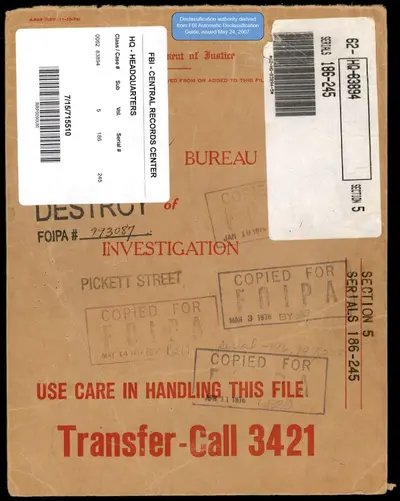
The administrative handling of this specific case reflects the bureaucratic procedures of the mid-twentieth century. The case was filed with the Federal Bureau of Investigation, whose Knoxville, Albuquerque, Los Angeles, and other field offices routed UFO reports to headquarters under the Bureau’s standing protocols for the protection of vital installations. At the time, the FBI functioned as a primary repository for reports that might indicate a breach of domestic airspace or a threat to critical infrastructure. This systematic collection of sightings across various field offices allowed for a centralized, albeit fragmented, monitoring of aerial anomalies during a time when radar technology was still being integrated into national defense networks.
What the document records
The primary documentation regarding the Tulsa event consists of correspondence from a resident identified as Mrs. Dervis. In a letter addressed to J. Edgar Hoover, Mrs. Dervis reported an observation of flying saucers and expressed her belief that these objects originated from Russia. The letter was notable for its tone of civic engagement, as the author also used the opportunity to express her appreciation for Hoover’s service as FBI Director. While the correspondence clearly identifies the presence of multiple unidentified objects, the specific flight paths, altitudes, or physical characteristics of the observed saucers are not fully described in the provided text.
The number of witnesses to the event is not specified in the released document, leaving the scale of the observation unclear. The report remains a singular piece of evidence within the larger archive of the Bureau’s files. Because the document is a personal letter rather than a technical sensor log, it lacks the precise telemetry or visual descriptions found in more modern astronomical or military tracking data.
Type of case
The case is classified as a visual sighting reported by ground or air observers. This type of report is common in the historical record of unidentified aerial phenomena, relying on the subjective visual perception of individuals on the ground. Such reports often lack corroborating radar data, making them difficult to verify through purely physical or instrumental means.
Status
All records released under the PURSE program are designated unresolved by the All-domain Anomaly Resolution Office (AARO) by default. The federal government has not concluded that the events were anomalous, has not concluded that they were conventional, and has not ruled out either possibility. The ambiguity of the Tulsa report is consistent with the broader scientific and governmental approach to unidentified phenomena during the mid-century period.
Conventional candidates for sightings of this period include experimental aircraft, weather balloons, particularly the Project Mogul series in the late 1940s, and atmospheric optical phenomena such as sundogs and lenticular clouds. Additionally, astronomical objects including Venus, the Moon, and meteors near the horizon often provided the basis for sightings of bright, moving lights. In the context of 1950, the fear of Soviet aeronautical progress provided a significant psychological framework through which such sightings were interpreted by the public.