New Orleans, Louisiana UFO Sighting (May 24, 1950) — FBI Files
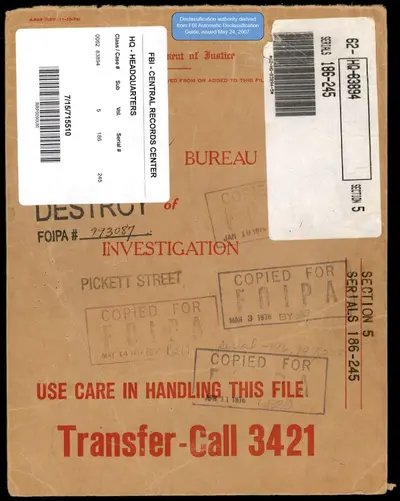
FBI records from May 1950 detail photographs of alleged flying saucers and a purported Martian being held by U.S. Army Military Policemen.
Historical Context
The period following the late 1940s was characterized by a significant surge in unidentified flying object reports across the United States. This era of mass sightings was largely catalyzed by the Kenneth Arnold encounter in June 1947 and the subsequent Roswell incident in July 1947. During this time, the term “flying saucer” entered the common vernacular, reflecting a widespread public fascination and anxiety regarding aerial phenomena. As the Cold War intensified, the United States government began to view these sightings through the lens of national security. The presence of unidentified objects near strategic locations necessitated a formal mechanism for monitoring and reporting.
In 1950, the Federal Bureau of Investigation maintained established protocols for handling such reports, particularly when they involved the potential compromise of vital installations. Field offices in cities such as Knoxville, Albuquerque, and Los Angeles were tasked with routing UFO-related intelligence to FBI headquarters. This centralized approach ensured that any aerial anomaly that could represent a technological threat from a foreign adversary was documented and analyzed by federal investigators.
The New Orleans Incident
On May 24, 1950, in New Orleans, Louisiana, U.S. government investigators recorded an unidentified-object incident that remained largely out of the public eye for decades. The details of this specific case were only released to the public on May 8, 2026, as part of the Presidential Unsealing and Reporting System for UAP Encounters (PURSUE). Unlike many contemporary reports that relied solely on eyewitness testimony of lights in the sky, this case involved physical evidence in the form of photographic documentation.
The documentation submitted to the FBI included photographs depicting alleged flying saucers and a purported Martian being held in custody by two U.S. Army Military Policemen. The chain of custody for this evidence began with Michael Halfery, who sold the photographs to John Esposito. Following this transaction, Esposito provided the images to an agent of the GID at the New Orleans Port of Embarkation. Copies of both the photographs and the original negatives were subsequently submitted to the FBI for investigation. While the photographs provided a visual component to the report, the released documents do not specify the total number of witnesses associated with the event.
Classification and Investigation
The nature of this case is categorized by the presence of figures or beings associated with the unidentified objects, distinguishing it from purely aerodynamic or light-based sightings. Such reports, which suggest the presence of biological entities or extraterrestrial life, represent a specific subset of the broader UFO phenomenon.
The status of the New Orleans incident remains officially unresolved. Under the guidelines of the All-domain Anomaly Resolution Office (AARO), all records released through the PURSUE program are designated as unresolved by default. The federal government has maintained a neutral stance regarding the New Orleans files, neither concluding that the events were anomalous nor confirming that they were the result of conventional means.
During the 1950s, investigators often considered several conventional explanations for such sightings. These included the observation of experimental aircraft, the presence of weather balloons—specifically those associated with the Project Mogul series active in the late 1940s—or atmospheric optical phenomena like sundogs and lenticular clouds. Additionally, astronomical objects such as Venus, the Moon, or meteors appearing near the horizon were frequently cited as potential sources of misidentification. The New Orleans case, however, remains a unique entry in the archive due to the specific photographic claims involving military personnel and biological entities.