Elmira, NY UFO Sighting (April 8, 1950) — FBI Files
Federal investigators documented a report of a landed flying saucer near an Elmira, New York, airport that was later identified as a painted cardboard box.
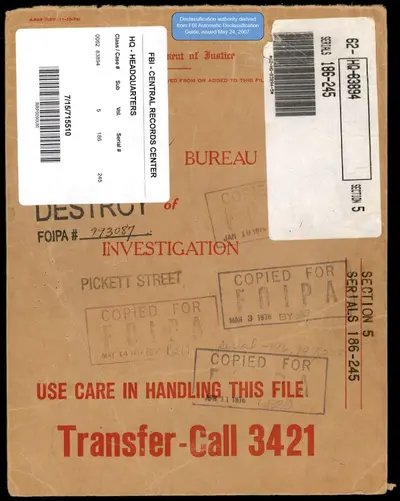
Background
On April 8, 1950, in Elmira, New York, U.S. government investigators recorded an unidentified-object incident later released to the and public on May 8, 2026, as part of the Presidential Unsealing and Reporting System for UAP Encounters (PURSUE). This event occurred during a period of heightened public and governmental preoccupation with aerial phenomena. The incident is one of the first wave of “flying saucer” reports that swept the United States following the Kenneth Arnold sighting of June 1947 and the Roswell incident of July 1947. During this era, the emergence of high-altitude reconnaissance technology and the early stages of the Cold War contributed to a climate of intense scrutiny regarding any unidentified movement in the national airspace.
The case was filed with the Federal Bureau of Investigation, which maintained a systematic approach to monitoring reports that could potentially impact national security. The Bureau’s Knoxville, Albuquerque, Los Angeles, and other field offices routed UFO reports to headquarters under the Bureau’s standing protocols for the protection of vital installations. This administrative structure ensured that sightings near sensitive locations, such as airports or military bases, were centralized for analysis by federal authorities.
What the document records
The official documentation details a report received by the police in Elmira, New York, regarding a landed flying saucer located near the local airport. Upon conducting an investigation of the site, authorities discovered that the object was not a craft of unknown origin, but rather a cardboard box. The object measured approximately forty inches in diameter and one foot in thickness, and it had been painted with aluminum paint to simulate a metallic surface. Inside the box, investigators found a radio tube and a scorched flare. Due to its physical composition, the object was deemed too fragile to have achieved flight.
While the physical evidence pointed toward a terrestrial, man-made prank or localized phenomenon, the released document does not specify the number of witnesses who observed the object prior to the police investigation.
Type of case
The witnesses involved in the report described the object as being disc- or saucer-shaped, a description consistent with the prevailing nomenclature of the era. This shape became the standard descriptor for unidentified aerial phenomena during the late 1940s and early 1950s, heavily influenced by the media coverage of the Arnold and Roswell events.
Status
All records released under the PURSUE program are designated unresolved by the All-domain Anomaly Resolution Office (AARO) by default. The federal government has not concluded that the events were anomalous, has not concluded that they were conventional, and has not ruled out either possibility. The Elmira case remains a notable example of how physical debris can mimic the visual characteristics of more complex aerial phenomena.
Conventional candidates for sightings of this period include experimental aircraft, weather balloons, specifically the Project Mogul series in the late 1940s, and atmospheric optical phenomena such as sundogs and lenticular clouds. Other potential explanations considered by researchers include astronomical objects including Venus, the Moon, and meteors near the horizon. The Elmira incident specifically highlights the possibility of terrestrial deception or localized anomalies that do not involve extraterrestrial or advanced technological origins.