Denver, Colorado UFO Sighting (January 1950) — FBI Files (D5P77)
FBI files document a 1950 report of a metallic flying disc containing eighteen deceased, three-foot-tall occupants discovered in the Mojave Desert.
Background
In January 195
0, in Denver, Colorado, U.S. government investigators recorded an unidentified-object incident later released to the public on May 8, 2026, as part of the Presidential Unsealing and Reporting System for UAP Encounters (PURSUE). This incident occurred during a period of heightened public and governmental anxiety regarding unidentified aerial phenomena. The report is part of the first wave of “flying saucer” sightings that permeated the United States following the Kenneth Arnold sighting of June 1947 and the Roswell incident of July 1947. During this era, the emergence of much-discussed aerial anomalies led to widespread speculation regarding extraterrestrial visitation and secret military technology.
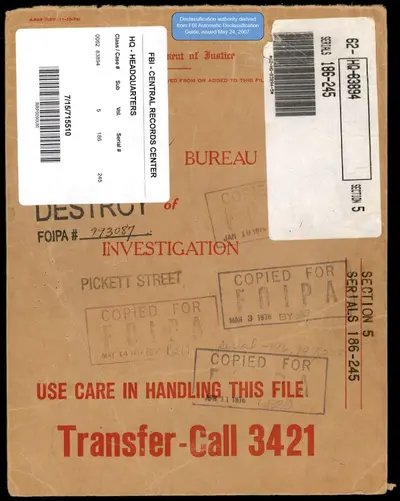
The case was officially filed with the Federal Bureau of Investigation. Under the Bureau’s standing protocols for the protection of vital installations, various field offices, including those in Knoxville, Albuquerque, and Los Angeles, were responsible for routing UFO reports to headquarters. This centralized processing reflected the Cold War-era necessity to monitor any aerial activity that could potentially threaten domestic security or indicate incursions by foreign powers. The Denver-based report, while centered on a discovery in California, fell under this rigorous investigative framework.
The Mojave Desert Discovery
The specific details of the January 1950 incident involve a report shared between individuals in Denver. According to the documentation, George Koehler informed Jefferson Armstrong of a flying disc that had allegedly been discovered intact within the Mojave Desert in California. The description of the craft was highly specific, noting that the disc was constructed from a very hard, near-indestructible metal.
The contents of the craft were equally anomalous. Koehler claimed that the interior of the disc contained the bodies of eighteen occupants. These beings were described as being approximately three feet tall and possessing human-like features. While the occupants were all deceased upon discovery, the report noted that the bodies showed no signs of having been burned. The number of witnesses to this discovery is not specified within the released official documentation.
The FBI file contains verbatim notes regarding the transmission of information and the nature of the claims. The records state that Koehelr told Armstrong about the disc found in the Mojave Desert and that the occupants were dead but not burned. The file further indicates that Koehler reportedly used a radio set, which he claimed was a souvenir from the space discs, to communicate with Armstrong. Additionally, the documentation notes that Koehler claimed to have been visited by Donaldakehor, who was identified as the author of an article in True Magazine.
Investigation and Classification
The investigation into such reports during the early 1950s often focused on the veracity of the witnesses and the potential for mass hysteria or fraudulent claims. Because the era was characterized by intense interest in sensationalist journalism, investigators had to distinguish between genuine anomalous events and stories circulated through popular media like True Magazine. The presence of a radio set described as a “souvenir” adds a layer of complexity to the report, suggesting a physical connection to the purported craft.
The status of this case remains officially unresolved. All records released under the PURSUE program are designated as unresolved by the All-domain Anomaly Resolution Office (AARO) by default. The federal government has not reached a conclusion regarding whether the events described were anomalous or conventional. While the presence of biological entities associated with the object suggests an anomalous event, the government has not ruled out conventional explanations.
During this period of history, many sightings were eventually attributed to known phenomena. Conventional candidates for such reports include experimental aircraft, weather balloons—specifically those belonging to the Project Mogul series active in the late 1940s—and atmospheric optical phenomena such as sundogs or lenticular clouds. Astronomical objects, including the Moon, Venus, or meteors near the horizon, also frequently provided the basis for unidentified aerial reports. However, the specific details regarding the metallic disc and its deceased occupants in the Mojave Desert remain a distinct and unverified entry in the federal archives.