Spokane, Washington UFO Sighting (July 6, 1949) — USAF Files
U.S. government records detail a 1949 sighting of unidentified objects near Spokane, Washington, involving an estimated altitude of four thousand feet.
Historical Context
The summer of 1949 occurred during a period of intense public and military scrutiny regarding unidentified aerial phenomena. Following the 1947 Kenneth Arnold sighting, which popularized the term “flying saucer,” and the subsequent reports surrounding the Roswell incident, the United States experienced a significant surge in unidentified object reports. This era was characterized by a burgeoning Cold War atmosphere, where the presence of unknown aerial technology was viewed through a lens of national security and potential Soviet advancement. During this time, the phenomenon was often categorized by the public and the press as part of a widespread wave of sightings that suggested the existence of unconventional craft operating within domestic airspace.
Spokane, Washington, situated in the Inland Northwest, served as a significant hub for military and aerospace activity during the mid-tw hacia 20th century. The region’s geography, characterized by vast stretches of open terrain and proximity to various airbases, made it a common area for the observation of aerial phenomena. In the late 1940s, the distinction between known aeronautical developments and unknown anomalies was often blurred by the rapid evolution of jet propulsion and high-altitude reconnaissance technology.
The July 6, 1949 Incident
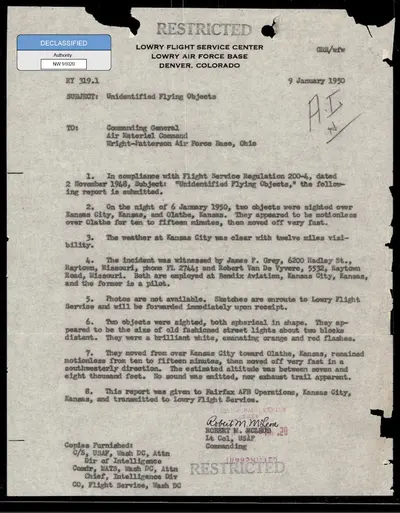
On July 6, 1949, a civilian observer near Spokane, Washington, reported seeing unidentified flying objects. According to official records, the sighting occurred at approximately 2020 Pacific Time. The objects were observed at an estimated altitude of four thousand feet and at a distance of approximately forty miles from the observer’s position. The documentation does not provide any accompanying visual evidence, as no photographs or sketches of the objects were available at the time of the report. While the incident was documented by U.S. government investigators, the released paperwork does not specify the total number of witnesses present during the event.
This specific case was part of a larger body of intelligence gathered by the United States government. The details of the encounter remained restricted for decades, eventually being released to the public on May 8, 2026, as part of the Presidential Unsealing and Reporting System for UAP Encounters (PURSUE). The presence of this sighting in U.S. Department of Defense documents indicates that the report was processed through official military or intelligence channels, reflecting the era’s practice of tracking unidentified aerial activity via government-sanctioned investigative frameworks.
Classification and Analysis
The Spokane sighting is classified as a visual sighting reported by ground or air observers. Within the framework of modern analysis, such cases are evaluated by the All-domain Anomaly Resolution Office (AARO). Under the protocols of the PURSUE program, all released records are designated as unresolved by default. This designation signifies that the federal government has not reached a definitive conclusion regarding the nature of the objects, leaving both anomalous and conventional explanations on the table.
When investigating sightings from the late 1940s, researchers often consider several conventional candidates. During this period, the United States was actively deploying the Project Mogul series of high-altitude balloons, which were designed to detect Soviet nuclear tests and could easily be mistaken for unidentified craft. Other potential explanations include experimental aircraft testing, atmospheric optical phenomena such as lenticular clouds or sundogs, and the visibility of bright astronomical objects like Venus or the Moon near the horizon. Despite these possibilities, the specific characteristics of the Spokane objects remain unverified due to the lack of physical or photographic evidence.