Fort Smith, Arkansas UFO Sighting (April 16, 1949) — FBI Files
On April 16, 19ASS, Wade Harrison observed a brilliant, high-altitude object moving southeast over Fort Smith, Arkansas, as recorded in FBI files.
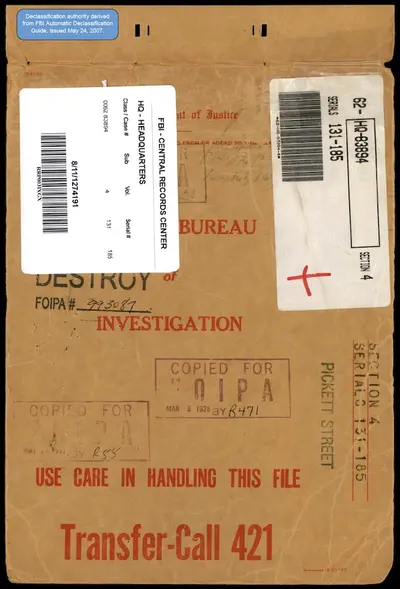
Background
On April 16, 1949, in Fort Smith, Arkansas, U.S. government investigators recorded an unidentified-object incident later released to the public on May 8, 2026, as part of the Presidential Unsealing and Reporting System for UAP Encounters (PURSUE). This sighting occurred during a period of heightened public and governmental scrutiny regarding aerial phenomena. The incident is part of the first wave of “flying saucer” reports that swept the United States following the Kenneth Arnold sighting of June 1947 and the Roswell incident of July 1947. During this era, the term “flying saucer” had entered the common vernacular, and the sudden appearance of unidentified aerial phenomena (UAP) prompted a variety of responses from both civilian observers and federal agencies.
The geographic location of Fort Smith, situated in the western part of Arkansas near the Oklahoma border, placed it within a region of significant logistical and military importance during the early Cold War. As the United States transitioned into a period of intense aerospace development and heightened vigilance against Soviet aerial capabilities, the monitoring of the national airspace became a priority for domestic security. The case was filed with the Federal Bureau of Investigation, whose Knoxville, Albuquerque, Los Angeles, and other field offices routed UFO reports to headquarters under the Bureau’s standing protocols for the protection of vital installations. This bureaucratic process ensured that any reported anomaly that could potentially threaten or involve sensitive government infrastructure was centralized for review by federal authorities.
What the document records
The primary documentation regarding the event details the observations of Wade Harrison. On April 16, 1949, Harrison was stopped at a traffic light in Fort Smith when he observed a brilliant object moving in a southeastern direction. Based on his visual assessment, Harrison estimated the object was positioned at an altitude of approximately 2 miles. He tracked the object as it traveled a distance of roughly 3 to 4 miles before it disappeared from view behind a line of trees. In an attempt to share the experience, Harrison tried to point the object out to other drivers present at the intersection, but he lost sight of the phenomenon as the flow of traffic resumed.
The released document does not specify the total number of witnesses present at the intersection during the sighting. While Harrison attempted to alert other motorists, the official record remains silent on whether any other individuals successfully verified the presence of the object or provided corroborating accounts to investigators.
Type of case
The case is classified as a visual sighting reported by ground or air observers. This category encompasses a wide range of phenomena, from low-altitude sightings of unidentified lights to high-altitude observations of moving objects that defy immediate identification.
Status
All records released under the PURSUE program are designated unresolved by the All-domain Anomaly Resolution Office (AARO) by default. The federal government has not concluded that the events were anomalous, has not concluded that they were conventional, and has not ruled out either possibility. The lack of a definitive conclusion reflects the inherent difficulty in verifying single-witness sightings without secondary sensor data, such as radar or photographic evidence.
During the late 1940s, several conventional candidates were frequently considered when evaluating such reports. These included experimental aircraft developed during the post-war aviation boom, weather balloons—specifically those associated with the Project Mogul series designed to detect Soviet nuclear tests—and various atmospheric optical phenomena such as sundogs or lenticular clouds. Additionally, astronomical objects including Venus, the Moon, or meteors passing near the horizon were often identified as the source of brilliant, moving lights. The Fort Smith incident remains part of this broader historical dataset of unverified aerial phenomena.