Mexico City UFO Sighting, 1948 — FBI Files
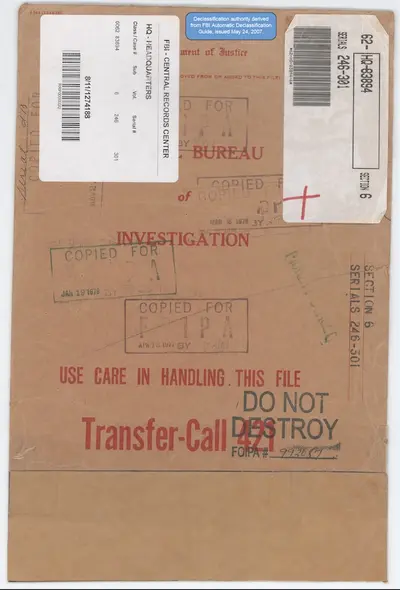
An FBI report from 1948 details an unverified claim regarding wreckage and small figures found near Mexico City during the post-war saucer era.
Historical Context
The year 1948 represented a period of heightened global anxiety and intense aerial surveillance. Following the conclusion of World War II, the rapid advancement of aeronautical technology and the onset of the Cold War created a climate where unidentified aerial phenomena were frequently scrutinized by national security apparatuses. During this era, the phenomenon of “flying saucers” had become a staple of public discourse, largely triggered by the Kenneth Arnold sighting in June 1947 and the subsequent Roswell incident in July 1947. These events catalyzed a wave of sightings across North America, as the public and various government agencies attempted to categorize objects that appeared to defy known aerodynamic principles.
In the United States, the Federal Bureau of Investigation maintained a systematic approach to monitoring such reports. Under established protocols designed for the protection of vital installations, various field offices—including those in Knoxville, Albuquerque, and Los Angeles—were tasked with routing UFO reports to the Bureau’s headquarters. This bureaucratic structure ensured that any potential threat to national infrastructure or sensitive military sites was centralized for evaluation. The Mexico City incident, though occurring outside U.S. borders, fell under this investigative umbrella due to the interconnected nature of North American airspace security and the interest of U.S. government investigators in regional anomalies.
The 1948 Incident
The specific details of the 1948 Mexico City sighting were not made available to the public for decades. The documentation only surfaced on May 8, 2026, following its release through the Presidential Unsealing and Reporting System for UAP Encounters (PURSUE). The released file contains a brief but notable record regarding a report of a disc- or saucer-shaped object. Within this report, a specific and more sensational claim was noted: the presence of “little men” allegedly discovered within the wreckage of a flying saucer near the vicinity of Mexico City.
Despite the extraordinary nature of the claim involving biological entities, the investigation yielded no physical proof. The FBI records indicate that this particular narrative was quickly debunked. The investigation determined that the story of the small figures was the unsubstantiated account of a single traveler, lacking any corroborating evidence or secondary witness testimony to support the existence of wreckage or extraterrestrial occupants. While the number of witnesses to the initial object sighting is not specified in the released document, the primary focus of the Bureau’s internal note was the dismissal of the more sensationalist elements of the report.
Classification and Analysis
The status of this case remains officially unresolved. Under the standard operating procedures of the All-domain Anomaly Resolution Office (AARO), all records released through the PURSIVE program are designated as unresolved by default. This designation reflects a lack of definitive proof regarding the nature of the object. The federal government has maintained a neutral stance, neither concluding that the event was anomalous nor confirming that it was the result of conventional phenomena.
In the context of late 1940s aerial sightings, several conventional explanations are frequently considered by researchers. During this period, the deployment of the Project Mogul series of high-altitude balloons was active, which often resulted in unidentified objects appearing on radar or to visual observers. Other frequent candidates for such sightings include experimental aircraft, atmospheric optical phenomena like lenticular clouds or sundogs, and the visual presence of bright astronomical bodies such as Venus, the Moon, or meteors passing near the horizon. The Mexico City report remains a significant artifact of the era’s investigative history, representing the intersection of public folklore and formal government surveillance.