Kapustin Yar UFO Incident
On a clear summer day above a top-secret Soviet rocket range, fighter pilots reportedly engaged a silver crescent-shaped craft that disabled their guns and outclimbed every MiG sent against it.
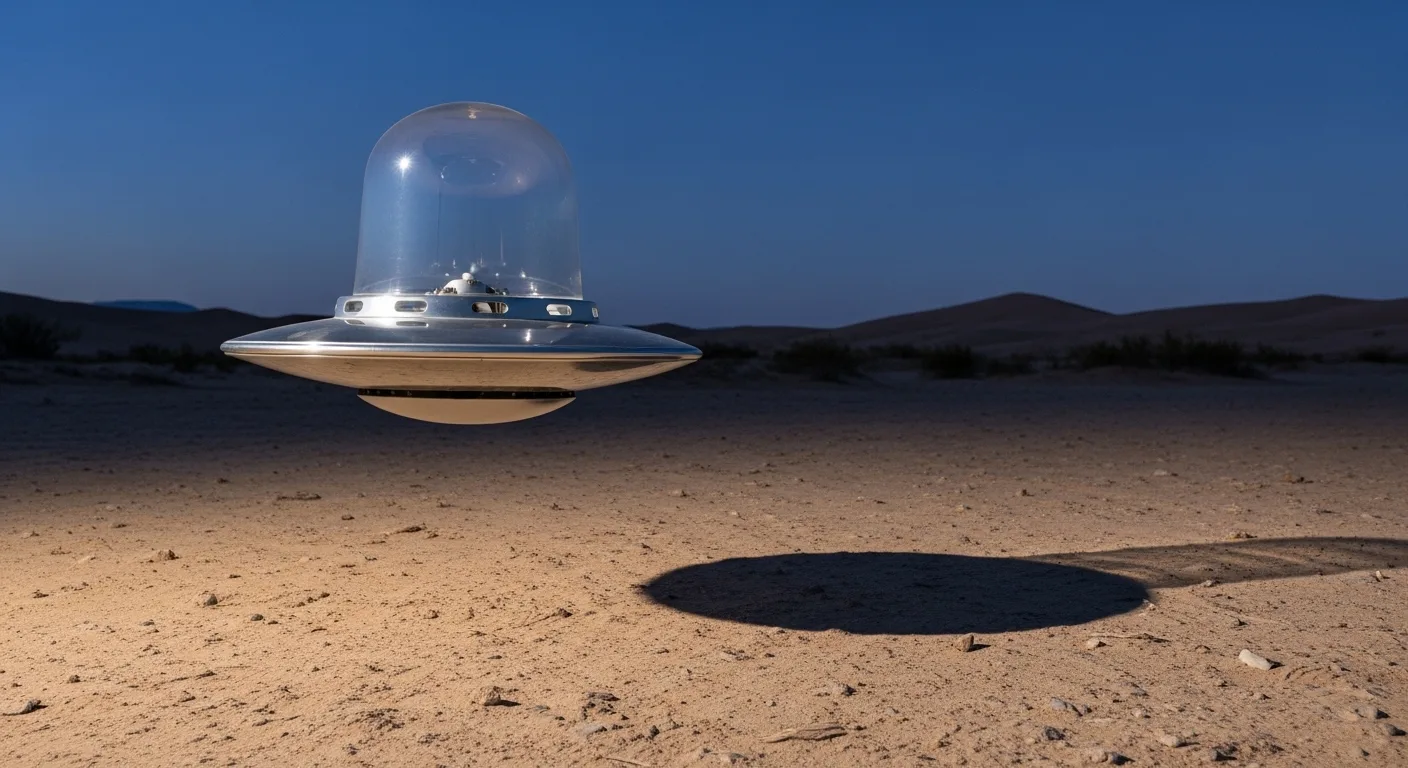
In the summer of 1948, a craft that no Soviet engineer recognized is said to have crossed the airspace above Kapustin Yar, a guarded patch of steppe in the lower Volga that did not appear on any civilian map. The base, established two years earlier by direct order of Joseph Stalin, was the cradle of the Soviet rocket program. Captured German V-2 components were being reverse-engineered there under the supervision of Sergei Korolev, and the perimeter was patrolled by some of the best-trained anti-aircraft crews in the Red Army. Whatever flew over the test range that afternoon, according to accounts that began surfacing only in the late 1980s, was photographed, fired upon, and ultimately allowed to escape. If true, the Kapustin Yar incident would predate the more famous American Roswell crash by less than a year and would constitute the first documented engagement between Soviet jet fighters and an unidentified aerial craft.
The Range
Kapustin Yar lay roughly a hundred kilometers east of Stalingrad, in a stretch of semi-desert that the planners of the secret installation had chosen for its emptiness and its distance from prying eyes. By 1948, the site was the most sensitive piece of real estate in the Soviet Union outside of Moscow itself. Captured V-2s were being launched from its pads, and the first generation of indigenously produced R-1 missiles was nearing flight tests. Air defense around the range was layered and unforgiving; any aircraft entering the prohibited zone without clearance was to be intercepted and, if it failed to identify itself, destroyed.
The episode that became known in later Western ufology as the “Russian Roswell” reportedly began in the early afternoon, when ground radar at the range registered a contact moving at high altitude on a southerly course. According to the account assembled decades later by retired Soviet intelligence officers and by the American researcher George Knapp, the contact did not respond to challenge. Two flights of MiG-15 fighters were scrambled from a nearby airfield. Some versions of the story place the incident slightly later, in 1949, when the MiG-15 had entered service in greater numbers, and some authors describe the intercepting aircraft as Yak fighters instead. The discrepancy reflects the secondhand nature of the surviving testimony.
The Encounter
The pilots are said to have closed on a metallic, crescent- or wing-shaped object that hung at high altitude with no visible propulsion. Several reported a faint shimmer around its hull and described its skin as resembling polished aluminum. When the lead pilot armed his cannon, his guns reportedly failed to fire. A second pilot did manage to release a burst, and at that moment the object accelerated vertically at a rate the MiGs could not match, climbing out of their reach in seconds.
What grounds these stories more concretely is the persistent claim that the object was photographed, both from the air and from the ground. The chief of air defense at the range is alleged to have ordered every visual record of the encounter sealed in a single classified file, which then traveled up the chain of command to Moscow. The dossier became part of the early body of evidence that the Soviet General Staff used to justify a serious, if quiet, internal study of unidentified aerial phenomena, an effort that would mature decades later into the SETKA programs of the late 1970s.
A Crash, Or Only A Sighting?
A more sensational version of the Kapustin Yar story circulated in the 1990s, principally through Russian writer Felix Zigel and American documentary filmmaker George Knapp, who interviewed former Soviet officers for a 1998 television special. In this telling, the craft did not simply escape; it was struck by anti-aircraft fire and crashed in the steppe near the range, where its wreckage and at least one nonhuman occupant were recovered for study. No primary documentation has ever supported this claim, and the original engagement report, if it exists, has not been declassified. The crash narrative should be treated as folklore that grew up around an underlying event whose exact contours remain unknown. What can be said with greater confidence is that the date and location are consistent with the documented sensitivity of the range, that the witnesses named in later accounts were real Soviet officers attached to air defense units in the area, and that the Soviet military did, from this period onward, take anomalous aerial intrusions over strategic installations with quiet seriousness.
Investigation And Skepticism
Soviet handling of the case followed the pattern that would characterize the entire Cold War. Internally, the file was treated as classified intelligence material; externally, no acknowledgment was permitted. Civilian Soviet ufology did not emerge as a recognizable movement until the late 1960s, and by then any contemporaneous investigators of the Kapustin Yar incident were either dead, retired, or under continuing security obligations. The first Western account did not appear until the 1991 publication of journalist Antonio Huneeus’s research in the magazine UFO Universe, by which time the original witnesses were elderly and the documentary trail was cold.
Skeptics have noted that a crescent-shaped craft is not the typical 1948 UFO morphology, that the technical claim of guns “jamming” in the presence of an unknown object is a recurring trope rather than a verifiable detail, and that a number of specifics in the various retellings appear to have been imported from later Western cases. A conventional explanation has been proposed: the object may have been a balloon-borne reconnaissance platform launched by a Western intelligence service, or a high-altitude aircraft of a type unfamiliar to the Soviet pilots. Neither explanation accounts cleanly for the alleged vertical climb performance. The case sits in the same evidential grey zone as the Tunguska explosion and other early Soviet anomalies, where the underlying record is fragmentary and the surrounding mythology has grown in proportion to that scarcity.
Legacy
Kapustin Yar continued to operate as a missile test range throughout the Cold War and remains an active Russian military facility today. The 1948 incident, real or embellished, became one of the founding episodes of Soviet ufology and is routinely cited in Russian-language overviews of the subject. It established a template that recurs across the Soviet UFO record: a sensitive military installation, a high-performance unidentified craft, a brief and inconclusive engagement, and a lasting silence broken only decades later by retired officers willing to speak. Whether the events of June 1948 represent the first hostile contact between human aircraft and a non-human craft, or simply a misidentified test asset embellished by years of retelling, the case continues to draw researchers seeking to reconstruct the early history of the modern UAP phenomenon.
Sources
- Knapp, George, “The Secret KGB UFO Files,” 1998 television documentary.
- Huneeus, Antonio, “Soviet UFO Files,” UFO Universe, 1991.
- Zigel, Felix, Unidentified Flying Objects: Observations and Investigations in the USSR, samizdat manuscript, 1968.
- Good, Timothy, Above Top Secret, William Morrow, 1988.