Circling Andrews AF Base UAP Encounter, 1948 — USAAF Box 7 #206
An unidentified flying object was recorded by the U.S. Army Air Forces near Andrews Air Force Base in 1948, as revealed by the PURSUE declassification.
Historical Context
The year 1948 represented a period of significant transition and heightened anxiety regarding unidentified aerial phenomena in the United States. Following the high-profile Kenneth Arnold sighting in June 194
7 and the subsequent reports surrounding the Roswell incident in July 1947, the American public and military institutions were navigating a new era of “flying saucer” phenomena. This period, often referred to as the first wave of modern UAP sightings, coincided with the early stages of the Cold War, a time when the rapid advancement of aerospace technology made the distinction between conventional aircraft and anomalous objects increasingly difficult to discern. During this era, the U.S. Army Air Forces maintained various internal tracking mechanisms to document aerial anomalies that could potentially impact national security or air traffic safety.
The geographic area surrounding Camp Springs, Maryland, particularly the vicinity of Andrews Air Force Base, has long been a critical node for military aviation and communications. As a primary installation for the United States Air Force, the base’s airspace was subject to rigorous monitoring. The presence of significant telecommunications infrastructure in the Washington, D.C. metropolitan area further increased the density of observers capable of noting unusual aerial activity.
The 1948 Incident
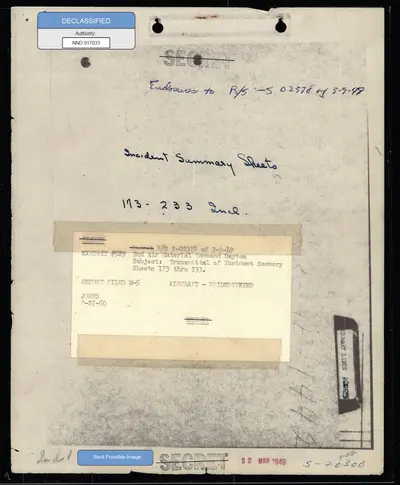
In 1948, near Andrews Air Force Base in Camp Springs, Maryland, the U.S. Army Air Forces recorded an unidentified-object incident that became Incident #206 in the “Check-List - Unidentified Flying Objects” series. This specific record is archived in Box 7 of file 38_143685. The details of this encounter remained restricted from public view for decades until the records were released by the Department of War on May 8, 2026, as part of the Presidential Unsealing and Reporting System for UAP Encounters (PURSUE).
The official summary of the incident records a sighting reported by 2d Lt. Kenwood W. Jackson, identified as part of the 1326 28th Gt, S.E., based in Washington, D.C. At the time of the report, Lieutenant Jackson’s occupation or status was documented as a 2d Lt AFR, serving as a telephone cableman. The documentation classifies the event as a visual sighting reported by ground or air observers, noting the location of the sighting as the area circling Andrews Air Force Base.
Analysis and Classification
The classification of this event as a UFO (Unidentified Flying Object) reflects the standard terminology used by military observers during the late 1940s. Because the incident was recorded within the official “Check-List - Unidentified Flying Objects” series, it represents a formal attempt by the Army Air Forces to catalog and track objects that could not be immediately identified through standard radar or visual identification protocols.
The status of this case remains officially unresolved. Under the protocols of the All-domain Anomaly Resolution Office, all records released through the PURSUE program are designated as unresolved. The federal government has maintained a position of neutrality regarding the nature of the object in Incident #206, neither concluding that the sighting was anomalous nor confirming that it was caused by conventional means.
When evaluating such 1947-era incidents, researchers often consider several conventional candidates that could explain the presence of unidentified objects in the sky. These include the Project Mogul balloon flights, which were active over the American Southwest during this period to detect Soviet nuclear tests, as well as the testing of experimental jet and rocket aircraft. Other possibilities include atmospheric optical effects or astronomical objects that may have been misidentified due to unusual viewing angles. Despite these possibilities, the official record for the Andrews Air Force Base encounter remains an open inquiry within the archives of the Department of War.