Antarctica UFO Sighting (December 23, 1953) — FBI Files
Declassified FBI records document a 1953 report of multiple flying saucers maneuvering at high speeds over Antarctica.
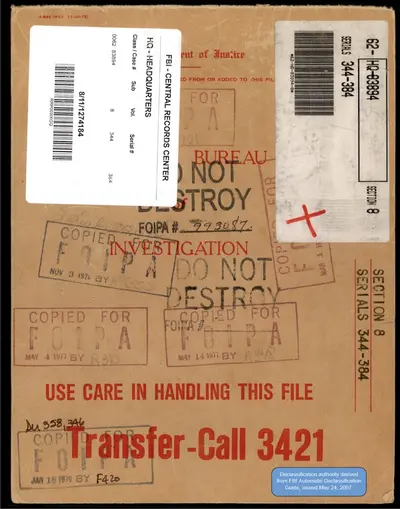
Background
On December 23, 1953, in Antarctica, U.S. government investigators recorded an unidentified-object incident later released to the public on May 8, 2026, as part of the Presidential Unsealing and Reporting System for UAP Encounters (PURSUE). This incident occurred during a period of heightened global anxiety regarding aerial unidentified phenomena. The report is categorized as part of the first wave of “flying saucer” reports that swept the United States following the Kenneth Arnold sighting of June 1947 and the Roswell incident of July 1947. During this era, the sudden appearance of unidentified aerial phenomena prompted significant scrutiny from both the public and various government agencies.
The case was filed with the Federal Bureau of Investigation, which maintained a systematic approach to monitoring reports that could potentially impact national security. Under the Bureau’s standing protocols for the protection of vital installations, various field offices, including those in Knoxville, Albuquerque, and Los Angeles, were responsible for routing UFO reports to headquarters. This administrative structure ensured that any aerial activity that could be interpreted as a threat to sensitive or strategic locations was centralized for federal review. The Antarctic theater, while geographically remote, remained a point of interest for intelligence agencies due to the strategic importance of polar surveillance and the potential for undetected incursions into sovereign or international airspace.
What the document records
The documentation regarding the December 1953 event is closely linked to claims made by maritime personnel operating in the southern latitudes. In 1948, Captain Orrego of the Chilean Navy claimed to have photographed UFOs in formation near Antarctica, describing them as flying saucers turning at tremendous speeds. These descriptions align closely with the technical characteristics reported in the 1953 FBI file. However, the historical record of this specific claim is complicated by subsequent developments. Captain Orrego later stated that he had not seen any UFOs in that region and that the photographs did not exist, which led to significant questions regarding potential international censorship or the suppression of maritime intelligence.
While the specific number of witnesses to the December 23, 1953, event is not specified in the released document, the nature of the report suggests a direct observation of multiple objects. The case is notable because it includes the mention of photographic or video evidence of the unidentified object, a detail that distinguishes it from purely anecdotal sightings. The presence of such evidence, even if its current availability is unverified, places the case within a specific subset of investigations focused on physical or visual proof of anomalous aerial activity.
Verbatim from the file
The official file contains a direct account of the observation, stating: “During the bright antarctic night we saw flying saucers, one above the other, turning at tremendous speeds. We have photographs to prove what we saw.”
Type of case and status
The case includes photographic or video evidence of the unidentified object. All records released under the PURSUE program are designated unresolved by the All-domain Anomaly Resolution Office (AARO) by default. The federal government has not concluded that the events were anomalous, has not concluded that they were conventional, and has not ruled out either possibility.
During the mid-twentieth century, the scientific and intelligence communities often evaluated such sightings against a backdrop of rapid technological advancement. Conventional candidates for sightings of this period include experimental aircraft, weather balloons—specifically the Project Mogul series active in the late 1940s—and atmospheric optical phenomena such as sundogs or lenticular clouds. Additionally, astronomical objects including Venus, the Moon, and meteors near the horizon were frequently considered as potential sources for unidentified lights. The Antarctica UFO Sighting remains a significant entry in the archive due to its placement within the early era of modern UAP documentation and its connection to the broader history of polar aerial observations.