Williams Field UFO Sighting (July 14, 1947) — FBI Files
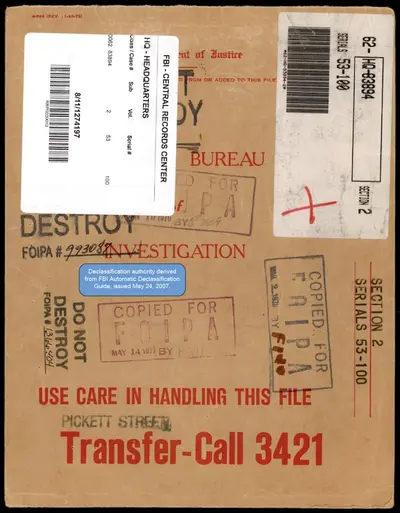
Federal investigators documented an encounter involving multiple white, circular objects observed by a pilot near Lake Meade in July 194
Historical Context
The summer of 1947 represents a pivotal moment in the history of unidentified aerial phenomena, marking the beginning of a period of intense public and governmental scrutiny regarding objects in the sky. This era was characterized by a sudden influx of reports following the June 1947 Kenneth Arnold sighting, which popularized the term “flying saucer,” and the subsequent July 1947 Roswell incident. During this period, the United States was navigating the early complexities of the Cold War, a geopolitical climate that heightened sensitivity toward any unidentified presence in domestic airspace. The presence of advanced, unidentifiable technology was viewed through a lens of national security, leading to the systematic documentation of such sightings by various federal agencies.
The geographic area surrounding Chandler, Arizona, and the broader Southwest United States, has long been a focal point for such observations due to its vast, sparsely populated desert landscapes and the presence of numerous high-security military installations. Williams Field, a significant military installation during this era, served as a critical hub for aviation operations. Because of the strategic importance of such bases, the Federal Bureau of Investigation (FBI) maintained rigorous protocols for monitoring and reporting any unusual activity that could potentially threaten vital installations. Under these standing protocols, various field offices, including those in Knoxville, Albuquerque, and Los Angeles, were tasked with routing UFO reports directly to FBI headquarters to ensure centralized oversight of potential security breaches.
The Incident at Williams Field
On July 14, 1947, U.S. government investigators recorded an unidentified-object incident at Williams Field, Chandler, Arizona. The details of this specific encounter were not made public for decades, eventually being released to the public on May 8, 2026, as part of the Presidential Unsealing and Reporting System for UAP Encounters (PURSUE). This release provided a rare glimpse into the internal bureaucratic handling of aerial anomalies during the mid-century period.
The primary account of the event originates from the observations of Lieutenant Armstrong. While piloting a P-51 Mustang from Arizona to Oregon on June 28, 1947, the lieutenant observed five or six white, circular objects in the vicinity of Lake Meade, Nevada. These objects were estimated to be approximately 36 inches in diameter and were seen flying in a smooth, close formation at an altitude of roughly 6,000 feet. Based on the visual evidence, Lieutenant Armstrong concluded that the objects were not birds, jets, or any form of conventional aircraft known at the time, citing their exceptional speed and maneuverability as the primary reasons for this assessment. While the released documentation details the Lieutenant’s observations, the total number of witnesses to the event is not specified within the official record.
Classification and Investigation
This case is classified as a pilot or aircrew sighting, a type of encounter where the phenomenon is observed directly from the cockpit during active flight. Such sightings are considered significant in the study of aerial anomalies because the observer is often a trained professional with a high degree of situational awareness and familiarity with the behavior of conventional aircraft and atmospheric conditions.
The official status of the Williams Field sighting remains unresolved. All records released under the PURSUE program are designated as unresolved by the All-domain Anomaly Resolution Office (AARO) by default. The federal government has maintained a neutral stance, neither concluding that the events were anomalous nor confirming that they were caused by conventional means. This lack of a definitive conclusion reflects the inherent difficulty in verifying mid-century reports without contemporary sensor data.
In the study of 1940s-era sightings, researchers often consider several conventional candidates. These include the presence of experimental aircraft being tested in secret, the use of weather balloons—specifically the Project Mogul series, which utilized high-altitude balloons to detect Soviet nuclear tests—and various atmospheric optical phenomena such as sundogs or lenticular clouds. Additionally, astronomical objects such as the Moon, Venus, or meteors near the horizon are frequently evaluated as potential sources for such reports. The Williams Field case remains a documented part of the broader pattern of aerial observations that defined the post-war era.