Grand Canyon, Arizona UFO Sighting (July 9, 1947) — FBI Files
FBI records document an unidentified object sighting over the Grand Canyon on July 9, 1947, reported by a US Navy Lieutenant.
Historical Context
The summer of 1947 represents a pivotal moment in the history of modern ufology, characterized by a sudden and intense surge in reports of unidentified aerial phenomena across North America. This period, often referred to by historians as the first wave of “flying saucer” sightings, began in earnest following the Kenneth Arnold sighting in June 1947 and was further amplified by the events surrounding the Roswell incident in July 1947. During this era, the public and government agencies were grappling with the implications of newly emerging technologies, including long-range radar and high-altitude reconnaissance. The geopolitical climate of the early Cold War also contributed to a heightened state of vigilance regarding any unidentified objects traversing American airspace.
The Grand Canyon, a massive geological feature in northern Arizona, has long been a site of significant interest due to its vast, unpopulated expanses and its strategic importance within the American Southwest. In the mid-twentieth century, the region was a frequent corridor for military aviation and atmospheric research. The presence of unidentified objects in such a prominent landmark often triggered immediate concern regarding national security and the integrity of domestic airspace.
The Incident
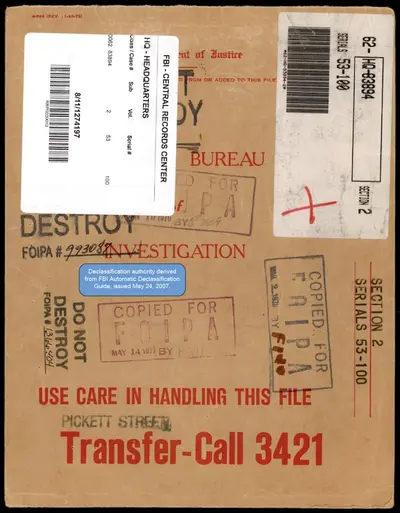
On July 9, 1947, at 09:10 MST, unidentified objects were reported over the Grand Canyon, Arizona. The observation was made by Lt. W. G. feGinty, USN, who was stationed at Brooks Field, Texas, at the time of the sighting. While the specific number of witnesses involved in this particular observation is not specified in the released documentation, the report was formally recorded by U.S. government investigators.
The documentation regarding this event remained classified for decades, only becoming available to the public on May 8, 2026, through the Presidential Unsealing and Reporting System for UAP Encounters (PURSUE). This release was part of a broader effort to provide transparency regarding historical encounters with unidentified phenomena.
Investigative Procedures
At the time of the sighting, the Federal Bureau of Investigation (FBI) maintained a structured protocol for handling reports of unidentified objects. Under the Bureau’s standing protocols for the protection of vital installations, various field offices—including those in Knoxville, Albuquerque, and Los Angeles—were responsible for receiving and processing such reports. When an incident was deemed to have potential implications for national security or the safety of sensitive sites, these offices routed the information directly to FBI headquarters. This systematic approach ensured that any perceived threat to the nation’s infrastructure or military assets was centralized for analysis by federal authorities.
Analysis and Classification
The case is classified as a visual sighting reported by ground or air observers. Within the framework of modern analysis, the All-domain Anomaly Resolution Office (AARO) designates all records released under the PURSUE program as unresolved by default. The federal government has maintained a neutral stance regarding the nature of the objects seen over the Grand Canyon, neither concluding that the events were anomalous nor confirming that they were of a conventional origin.
When evaluating sightings from the late 1940s, researchers often consider several conventional candidates. These include the presence of experimental aircraft undergoing testing, weather balloons—specifically those associated with the Project Mogul series designed to detect Soviet nuclear tests—and various atmospheric optical phenomena such as sundogs or lenticular clouds. Additionally, astronomical objects like the Moon, Venus, or meteors appearing near the horizon are frequently considered as potential explanations for unidentified light phenomena observed during this period.