Weksville UFO Sighting (July 10, 1947) — FBI Files
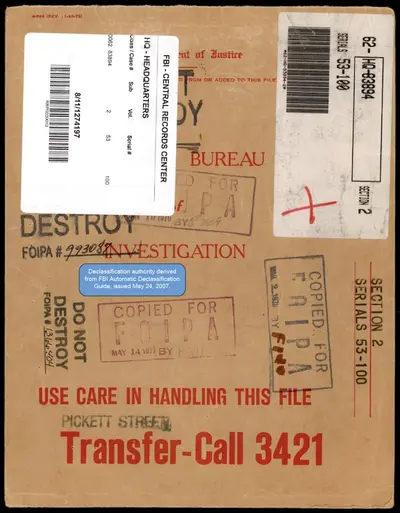
FBI records detail a 1947 unidentified object report in Weksville, New York, involving a coded message derived from a newspaper clipping.
Historical Context
The summer of 1947 represents a pivotal period in the history of unidentified aerial phenomena in the United States. Following the Kenneth Arnold sighting in June 1947, which popularized the term “flying saucer,” the American public and government agencies experienced a significant surge in reports of anomalous objects. This period of intense scrutiny coincided with the early stages of the Cold War, a time when the detection of unauthorized aerial incursions was a matter of national security. The Weksville incident occurred amidst this broader wave of sightings, which included the highly publicized events in Roswell, New Mexico, later that same month.
During this era, the classification of such phenomena was often handled through existing intelligence and law enforcement frameworks rather than dedicated astronomical or aerospace agencies. The Federal Bureau of Investigation maintained a systematic approach to documenting unusual reports, particularly those that might involve threats to the security of vital installations or sensitive government infrastructure. Field offices in cities such as Knoxville, Albuquerque, and Los Angeles were trained to identify and route UFO reports to headquarters according to established protocols designed to protect national interests.
The Weksville Incident
On July 10, 1947, in Weksville, Long Island, New York, U.S. government investigators recorded an unidentified-object incident. The details of this specific case remained largely shielded from public view until May 8, 2026, when the documentation was released as part of the Presidential Unsealing and Reporting System for UAP Encounters (PURSUE). The released files indicate that the primary evidence brought to the attention of the Bureau was not a direct eyewitness account from the field, but rather a communication received by the agency.
The documentation records the receipt of a letter containing information and a coded message. This message was derived from a newspaper clipping, the origins of which were unknown to the investigators at the time of receipt. To determine the validity of the communication, the FBI Laboratory was tasked with analyzing the cipher. The laboratory confirmed that the decoding of the message was substantially correct. Consequently, the New York Office was instructed to conduct an investigation into the source of the newspaper clipping and to identify the individual responsible for sending the correspondence to the Bureau. While the document details the investigative steps taken regarding the message, the total number of witnesses to the original unidentified object remains unspecified in the released records.
Classification and Analysis
The Weksville case is classified as a visual sighting reported by ground or air observers. In the context of mid-century aerial phenomena, such sightings were frequently analyzed through the lens of contemporary technological and atmospheric possibilities. Investigators of the era often considered whether such objects could be explained by the burgeoning field of aerospace engineering or natural occurrences.
All records released under the PURSUE program are designated as unresolved by the All-domain Anomaly Resolution Office (AARO) by default. The federal government has maintained a neutral stance regarding the Weksville event, neither concluding that the incident was anomalous nor confirming that it was the result of conventional means. The possibility of either remains open within the official record.
When evaluating sightings from the late 1940s, researchers often consider several conventional candidates. These include the presence of experimental aircraft testing, the deployment of weather balloons—specifically those associated with the Project Mogul series—and various atmospheric optical phenomena such as lenticular clouds or sundogs. Additionally, astronomical objects such as the Moon, Venus, or meteors passing near the horizon are frequently cited as potential explanations for reported unidentified objects during this period of high-frequency sightings.