Spokane, Washington UFO Sighting (August 8, 1947) — FBI Files
An FBI report from August 8, 1947, documents a "flying saucer" sighting in Spokane, Washington, reported by J. Madden and forwarded to Military Intelligence.
Background
The Spokane, Washington, UFO sighting of August 8, 194 and 1947 represents a specific moment in the mid-century phenomenon of unidentified aerial phenomena. This incident occurred during a period of intense public and governmental preoccupation with aerial anomalies, following a series of high-profile events that had fundamentally altered the American perception of the upper atmosphere. The summer of 1947 is widely recognized by historians of the phenomenon as the beginning of the “flying saucer” era, a period characterized by a sudden surge in reports of disc-shaped objects. This surge was precipitated by the Kenneth Arnold sighting in June 1947 and the subsequent reports surrounding the Roswell incident in July 1947.
During this era, the United States was navigating the early complexities of the Cold War, which necessitated heightened vigilance regarding any unidentified objects entering sovereign airspace. The geography of the Pacific Northwest, with its significant military installations and strategic importance, made the region a focal point for aerial monitoring. The Spokane incident was documented within the administrative framework of the Federal Bureau of Investigation. At the time, the Bureau maintained standing protocols for the protection of vital installations, which required field offices to monitor and report any unusual activity that could potentially threaten national security or involve unauthorized incursions into restricted airspace. Consequently, the FBI’s Knoxville, Albuquerque, and Los Angeles offices frequently routed UFO-related reports to headquarters for centralized processing.
The Incident and Documentation
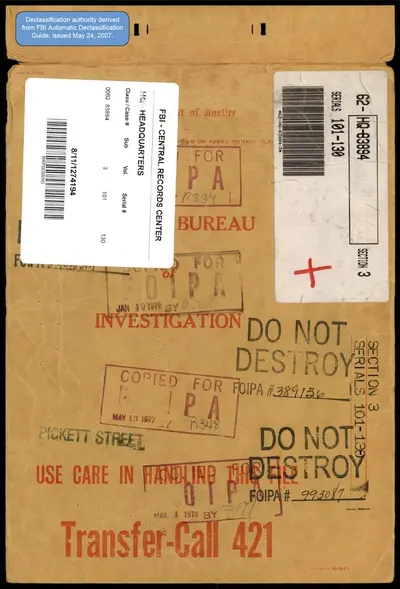
The primary documentation for this event was released to the public on May 8, 2026, as part of the Presidential Unsealing and Reporting System for UAP Encounters (PURSUE). The released records detail a specific observation made on August 8, 1947, by an individual identified as Re J. Madden. According to the written report submitted by Madden, he observed what he described as a “flying saucer” moving through the skies over Spokane.
The administrative trajectory of the report indicates that after the Seattle FBI field office received the information, the documentation was forwarded to Military Intelligence at McChord Field. This movement of information between civilian law enforcement and military intelligence highlights the inter-agency nature of aerial anomaly investigations during the late 1940s. Despite the formal reporting and the subsequent transmission to military authorities, the released documents indicate that no further investigative action was taken by the Seattle FBI field office regarding this specific sighting. The released documentation does not specify the total number of witnesses present during the observation, focusing instead on the primary reporter and the formal submission of the written account.
Classification and Analysis
The witnesses involved in the Spokane sighting described the object as being disc- or saucer-shaped, a description that aligned with the prevailing nomenclature of the time. This morphological description was consistent with the “flying saucer” archetype that had become common in news media and public discourse following the Arnold sighting.
The status of the Spokane case remains officially unresolved. Under the protocols of the All-domain Anomaly Resolution Office (AARO), all records released through the PURSUE program are designated as unresolved by default. This designation reflects a lack of definitive evidence to categorize the event. The federal government has maintained a neutral stance, neither concluding that the event was the result of anomalous phenomena nor confirming it was the result of conventional objects.
In the context of 1947, many such sightings were later attributed to conventional candidates. These include the presence of experimental aircraft testing, the deployment of high-altitude weather balloons—specifically those associated with the Project Mogul series designed to detect Soviet nuclear tests—and various atmospheric optical phenomena such as lenticular clouds or sundogs. Additionally, astronomical objects like Venus, the Moon, or meteors appearing near the horizon were frequently cited as potential explanations for unidentified lights in the night sky. The Spokane report remains a documented piece of this broader historical period of aerial uncertainty.