Laurel, Maryland UFO Sighting (July 11, 1947) — FBI Files (D33P68)
An investigation by the Laurel Police Department into a reported flying disc revealed a hoax constructed from a Gulf Oil sign and various household items.
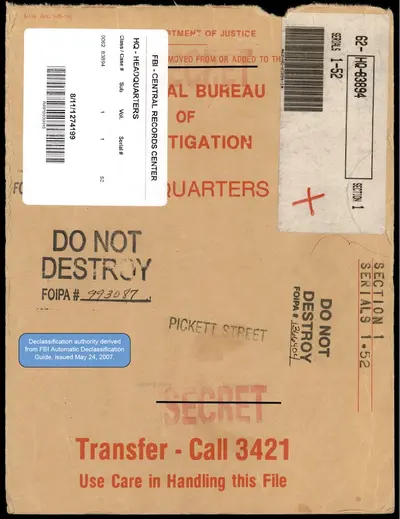
Background
On July 11, 1947, in Laurel, Maryland, U.S. government investigators recorded an unidentified-object incident later released to the public on May 8, 2026, as part of the Presidential Unsealing and Reporting System for UAP Encounters (PURSUE). This specific event occurred during a period of intense public and governmental preoccupation with aerial phenomena. The incident is one of the first wave of “flying saucer” reports that swept the United States following the Kenneth Arnold sighting of June 1947 and the Roswell incident of July 1947. During this era, the sudden influx of sightings led to widespread speculation regarding extraterrestrial visitors or advanced secret technologies.
The geographic location of Laurel, Maryland, placed the event within the sensitive corridor of the Mid-Atlantic region, an area heavily populated by significant military and governmental infrastructure. Because of the proximity to high-value installations, the Federal Bureau of Investigation maintained a systematic approach to monitoring such reports. The case was filed with the FBI, whose Knoxville, Albuquerque, Los me, and other field offices routed UFO reports to headquarters under the Bureau’s standing protocols for the protection of vital installations. This bureaucratic process ensured that any potential threat to national security or sensitive airspace was documented and centralized for analysis by federal authorities.
What the document records
The documentation regarding the July 11 event focuses on the physical investigation conducted by local law enforcement. On July 11th, Sergeant Lonis of the Laurel, Maryland Police Department examined a reported ‘flying disc’. Upon closer inspection, the investigator determined that the object was not an anomalous aerial phenomenon but rather a hoax. The construction of the device utilized a Gulf Oil sign and a garbage can lid, which had been coated with aluminum paint to simulate a metallic, saucer-like appearance. The internal mechanics of the device included a battery, a bulb, wires, and a buzzer, which likely provided the light or sound necessary to deceive observers from a distance.
While the physical components of the hoax were clearly identified, the released document does not specify the number of witnesses who observed the object before its discovery. This lack of witness data is common in many contemporary police reports from the mid-twentieth century, where the focus often remained on the physical evidence found at the scene rather than the collection of testimonial accounts.
Type of case
The witnesses described the object as disc- or saucer-shaped. This description aligns with the prevailing terminology of the late 1940s, as the “flying saucer” archetype became the dominant way for the public to describe unidentified aerial phenomena. The use of a circular sign and a lid allowed the hoaxer to mimic the specific geometry that was being widely reported across the country during that summer.
Status
All records released under the PURSUE program are designated unresolved by the All-domain Anomaly Resolution Office (AARO) by default. The federal government has not concluded that the events were anomalous, has not concluded that they were conventional, and has not ruled out either possibility. While the Laurel investigation specifically identified a man-made hoax, the broader category of sightings from this period remains a subject of historical and scientific scrutiny.
Conventional candidates for sightings of this period include experimental aircraft, weather balloons, especially the Project Mogul series in the late 1940s, and atmospheric optical phenomena such as sundogs and lenticular clouds. Additionally, astronomical objects including Venus, the Moon, and meteors near the horizon frequently contributed to the high volume of reports. The Laurel case serves as a documented instance of how terrestrial deception can mimic the visual characteristics of the era’s most prominent unidentified aerial phenomena.