Helena, Montana UFO Sighting (August 20, 1947) — FBI Files
An August 1947 report from a Pacific Telephone and Telegraph engineer in Helena, Montana, details an unidentified object sighting filed with the FBI.
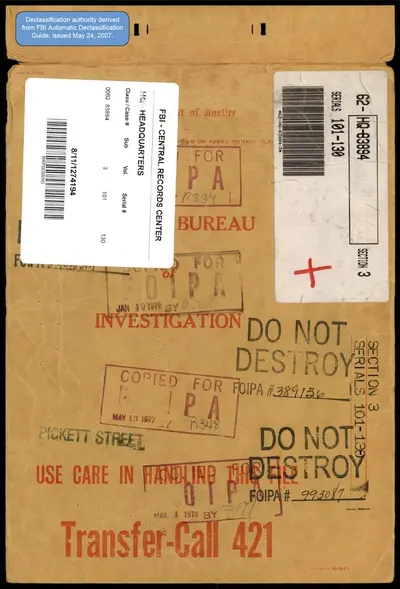
Background
On August 20, 1947, in Helena, Montana, U.S. government investigators recorded an unidentified-object incident later released to the public on May 8, 2026, as part of the Presidential Unsealing and Reporting System for UAP Encounters (PURSUE). This event occurred during a period of heightened public and governmental preoccupation with aerial anomalies. The summer of 1947 is widely regarded by historians of the phenomenon as the beginning of the first major wave of “flying saucer” reports that swept the United States. This wave was precipitated by the Kenneth Arnold sighting in June 1947 and followed closely by the Roswell incident in July 1947. During this era, the sudden influx of reports led to a lack of standardized classification, as the term unidentified flying object was not yet the formal nomenclature used by the military.
The geographical context of the sighting is significant, as Helena serves as a central hub within the mountainous terrain of western Montana. During the post-war period, the expansion of telecommunications and national infrastructure meant that more personnel were stationed in remote or high-altitude areas, increasing the likelihood of sightings involving atmospheric or aerial phenomena. The administrative handling of such reports during the late 1940s was characterized by a decentralized approach. The case was filed with the Federal Bureau of Investigation, whose Knoxville, Albuquerque, Los Angeles, and other field offices routed UFO reports to headquarters under the Bureau’s standing protocols for the protection of vital installations. This procedure suggests that the government viewed unidentified aerial phenomena through the lens of national security and the potential for espionage or unauthorized incursions into restricted airspace.
What the document records
The primary documentation regarding this event originates from a report submitted by R. Jemadden, a Division Plant Engineer with the Pacific Telephone and Telegraph Company in Helena, Montana. Jemadden reported the sighting to Lieutenant Colonel Springer, and the resulting report was dated August 20, 1947. Following the established reporting chain, these details were forwarded to the FBI for further review. While the official record confirms the existence of the report and the identity of the reporting engineer, the specific nature of the sighting is not described on this page. The documentation provides no specific details regarding the visual characteristics, flight path, or duration of the object in question.
Furthermore, the released document does not specify the number of witnesses present during the event. This lack of corroborative witness data is common in many mid-century aerial reports, where the identity of secondary observers was often omitted from official summaries unless they were also formal complainants. The absence of descriptive detail in the forwarded files highlights the difficulty investigators faced when attempting to reconstruct events based on brief, high-level summaries passed between field offices and federal headquarters.
Type of case
The case is classified as a visual sighting reported by ground or air observers. Such sightings represent the most common form of reported anomaly from the 1940s, relying entirely on the optical perception of individuals on the ground or within aircraft.
Status
All records released under the PURSUE program are designated unresolved by the All-domain Anomaly Resolution Office (AARO) by default. The federal government has not concluded that the events were anomalous, has not concluded that they were conventional, and has not ruled out either possibility. The investigation of such cases often encounters the same limitations found in other contemporary sightings, where the lack of physical evidence or radar data prevents a definitive classification.
Conventional candidates for sightings of this period include experimental aircraft, weather balloons, especially the Project Mogul series in the late 1940s, and atmospheric optical phenomena such as sundogs and lenticular clouds. Additionally, astronomical objects including Venus, the Moon, and meteors near the horizon are frequently considered as potential explanations for unidentified lights or objects. Without further descriptive data from the Jemadden report, the Helena sighting remains an unverified entry in the historical archive of aerial phenomena.