Asuncion, Paraguay UAP Encounter, 1947 — USAAF Box 7 #119
An archived U.S. Army Air Forces report documents an unidentified object sighting near Asuncion, Paraguay, during the 1947 saucer wave.
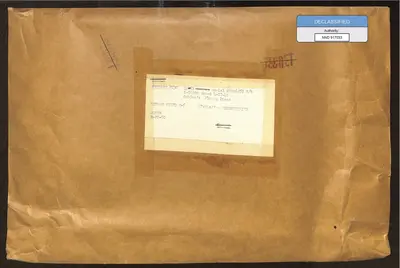
Case Overview
In 1947, near Asuncion, Paraguay, the U.S. Army Air Forces recorded an unidentified-object incident that became Incident #119 in the “Check-List - Unidentified Flying Objects” series archived in Box 7 of file 38_143685. The records were released by the Department of War on May 8, 2026, as part of the Presidential Unsealing and Reporting System for UAP Encounters (PURSUE). The case is one of the first wave of “flying saucer” reports that swept the United States after the Kenneth Arnold sighting of June 1947 and the Roswell incident of July 1947.
Documentation and Observations
Incident #119 of the U.S. Army Air Forces “Check-List - Unidentified Flying Objects” series, archived in Box 7 of file 38_143685 and released by the Department of War on May 8, 2026, as part of the PURSUE program, contains limited descriptive data. The summary records that an unspecified observer reported a sighting near the location of Asuncion, Paraguay. The nature of the case is classified as a visual sighting reported by ground or air observers. Due to the brevity of the original military checklist, the specific flight path, speed, or physical characteristics of the object were not detailed in the primary entry.
Historical and Geographic Context
The sighting occurred during a period of significant global transition and heightened aerial surveillance. Asuncion, the capital of Paraguay, serves as a central hub in the Río de la Plata region, a geographic area that has historically been subject to various forms of migratory and atmospheric observation. During the late 1940s, the emergence of Unidentified Aerial Phenomena (UAP) was closely linked to the rapid advancement of aeronautical technology. The summer of 1947 is widely recognized by historians of the phenomenon as the beginning of a “saucer wave,” a period characterized by a sudden increase in reports of metallic, disc-shaped objects traversing the skies.
At the time of this report, the scientific and military communities were beginning to grapple with sightings that did not align with known aeronautical capabilities. The emergence of the “flying saucer” archetype in the public consciousness was driven by high-profile events in the United States, yet the presence of similar reports in South America suggests a broader, perhaps global, phenomenon. The documentation of such incidents in Paraguay indicates that the phenomenon was being tracked by military interests even outside the primary theater of the United States.
Investigative Status and Analysis
All records released under the PURSUE program are designated unresolved by the All-domain Anomaly Resolution Office. The federal government has not concluded these 1947-era incidents were anomalous, has not concluded they were conventional, and has not ruled out either possibility. The lack of a definitive conclusion reflects the difficulty of verifying mid-century sightings without modern sensor arrays or satellite imagery.
When analyzing the 1947 saucer wave, researchers often consider several conventional candidates that could account for such sightings. These include the Project Mogul balloon flights, which were active over the U.S. Southwest during this era, as well as the testing of experimental jet and rocket aircraft. Other possibilities include atmospheric optical effects, such as sun dogs or temperature inversions, and astronomical objects misidentified at unusual angles. The Asuncion incident remains part of this broader scientific inquiry into whether these sightings represented new technology, natural phenomena, or an unidentified class of objects.