The Lonnie Zamora Encounter
A police officer witnessed a landed craft and two small beings outside Socorro.
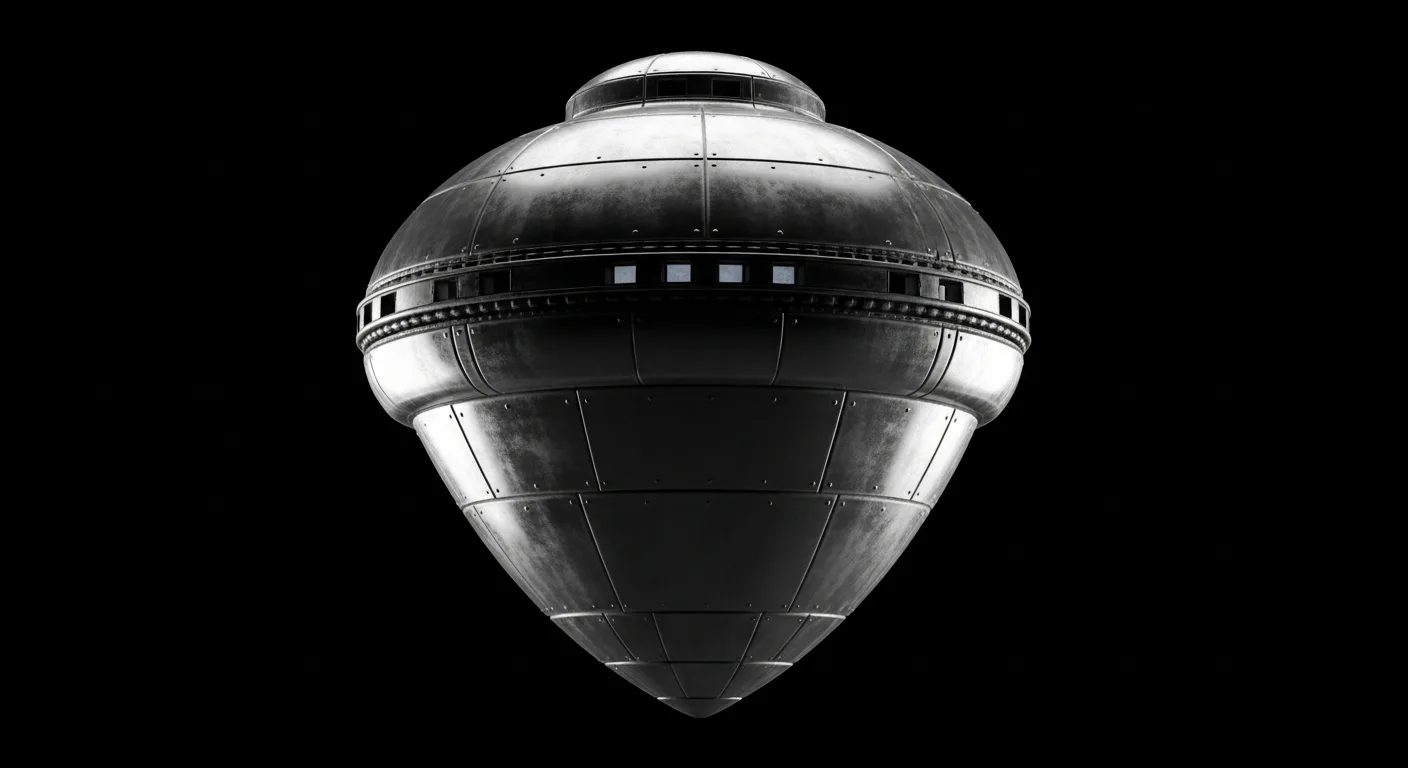
On the afternoon of April 24, 1964, Socorro, New Mexico, police officer Lonnie Zamora was doing what police officers in small desert towns do on quiet Friday afternoons—patrolling the roads south of town, watching for speeders and keeping an eye on nothing in particular. He was chasing a black Chevrolet that was exceeding the speed limit when a sudden roar and a descending flame in the sky to the southwest caught his attention. Believing he had heard an explosion and fearing that a dynamite shack in the area might have detonated, Zamora broke off his pursuit and turned his patrol car toward the source of the disturbance. What he found in a gully on the outskirts of Socorro would become one of the most thoroughly investigated and enduringly puzzling close encounter cases in UFO history—an event that left physical evidence, convinced hardened skeptics, and transformed a quiet, methodical police officer into one of the most credible witnesses the phenomenon has ever produced.
The Officer
Lonnie Zamora was not the kind of man who saw things that were not there. Born in 1933 in Socorro, he had served the small community as a police officer for years, building a reputation for reliability, honesty, and an absence of imagination that his colleagues meant as a compliment. He was, by every account, a straightforward, unexcitable lawman who did his job, went home, and did not seek attention. He had no interest in science fiction, no background in UFO lore, and no personal characteristics that might predispose him to hallucination or fabrication.
Socorro itself was a quiet town of roughly five thousand people, situated along the Rio Grande in central New Mexico. The landscape surrounding it was classic high desert—flat expanses of scrubland broken by arroyos and gullies, with the distant mountains providing a perpetual backdrop. The area was familiar territory for Zamora, who had driven its roads and walked its terrain countless times. He knew what belonged in the desert landscape and what did not, and what he found in that gully on April 24 decidedly did not belong.
His character and reputation would prove to be the case’s greatest asset. When investigators arrived and began evaluating the encounter, they found a witness who was visibly shaken, reluctant to discuss what he had seen, and entirely devoid of any motive to fabricate. Zamora did not want attention. He did not want fame. He wanted someone to explain to him what had happened, and when no one could, he simply continued telling the same story, in the same way, for the rest of his life.
The Roar and the Flame
At approximately 5:45 PM on April 24, Zamora was heading south on the old highway out of Socorro when he noticed a black Chevrolet exceeding the speed limit ahead of him. He activated his lights and began pursuit. Moments into the chase, he heard a loud roar—not a sharp detonation but a sustained, rumbling sound—and simultaneously saw a flame descending in the sky to the southwest. The flame was bluish-orange, conical in shape, and appeared to be dropping toward the ground at a moderate speed.
Zamora’s first thought was the dynamite shack. A small structure used to store explosives for local mining operations sat in the area toward which the flame appeared to be descending, and Zamora feared an explosion or fire. He broke off his pursuit of the Chevrolet—the speeder would have to wait—and turned his patrol car onto a rough gravel road that led southwest toward the source of the sound and flame.
The gravel road climbed a gentle rise, and Zamora had difficulty getting his patrol car up the slope. He made three attempts before the vehicle’s tires found enough purchase to carry him to the top. At the crest, he stopped the car and looked down into a gully below.
The Object in the Gully
What Zamora saw in the gully was not a burning dynamite shack. Sitting on the desert floor, perhaps one hundred and fifty yards away, was a whitish, egg-shaped or oval object. It was smooth, metallic, and roughly the size of a car—Zamora initially thought it might be an overturned vehicle. The object appeared to be resting on legs or supports that held it a few feet above the ground.
Near the object, Zamora saw two figures. They were small—he estimated them as being about the size of children, perhaps four feet tall—and they were wearing what appeared to be white coveralls. One of the figures seemed to turn and notice Zamora’s approaching patrol car. At that moment, Zamora was still too far away to make out detailed features, but the impression he received was of small, human-like forms in white clothing standing beside a white object in a desert gully.
Zamora radioed his dispatcher, Nep Lopez, and reported that he was investigating what appeared to be an accident. He began driving toward the gully, losing sight of the object briefly as the terrain intervened. When he stopped his car and stepped out, he was much closer to the object and could see it clearly.
The object was smooth and white, with no visible windows, doors, or seams. On its surface, Zamora noticed a red marking or insignia—a crescent-shaped or inverted V-shaped symbol with additional markings that he could not clearly discern. The figures he had seen were no longer visible; they had apparently entered the craft or moved to its far side. The object sat silently in the gully, resting on its supports, and for a moment Zamora simply stood and stared at it.
The Departure
Then the roar returned. The sound that had first drawn Zamora’s attention began again, starting at a low frequency and rapidly increasing in volume and pitch. The object’s underside began to emit flame—a bluish-orange jet that scorched the desert brush beneath it. Zamora, suddenly and viscerally afraid, turned and ran. He stumbled, lost his glasses, and threw himself behind his patrol car for cover, expecting an explosion.
The explosion never came. Instead, the roar subsided to a high-pitched whine, and Zamora peered over the hood of his car to see the object rising from the gully. Its legs or supports had retracted, and it was climbing vertically, slowly at first, then with increasing speed. It cleared the rim of the gully, leveled off, and began moving horizontally toward the southwest, accelerating smoothly and silently away from Zamora’s position. The flame had ceased; the object moved without any visible means of propulsion, gaining speed until it was just a bright spot against the desert sky, and then it was gone.
The entire encounter, from the moment Zamora first saw the object in the gully to its disappearance over the horizon, had lasted perhaps two minutes. In those two minutes, a quiet police officer’s understanding of the world had been fundamentally altered.
Sergeant Chavez Arrives
Zamora radioed for assistance, and Sergeant Sam Chavez of the New Mexico State Police arrived within minutes. Chavez found Zamora standing beside his patrol car, visibly shaken. The normally composed officer was pale, sweating, and clearly distressed. Whatever Zamora had experienced, Chavez could see that it had genuinely frightened him.
The two men walked to the gully together. What they found corroborated Zamora’s account in physical detail. The desert brush where the object had rested was burned—charred and smoldering, the soil beneath it heated by the flame that had accompanied the object’s departure. In the earth, they found four angular impressions arranged in a roughly rectangular pattern, consistent with the legs or supports that Zamora had described. The impressions were deep and clearly defined, suggesting a heavy object had rested on them. Nearby, they found additional marks in the soil—scrapes and disturbances consistent with something landing and then departing.
Chavez, a seasoned law enforcement officer, recognized the significance of what he was seeing. He secured the area and called for additional investigators. Within hours, the gully south of Socorro was being examined by personnel from multiple agencies, and the case was rapidly escalating beyond a routine police report.
The Investigation
The Socorro incident attracted an extraordinary level of official attention for a UFO sighting. The FBI dispatched an agent to examine the site and interview Zamora. The United States Army sent investigators from White Sands Missile Range, which was located nearby. And Project Blue Book, the Air Force’s official UFO investigation program, sent its top scientific consultant, Dr. J. Allen Hynek, an astronomer from Northwestern University.
Hynek arrived expecting to find a misidentification or a hoax. He was Blue Book’s resident debunker, a scientist whose role was to provide conventional explanations for UFO reports and thereby reassure the public that nothing extraordinary was occurring. By 1964, Hynek had evaluated hundreds of cases and had developed a repertoire of standard explanations—aircraft, balloons, meteors, planets, atmospheric phenomena—that could account for the vast majority of sightings.
The Socorro case resisted every one of them. Hynek interviewed Zamora at length and found him to be one of the most credible witnesses he had ever encountered. The officer’s account was detailed, consistent, and delivered without embellishment or enthusiasm. Zamora clearly wished the encounter had never happened and was embarrassed by the attention it was bringing. He answered questions directly, admitted uncertainty where it existed, and did not attempt to make his experience seem more dramatic than it was.
The physical evidence at the site supported Zamora’s account. The burned vegetation was genuine—laboratory analysis confirmed that the brush had been subjected to intense heat, consistent with a propulsive flame of some kind. The four landing impressions were measured and documented, and their arrangement matched the legs or supports that Zamora had described. The soil in and around the impressions showed evidence of compression by a heavy weight.
Hynek could find no conventional explanation for the case. He checked military records for rocket tests, balloon launches, and experimental aircraft operations—none coincided with the sighting. He considered the possibility of a hoax and rejected it; Zamora had no motive to fabricate, and the physical evidence was inconsistent with any practical hoaxing method. He examined the possibility of hallucination and rejected that too; Zamora was sober, alert, and had been engaged in routine police work immediately before the encounter.
Project Blue Book classified the Socorro case as “Unknown”—one of a relatively small number of cases that the Air Force’s own investigation was unable to explain. For Hynek, it was a turning point. The case forced him to acknowledge that not all UFO reports could be dismissed with pat explanations, and it planted the seeds of the transformation that would eventually lead him from skeptic to serious researcher.
The Symbol
One of the most intriguing and debated aspects of the Socorro encounter is the red symbol that Zamora observed on the side of the object. He described it as a crescent-shaped or arc-like marking, roughly two feet wide, with an inverted V or arrow beneath it and additional elements that he could not clearly discern at his distance from the craft.
The exact nature of the symbol has been the subject of considerable debate. Zamora drew it from memory for investigators, and his rendering shows a distinctive design that does not match any known military insignia, corporate logo, or conventional marking. Some researchers have noted similarities to alchemical or astrological symbols; others have found parallels in various ancient scripts and iconographies. None of these comparisons is definitive, and the symbol remains unidentified.
The Air Force reportedly asked Zamora to keep the exact details of the symbol confidential and circulated a slightly altered version to the public, apparently to use as a test—anyone who claimed to have seen the same craft could be checked against the real symbol to verify or disprove their account. This decision, while understandable as an investigative technique, has complicated subsequent research by creating uncertainty about which version of the symbol is accurate.
The Aftermath for Zamora
The Socorro encounter changed Lonnie Zamora’s life, though not in the way that it might have changed the life of someone who desired attention. Zamora became famous against his will, and the fame brought him nothing but discomfort. Reporters descended on Socorro, crowds of curiosity seekers trampled the site, and Zamora found himself at the center of a media circus that was entirely alien to his temperament and preferences.
He handled it with the same quiet professionalism that characterized his police work. He answered questions honestly, declined offers to profit from his experience, and returned to his routine as quickly as the attention would permit. He remained on the Socorro police force, continuing to patrol the same roads and serve the same community, and he maintained his account of the encounter without variation for the remaining forty-five years of his life.
Zamora never changed his story. He never added details, never exaggerated, never retracted. When asked about the encounter late in life, he described it in the same terms he had used in 1964, with the same measured delivery and the same evident discomfort. He did not enjoy being a UFO witness. He did not enjoy the attention. He simply told the truth as he experienced it and endured the consequences.
Lonnie Zamora died on November 2, 2009, at the age of seventy-six. He went to his grave having never wavered from his account of what he saw in that gully on the outskirts of Socorro—a white, egg-shaped craft resting on legs, two small figures in white coveralls, a roaring flame, and a departure that left burned brush and landing marks in the desert soil.
Why Socorro Matters
The Socorro encounter endures as one of the most significant close encounter cases in UFO history for reasons that go beyond the strangeness of the event itself. It matters because of the quality of the witness, the rigor of the investigation, and the physical evidence that corroborated the testimony.
Lonnie Zamora was not merely credible; he was unimpeachable. His character, his career, his demeanor, and his complete lack of motivation to fabricate combined to create a witness profile that is virtually impossible to challenge on personal grounds. When skeptics attempted to dismiss the case, they invariably found themselves confronting a man whose honesty and reliability were vouched for by everyone who knew him.
The investigation was conducted by multiple agencies with different mandates and different perspectives, and all of them reached the same conclusion: something had been there. The physical evidence was documented by professionals using standard forensic procedures, and it supported Zamora’s account in every verifiable detail. The case was not a matter of testimony alone—it was testimony plus evidence, each reinforcing the other.
And the official verdict—“Unknown”—acknowledged that the most powerful military in the world, with all its resources and expertise, could not explain what a small-town police officer had encountered on a routine Friday afternoon. Something landed in the desert outside Socorro on April 24, 1964. It left marks in the earth, burns on the brush, and an indelible impression on a man who never wanted to be anything more than an honest cop doing his job. Whatever it was, it remains unexplained—a question mark etched into the New Mexico sand that no amount of time or scrutiny has been able to erase.
Sources
- Project Blue Book — National Archives — USAF UFO investigation files, 1947–1969
- CIA UFO/UAP Reading Room — Declassified CIA documents on UAP