The Pascagoula Abduction
Two fishermen claimed to be abducted by bizarre robotic creatures in one of the strangest encounter cases.
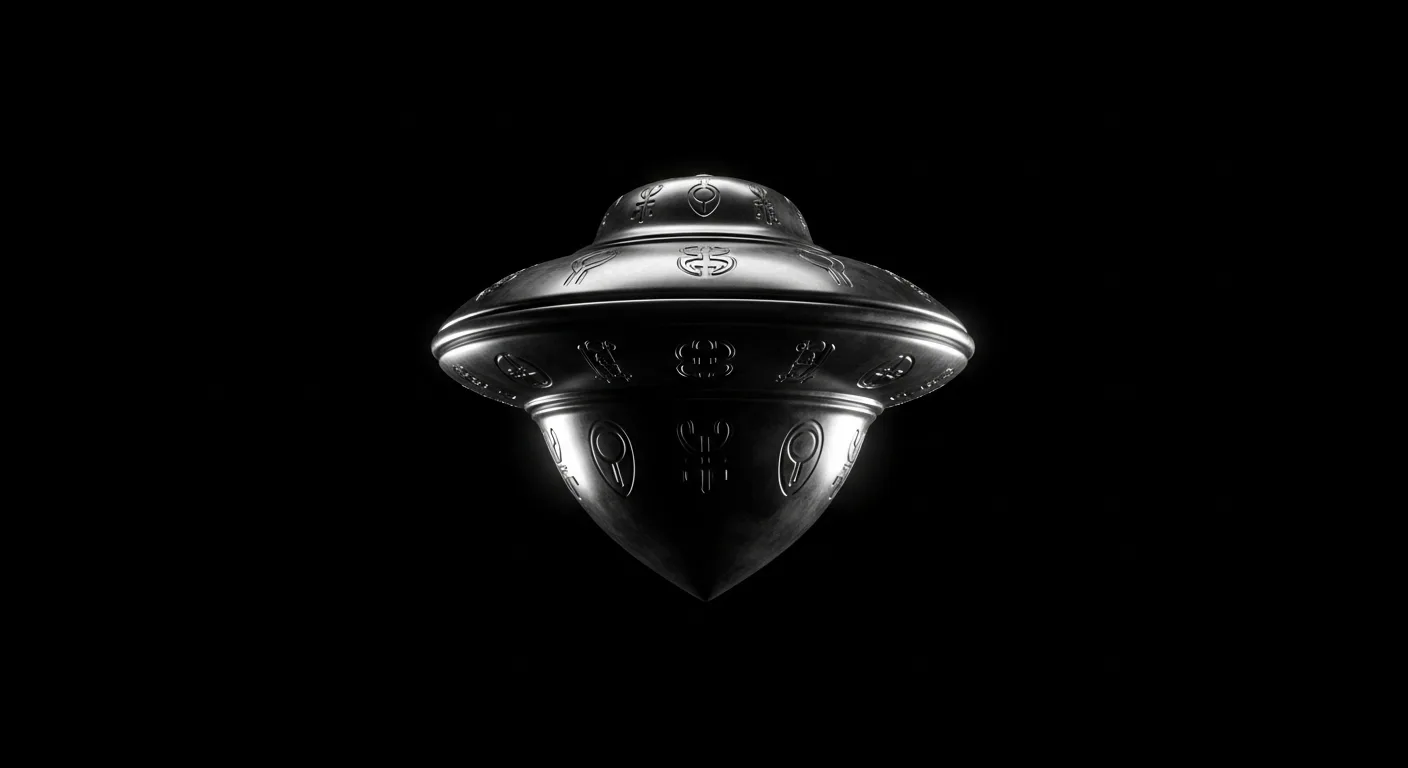
The Pascagoula River winds its way through the pine flatlands and marshy lowlands of southeastern Mississippi before emptying into the Gulf of Mexico, its dark waters carrying the tannin stain of countless cypress roots. On warm autumn evenings, the riverbank draws fishermen who cast their lines into the slow current and wait in the particular stillness that settles over the Gulf Coast as the day fades. It was on such an evening, October 11, 1973, that two men fishing from an old pier on the river’s west bank experienced something that would upend their lives, divide public opinion for decades, and produce one of the most bewildering and enduring cases in the history of UFO research. What Charles Hickson and Calvin Parker described that night bore almost no resemblance to the standard alien encounter narrative. The beings they reported were not the now-familiar gray-skinned figures with oversized eyes. They were something far stranger, something almost mechanical, something that seemed to belong to no established category of the unexplained.
An Autumn Evening on the River
To understand the Pascagoula abduction, one must first understand the men at the center of it and the world they inhabited. Charles Hickson was forty-two years old in October 1973, a foreman at Walker Shipyard in Pascagoula, a man of practical temperament who had served in the Korean War and raised a family in the working-class communities along the Mississippi coast. He was not someone given to flights of fancy. His companion that evening was Calvin Parker, just nineteen years old, a relative newcomer to Pascagoula who had come down from the small town of Laurel, Mississippi, to find work at the shipyard. Parker was quiet by nature, somewhat shy, and looked up to Hickson as a mentor and father figure. The two had developed a friendship through work, and fishing together on the Pascagoula River had become a regular pastime.
The evening of October 11 was unremarkable in every way. The weather was mild, the air carrying the faintly brackish scent of the tidal river. Hickson and Parker had driven to a spot along the west bank near the old Shaupeter Shipyard, a stretch of waterfront that offered a concrete pier extending over the river. It was a familiar spot, one they had fished many times before. They set up their tackle as the light softened and the sky deepened toward dusk, settling into the easy quiet of two men who know each other well enough to be comfortable in silence.
The events that followed would transform that quiet evening into one of the most investigated and debated close encounters in American history.
The Craft Descends
According to Hickson’s account, the first indication that something was wrong came as a sound, a rhythmic whirring or buzzing that seemed to emanate from behind them, somewhere to the west. Both men turned toward the noise. What they saw, hovering perhaps two feet above the ground at a distance of roughly thirty to forty yards, was an elongated, oval-shaped craft emitting a bluish-gray luminescence. Hickson estimated the object was approximately thirty feet long and eight to ten feet high, with no visible seams, windows, or markings of any kind. The light it produced was not blinding but seemed to pulse faintly, as if the craft itself were breathing.
Parker, who had been sitting with his back to the western bank, turned and saw the object at roughly the same moment as Hickson. His reaction was immediate and visceral. A wave of terror overtook him, and by his own later admission, he felt his body go rigid with a fear unlike anything he had ever experienced. Hickson, though alarmed, maintained enough composure to observe what happened next.
An opening appeared in the craft, though neither man could describe how. There was no door sliding aside, no hatch swinging open. One moment the surface of the object was seamless; the next, there was an aperture from which three figures emerged. They did not walk. They floated, drifting toward the two fishermen with a mechanical smoothness that Hickson would later struggle to articulate. The beings moved as if gravity were a suggestion rather than a law, their feet never quite touching the ground.
The Beings
The creatures that approached Hickson and Parker defied every expectation of what an extraterrestrial visitor might look like. Standing roughly five feet tall, they had pale, grayish skin that appeared wrinkled or creased, giving them an almost mummified appearance. Their heads were dome-shaped, sitting directly on their shoulders without any discernible neck. Where one might expect eyes, there were no visible organs of sight, only a continuation of the wrinkled, featureless skin. Below the head, a small slit served as a mouth, though neither man ever observed it move or produce sound. Small, cone-shaped protrusions extended from the sides of their heads where ears might have been.
Most striking were the appendages. Instead of hands, the beings’ arms terminated in what both men described as lobster-like claws or pincers, a single articulation that could open and close but bore no resemblance to human fingers. Their legs appeared fused together, ending in rounded, elephant-like feet that never made contact with the ground as the creatures moved. The overall impression was of something manufactured rather than born, an automaton designed with only a passing reference to humanoid form. Hickson would later tell investigators that the beings moved with a stiffness that reminded him of robots, their joints articulating in ways that seemed mechanical rather than biological.
The appearance of these entities remains one of the most unusual aspects of the Pascagoula case. In 1973, the popular image of an alien being was already crystallizing around the archetype of the small gray humanoid with large dark eyes, an image that would dominate abduction accounts for decades to come. Hickson and Parker’s creatures shared almost nothing with that template, a fact that some researchers have cited as evidence of sincerity. If the men had fabricated their account, why invent beings so radically different from what audiences expected?
The Abduction
What followed the appearance of the beings happened with terrifying swiftness. Two of the three entities seized Hickson, each grasping one of his arms with their claw-like appendages. The grip was firm but not painful, though Hickson found himself completely unable to move. A paralysis overtook his body, not a loss of consciousness but a total inability to command his muscles. He remained aware, his mind racing with confusion and fear, but his body had been rendered as immobile as a statue.
The third being took hold of Parker, who by this point had succumbed entirely to terror. Parker would later describe the onset of unconsciousness, a merciful darkness that spared him the full experience of what followed. Whether he genuinely fainted from shock or was rendered unconscious by some means employed by the beings remains uncertain. For years afterward, Parker maintained that he remembered nothing of the interior of the craft, though his account would eventually evolve.
Hickson, however, remained conscious throughout. He described being floated into the craft through the same aperture from which the beings had emerged. The interior was featureless, bathed in the same bluish-gray light as the exterior, with no visible instruments, panels, or furnishings. The walls seemed to glow uniformly, making it impossible to identify a specific light source. The air inside was unremarkable. There was no detectable odor or temperature change.
Once inside, Hickson was suspended in midair in a reclined position, held in place by no visible mechanism. He simply floated, unable to move, while something he described as a large eye-like device, roughly the size of a football, detached from the wall or ceiling and moved slowly across his body. The object seemed to be examining him, hovering inches from his skin as it passed from his head downward along his torso and limbs. The examination was thorough but not painful. Hickson felt no physical sensation from the device beyond a vague awareness of its proximity. The entire procedure, he estimated, lasted fifteen to twenty minutes, though his sense of time under such extraordinary circumstances was admittedly unreliable.
When the examination concluded, the beings returned Hickson to the pier in the same manner they had taken him, floating him back through the opening and depositing him on the concrete surface. Parker was returned as well, still in a state of semi-consciousness. The beings withdrew into the craft, the opening sealed itself, and the object rose silently before accelerating away over the river and disappearing into the night sky.
The Aftermath
For several minutes, the two men remained on the pier, too shaken to move or speak. Hickson’s paralysis had lifted, but his body felt heavy and uncoordinated, as though his nervous system were slowly rebooting. Parker was weeping, his entire frame trembling with a terror that would take years to fully process. When they finally collected themselves enough to act, Hickson made a decision that would prove pivotal. Rather than driving home and trying to forget what had happened, rather than dismissing the experience as a shared hallucination brought on by bad catfish or river gas, he drove to the Jackson County Sheriff’s Office to report what they had witnessed.
This decision reflected something fundamental about Charles Hickson’s character. He was a man who believed in authority and procedure, who had served his country and worked hard his entire life. When something extraordinary happened, you reported it. You told the people in charge. The fact that what he had to report was utterly fantastical did not, in his mind, absolve him of the responsibility to report it.
The men arrived at the sheriff’s office visibly distraught. Hickson’s hands were shaking. Parker was nearly incoherent, his face streaked with tears. Sheriff Fred Diamond and Captain Glen Ryder listened to their account with the skepticism that any reasonable law enforcement officer would bring to such a story. But the men’s distress was clearly genuine. This was not the demeanor of pranksters enjoying a hoax. These were two frightened men struggling to communicate something that had overwhelmed their capacity to process it.
The Secret Recording
What happened next has become one of the most discussed elements of the Pascagoula case and one of its most compelling pieces of evidence. After taking the men’s initial statements, Sheriff Diamond and Captain Ryder left the room, ostensibly to get coffee. Before departing, they switched on a tape recorder hidden in the room. The logic was straightforward: if Hickson and Parker were perpetrating a hoax, they would likely drop the act once they believed themselves to be alone. They might congratulate each other, compare notes, or simply relax into their normal behavior. The recording would reveal the truth.
What the tape captured was the opposite of a confession. Left alone, Hickson and Parker did not break character because there was no character to break. Parker wept openly, repeating that he could not believe what had happened, that he wanted to go home, that he was afraid the beings would return. Hickson, attempting to steady his younger companion, spoke in the halting, bewildered tones of a man grappling with an experience for which his life had provided no framework. “I know you don’t want to sit here, Calvin,” Hickson said on the tape. “I don’t either. But we got to sit here till they come back.” He spoke of calling the nearby Keesler Air Force Base for help, of his fear that no one would believe them, of his certainty that what they had experienced was real.
At no point did either man deviate from their account. At no point did either suggest that the story was anything other than a truthful recounting of what had happened to them on the river. Sheriff Diamond, reviewing the tape, was struck by the consistency and the raw emotion. While the recording did not prove that an abduction had occurred, it strongly suggested that both men believed with absolute conviction that it had.
Investigation and Scrutiny
The Pascagoula abduction attracted immediate and intense attention. Within days of reporting their experience, Hickson and Parker found themselves at the center of a media storm. Reporters descended on the small shipbuilding city from across the country. Television crews set up outside the sheriff’s office. The story ran on network news broadcasts and in major newspapers, catapulting two private, working-class men into a spotlight neither had sought nor wanted.
Hickson, the more outgoing of the two, bore the brunt of the public attention. He submitted to interviews, appeared on television programs, and agreed to undergo a polygraph examination administered by a qualified operator. He passed. While polygraph results are not infallible and are generally inadmissible in court, Hickson’s ability to discuss his experience without triggering the physiological indicators of deception added another layer of credibility to his account.
Parker, by contrast, retreated almost immediately. The experience had damaged him in ways that were only beginning to manifest. He suffered what would today likely be diagnosed as post-traumatic stress disorder, experiencing nightmares, anxiety attacks, and a persistent fear of being taken again. He withdrew from public life, refusing interviews and avoiding discussion of the event whenever possible. His silence was sometimes cited by skeptics as suspicious, but those who knew Parker understood it as the response of a young man who had been profoundly traumatized and who lacked the emotional resources to process that trauma in the public arena.
Dr. J. Allen Hynek, the astronomer who served as a scientific consultant to the United States Air Force’s Project Blue Book and who would go on to found the Center for UFO Studies, took a personal interest in the Pascagoula case. Hynek interviewed both men and came away impressed by their sincerity. He noted that their account, while extraordinary, was internally consistent and that neither man appeared to be seeking financial gain or fame from the experience. Hynek classified the case as a “close encounter of the third kind,” a designation he had created specifically for incidents involving observation of or interaction with occupants of a UFO.
The case also drew the attention of Dr. James Harder of the University of California, Berkeley, who attempted to recover additional details through hypnotic regression. Under hypnosis, Hickson’s account remained largely consistent with his conscious recollections. Parker, also hypnotized, revealed fragmentary memories of the craft’s interior that he had not previously reported, though the reliability of memories recovered through hypnosis remains a subject of scientific debate.
The 1973 UFO Wave
The Pascagoula abduction did not occur in isolation. October 1973 witnessed one of the most intense periods of UFO activity in American history, a nationwide wave of sightings that produced hundreds of reports from coast to coast. The wave had begun in earnest in early October, with clusters of sightings reported across the southern and midwestern United States. Police departments, military installations, and media outlets were inundated with calls from ordinary citizens describing unusual lights, structured craft, and in some cases, encounters with beings.
The reasons for this concentrated burst of activity remain debated. Skeptics argue that media coverage of early sightings created a feedback loop, priming the public to interpret ambiguous stimuli as UFOs and encouraging those who might otherwise have remained silent to come forward with their own accounts. Proponents of the extraterrestrial hypothesis suggest that the wave represents a genuine increase in activity, perhaps coordinated reconnaissance by one or more non-human intelligences.
Whatever the explanation, the wave provided a context for the Pascagoula case that cut both ways. On one hand, it meant that Hickson and Parker were not alone in reporting extraordinary experiences during this period, lending their account a degree of cultural corroboration. On the other hand, the sheer volume of reports made it easier for skeptics to dismiss the entire wave, Pascagoula included, as a product of mass hysteria and media-fueled suggestibility.
Calvin Parker’s Long Silence
For more than four decades, Calvin Parker lived with the burden of his experience largely in silence. While Hickson became a public figure in the UFO community, appearing at conferences and granting interviews until his death in 2011, Parker retreated into the quietest life he could manage. He returned to Laurel, Mississippi, married, and worked a series of unremarkable jobs. He did not seek attention. He did not capitalize on the event. He simply endured.
In 2018, Parker finally broke his silence with the publication of his book, in which he shared details he had withheld for forty-five years. Among his revelations was the claim that the October 11 encounter was not his only experience with the beings. Parker described additional incidents, both before and after the famous abduction, suggesting a pattern of contact that extended far beyond a single evening on the river. He also shared his recovered memories of the craft’s interior, describing an environment and examination process that, while consistent with Hickson’s account in broad terms, included details he had never previously disclosed.
Parker’s decision to speak was driven partly by Hickson’s death. With his friend and protector gone, Parker felt a responsibility to ensure that the full story was preserved. He also acknowledged that decades of silence had taken a psychological toll, that carrying the weight of such an experience without being able to discuss it openly had contributed to struggles with anxiety and depression that shadowed his adult life.
The publication of Parker’s account revived public interest in the Pascagoula case and prompted a reassessment among researchers. Details that Parker revealed, including his description of the beings’ behavior as almost gentle or clinical rather than hostile, added nuance to an account that had previously been filtered almost entirely through Hickson’s perspective. Parker portrayed the experience not as an attack but as a procedure, something carried out with purpose and efficiency by entities that seemed indifferent to the terror they were causing.
Legacy and Significance
The Pascagoula abduction occupies a distinctive place in UFO history for several reasons. The strangeness of the beings described, so unlike the standard alien archetypes, has ensured that the case resists easy categorization. The secret recording at the sheriff’s office remains one of the few pieces of evidence in any abduction case that speaks directly to the witnesses’ sincerity. And the long arc of the story, from the initial report through decades of silence to Parker’s eventual disclosure, gives the case a narrative depth that few comparable incidents possess.
The city of Pascagoula itself has embraced its association with the event. A historical marker now stands near the site of the encounter on the Pascagoula River, and the case is referenced in local tourism materials. For a working-class shipbuilding town on the Gulf Coast, the abduction has become an unlikely but enduring element of civic identity.
Whether one accepts the Pascagoula abduction as evidence of extraterrestrial contact, as a product of shared psychological disturbance, or as something else entirely, the case demands engagement. Two men with no apparent motive for deception reported an experience that left them visibly shattered. They reported it immediately to law enforcement. They maintained their account under scrutiny, under hypnosis, and across the span of their lifetimes. They did not profit meaningfully from the experience, and in Parker’s case, it caused lasting harm.
The Pascagoula River still flows past the spot where Hickson and Parker cast their lines on that October evening. The old pier is gone now, and the shipyards that once defined the city’s economy have diminished. But the questions raised on that warm autumn night remain as vivid and unanswerable as ever, suspended in the same uncertainty that has surrounded the case since two terrified fishermen walked into a sheriff’s office and told a story that neither science nor skepticism has been able to fully resolve.
Sources
- CIA UFO/UAP Reading Room — Declassified CIA documents on UAP