Carson Sink Sighting
Two experienced Air Force pilots watched three bright UFOs outmaneuver their B-25 bomber over Nevada. Project Blue Book's own scientific consultant called it 'the best report in my files.'
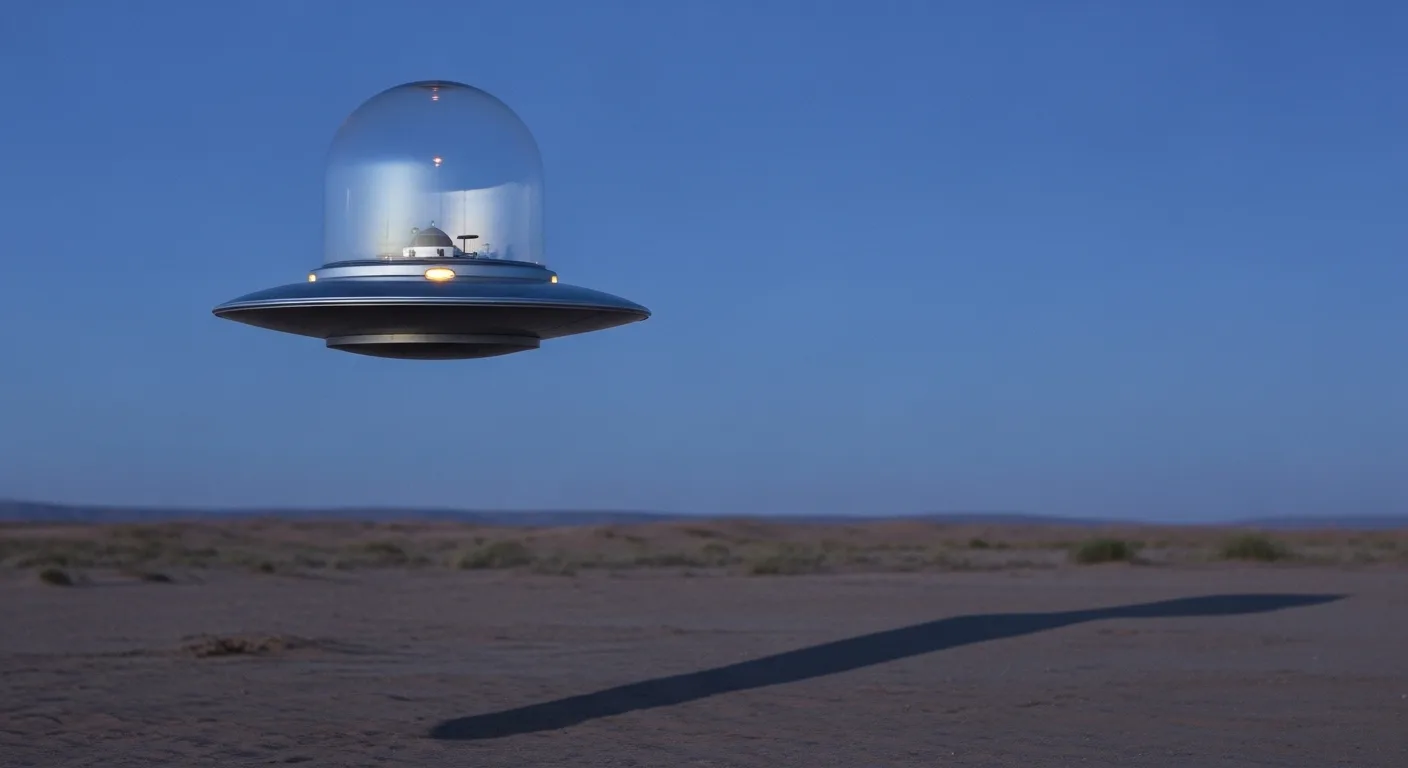
The summer of 1952 was the most extraordinary period in the early history of the UFO phenomenon. From coast to coast, Americans were reporting strange objects in their skies with a frequency and intensity that alarmed military planners and captivated the public. Washington, D.C., had been buzzed by formations of unidentified objects tracked on radar. Fighter jets had been scrambled to intercept lights that outpaced them effortlessly. Newspapers carried front-page stories about flying saucers almost daily. Into this atmosphere of heightened vigilance and bewilderment flew two experienced Air Force officers whose clear, daylight observation of three bright objects over the Nevada desert would earn the highest possible praise from the scientist responsible for evaluating such reports. Dr. J. Allen Hynek, the astronomer who served as scientific consultant to the Air Force’s Project Blue Book, would later call the Carson Sink sighting “the best report in my files,” a distinction that, given the thousands of cases that passed through his hands, spoke volumes about the quality of what these two men witnessed.
The Witnesses
Lieutenant Colonel John McGinn and Lieutenant Colonel John Grubb were not weekend hobbyists scanning the skies with binoculars. They were career military aviators, officers who had logged thousands of hours in the cockpit and whose professional lives depended on the accurate identification of objects in the air around them. A pilot who misidentifies aircraft, weather phenomena, or other aerial objects does not survive long in the military aviation community. The skills that had carried McGinn and Grubb through their careers, keen eyesight, spatial awareness, knowledge of aircraft types, understanding of atmospheric optics, were precisely the skills required to make a reliable observation of an unusual aerial phenomenon.
On July 24, 1952, the two officers were flying a B-25 Mitchell bomber on a routine mission over the Nevada desert. The B-25, a twin-engine medium bomber that had achieved fame during World War II in the Doolittle Raid on Tokyo, was by 1952 serving primarily in training and transport roles. It was a stable, reliable aircraft that provided its crew with excellent visibility through its cockpit windows, making it an ideal platform from which to observe aerial phenomena.
The weather that day was clear, with unlimited visibility across the vast expanse of the Nevada basin. The sun was high, providing strong, even illumination that eliminated the shadows and ambiguities that plague nighttime observations. Any objects in the sky would be seen in the most favorable conditions possible, with none of the visual distortions caused by darkness, haze, or atmospheric refraction.
The Great Wave of 1952
To fully appreciate the Carson Sink sighting, it must be placed in the context of the extraordinary UFO wave that swept the United States in the summer of 1952. Beginning in late June and intensifying through July, reports of unidentified flying objects flooded in from military bases, civilian airports, and ordinary citizens across the country at an unprecedented rate. Project Blue Book, the Air Force program tasked with investigating UFO reports, was overwhelmed with the volume of incoming cases.
The wave reached its dramatic peak in the days surrounding the Carson Sink sighting. On July 19-20 and again on July 26-27, unidentified objects appeared on radar screens at Washington National Airport and Andrews Air Force Base, and were simultaneously observed visually by commercial pilots, air traffic controllers, and citizens on the ground. Fighter jets were scrambled to intercept the objects, which appeared to outmaneuver the aircraft with ease. The Washington sightings generated national headlines and prompted a press conference at the Pentagon, the largest since World War II, at which Air Force officials struggled to explain what was happening in the skies over the nation’s capital.
It was during this period of maximum activity that McGinn and Grubb had their encounter over Carson Sink. The timing was significant not because it suggested the officers were influenced by the prevailing excitement, their training and discipline militated strongly against such suggestibility, but because it placed their sighting within a broader pattern of activity that was being documented by military and civilian observers simultaneously across the country. Whatever was happening in American skies in the summer of 1952, it was happening at Carson Sink as well.
The Carson Sink
The location of the sighting was itself noteworthy. Carson Sink is a dry lake bed, a vast, flat playa in the Nevada desert between Reno and the military testing ranges that dotted the state. The terrain is stark and empty, a landscape of salt flats and scrub brush stretching to distant mountain ranges under an enormous sky. The area was sparsely populated and largely undeveloped, offering few sources of reflected light, aircraft traffic, or other visual stimuli that might be confused with unusual aerial objects.
The Nevada desert had long been associated with military aviation and advanced technology. Nellis Air Force Base, the Nevada Test Site, and various classified facilities were all located in the broader region, and the skies above Nevada saw more than their share of experimental aircraft and weapons tests. McGinn and Grubb would have been aware of these activities and would have been familiar with the appearance of various military aircraft, conventional and experimental. Their inability to identify what they saw over Carson Sink was therefore all the more significant. These were men who knew what military aircraft looked like, in all their varieties, and what they observed that day did not match anything in their considerable experience.
The Sighting
The encounter began without warning. As the B-25 droned across the desert at cruising altitude, McGinn and Grubb noticed three bright objects approaching from the general direction of their flight path. The objects were immediately distinctive, bright silver in color, reflecting the desert sunlight with an intensity that made them clearly visible against the blue sky. They appeared solid and metallic, not the diffuse or luminous appearance one might associate with a weather balloon, an atmospheric phenomenon, or a trick of light.
The three objects were flying in a delta formation, a triangular arrangement with one object leading and two trailing at equal distances to either side. This formation flying was itself significant, as it implied coordinated, intelligent control. Weather balloons do not fly in formation. Birds do not maintain precise geometric arrangements at high speed. Meteorological phenomena do not organize themselves into delta patterns. Whatever these objects were, they were being guided by some form of controlling intelligence.
As the pilots watched, the objects approached their aircraft at high speed. The closure rate was rapid enough to be alarming, and both men had ample opportunity to observe the objects as they drew near. The objects appeared to be roughly circular or disc-shaped when seen head-on, with no visible wings, tail surfaces, or other conventional flight control structures. There was no exhaust trail, no contrail, no visible means of propulsion. They simply moved through the air with a smooth, silent efficiency that defied the aeronautical knowledge of two experienced aviators.
Then came the maneuver that sealed the case’s significance. As the objects drew close to the B-25, they executed a sharp turn, estimated at approximately ninety degrees, while maintaining their formation. The turn was abrupt and precise, performed at a speed and with a sharpness that no known aircraft of 1952 could have matched. Conventional aircraft banking through a ninety-degree turn at high speed must contend with G-forces, structural limitations, and the aerodynamic constraints of wings and control surfaces. These objects simply changed direction, as if the laws of inertia did not apply to them.
After completing the turn, the three objects accelerated away from the B-25 and departed the area at extraordinary speed, vanishing into the distance in a matter of seconds. The entire encounter lasted several minutes, long enough for both pilots to observe the objects carefully, discuss what they were seeing, and attempt to reconcile the sight with their extensive knowledge of aerial vehicles.
The Report
McGinn and Grubb filed a formal report of their sighting through official Air Force channels. As military officers, they were both obligated and accustomed to reporting unusual observations, and their account was detailed, measured, and free of sensationalism. They described the objects’ appearance, size, color, formation, approach, maneuver, and departure with the professional precision expected of trained aviators.
The report entered the Project Blue Book system, where it was assigned a case number and subjected to the standard investigative process. Analysts at Wright-Patterson Air Force Base in Ohio reviewed the officers’ accounts, examined the meteorological data for the time and location of the sighting, checked for known aircraft activity in the area, and considered possible conventional explanations.
No satisfactory explanation was found. The objects did not match any known aircraft, military or civilian. They were not consistent with weather balloons, which do not fly in formation, execute ninety-degree turns, or accelerate to extreme speeds. They were not consistent with meteorological phenomena, which do not reflect sunlight in the manner described or maintain structured geometric formations. The case was classified as “Unexplained,” a designation reserved for reports that resisted all conventional analysis.
Hynek’s Assessment
Dr. J. Allen Hynek’s endorsement of the Carson Sink case as “the best report in my files” was not offered lightly. Hynek was a careful, skeptical scientist who had been hired by the Air Force in 1948 precisely because of his ability to find conventional explanations for seemingly unusual observations. In the early years of his work with Project Blue Book, he had been an enthusiastic debunker, explaining away sighting after sighting as misidentified stars, planets, aircraft, or weather phenomena.
But the accumulation of cases like Carson Sink had gradually shifted Hynek’s perspective. Here was a report from two senior Air Force officers, men whose credibility was beyond question, who had observed three structured objects performing maneuvers that exceeded the capabilities of any known technology, in clear daylight, for several minutes. The witnesses were not anonymous civilians glimpsing something through a car window. They were trained military observers in an aircraft, experienced in identifying aerial objects, who had no reason to fabricate or exaggerate and everything to lose professionally by reporting something they could not explain.
What set the Carson Sink case apart, in Hynek’s estimation, was the combination of witness quality, observation conditions, and object behavior. The witnesses were the best possible observers, the conditions were the best possible for observation, and the behavior of the objects, particularly the formation flying and the high-speed ninety-degree turn, was the most clearly anomalous. There was simply no conventional explanation that could account for all the elements of the report.
Hynek’s assessment was significant because of his unique position in the field. As the Air Force’s own scientific consultant, he had access to all of the data that Project Blue Book had collected, thousands of reports from across the country and around the world. When he said that Carson Sink was the best case in his files, he was measuring it against the entirety of the Air Force’s UFO database. It was not merely a good report. It was, in the judgment of the man best positioned to evaluate such things, the finest case the Air Force had ever investigated.
The Problem of the Ninety-Degree Turn
The sharp turn executed by the three objects was perhaps the single most significant detail of the Carson Sink encounter, because it pointed to technological capabilities that were simply impossible by the standards of 1952 aeronautics, or indeed by the standards of aviation today. Any solid object traveling at high speed through the atmosphere must contend with the laws of physics, specifically Newton’s laws of motion, which dictate that changing direction requires overcoming the object’s momentum. The faster the object is traveling, the greater the force required to change its direction, and the more gradual the resulting turn.
An aircraft executing a ninety-degree turn at the speeds estimated by McGinn and Grubb would have been subjected to G-forces sufficient to destroy most airframes and kill any human occupants. The structural limitations of aluminum and steel simply do not permit such maneuvers. Even modern fighter aircraft, designed to withstand extreme G-forces, cannot perform instantaneous ninety-degree turns at high speed. They must bank, roll, and gradually alter their flight path, a process that takes time and space and leaves a visible arc in their trajectory.
The objects observed at Carson Sink appeared to turn instantaneously, without banking, without any visible arc, and without any change in speed. They simply went from traveling in one direction to traveling in another, as if the intermediate steps required by conventional physics had been omitted. This behavior, if accurately reported, implied either a propulsion system that could neutralize inertia or a vehicle that operated on principles entirely outside the framework of known physics.
For McGinn and Grubb, who understood precisely what an aircraft could and could not do, this was the detail that convinced them they had seen something genuinely anomalous. They knew what a sharp turn looked like when performed by a conventional aircraft. What they saw over Carson Sink was something else entirely.
The Formation
The delta formation maintained by the three objects throughout the encounter was another detail of considerable significance. Formation flying requires coordination, communication, and shared intent among the vehicles involved. When military aircraft fly in formation, they do so because pilots are communicating with each other and following established protocols. The maintenance of formation during complex maneuvers, such as the ninety-degree turn, is particularly demanding and requires extensive training and practice.
The fact that the three objects at Carson Sink maintained their triangular arrangement throughout the approach, the turn, and the departure suggested a level of coordination that went beyond what could be attributed to natural phenomena or random chance. Three weather balloons caught in the same wind current would not maintain a precise geometric pattern. Three birds might briefly form a triangular arrangement, but they would not maintain it through a high-speed ninety-degree turn. Only vehicles under intelligent control could exhibit such behavior.
This implied that the objects were not merely anomalous but were being operated or guided by some form of intelligence. Whether that intelligence was aboard the objects, controlling them remotely, or built into their autonomous systems was impossible to determine from the observation. But the formation flying established that whatever the objects were, they were not natural phenomena and were not operating randomly.
Blue Book’s Dilemma
The Carson Sink case exemplified the fundamental dilemma that confronted Project Blue Book throughout its existence. The Air Force program had been established, in part, to reassure the public that UFO sightings had conventional explanations. Its institutional bias was toward debunking, toward finding mundane causes for unusual reports, and thereby reducing public anxiety about the phenomenon.
But cases like Carson Sink resisted debunking. The witnesses were unimpeachable. The observation conditions were ideal. The behavior of the objects was clearly anomalous. No conventional explanation could account for what McGinn and Grubb had seen. Forced to choose between stretching a weak explanation to the breaking point and admitting that something genuinely unexplained had been observed, Blue Book chose the latter, classifying the case as “Unexplained.”
This designation was not an admission that the objects were extraterrestrial or even that they were necessarily mysterious. It simply meant that the investigation had failed to identify a conventional explanation. But in the context of the summer of 1952, when the Air Force was under intense pressure to explain the UFO wave to an anxious public, even this limited admission was significant. If two senior Air Force officers could observe something in broad daylight that the Air Force itself could not explain, what did that say about the nature of the phenomenon?
Legacy
The Carson Sink sighting occupies a secure place in the canon of UFO cases that have withstood the test of time. It has been analyzed and re-analyzed by researchers for over seven decades, and no convincing conventional explanation has ever been proposed. The quality of the witnesses, the clarity of the observation, and the anomalous behavior of the objects have ensured that the case remains relevant to any serious discussion of the UFO phenomenon.
Hynek’s endorsement has given the case an enduring authority that few other sightings enjoy. When the scientific consultant to the Air Force’s own investigation identifies a case as the best in his files, that assessment carries weight that transcends the usual debates between believers and skeptics. Hynek was not a true believer. He was a scientist who followed the evidence, and the evidence at Carson Sink pointed to something genuinely unknown.
The Nevada desert where the encounter occurred remains much as it was in 1952, a vast, empty landscape under an enormous sky. The B-25s are long gone, replaced by generations of faster, more sophisticated aircraft. The objects that McGinn and Grubb observed have never been identified. They came out of the bright desert sky, flew in formation, turned at impossible angles, and vanished into the distance, leaving behind only the testimony of two men whose professional qualifications made their account impossible to dismiss and whose words, seven decades later, still echo through the literature of the unexplained.
Sources
- Project Blue Book — National Archives — USAF UFO investigation files, 1947–1969
- CIA UFO/UAP Reading Room — Declassified CIA documents on UAP
- Chronicling America — Historic US newspapers (1690–1963)