Langley AFB Drone Swarms
For 17 consecutive nights in December 2023, swarms of unidentified drones invaded restricted airspace over Langley Air Force Base. F-22 Raptors were scrambled. NASA deployed a WB-57F high-altitude jet. The origin of the car-sized drones remains unknown.
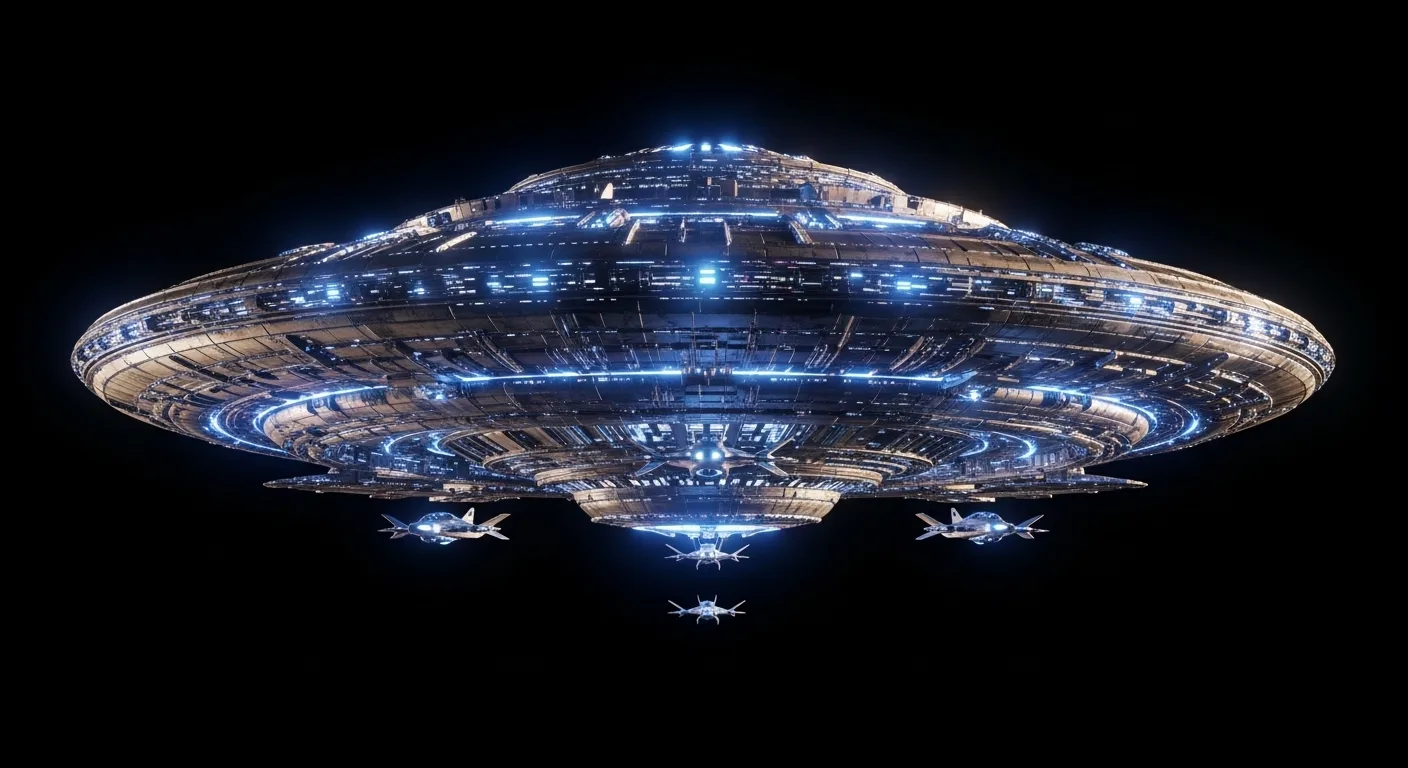
For seventeen consecutive nights in December 2023, the most advanced fighter base in the United States found itself under siege by an enemy it could not identify, intercept, or stop. Langley Air Force Base—home of the F-22 Raptor, America’s premier air superiority fighter—was invaded night after night by swarms of unidentified drones that brazenly penetrated restricted military airspace, conducted what appeared to be coordinated surveillance operations, and departed without a single interception. The world’s most sophisticated air defense systems, designed to counter the most advanced adversaries on Earth, proved utterly ineffective against objects the size of cars that moved with apparent purpose through some of the most protected airspace in the nation. F-22s scrambled to intercept. NASA deployed a high-altitude reconnaissance jet. The FBI launched an investigation. Coast Guard vessels patrolled the waters. And still the drones came, night after night, until they simply stopped—leaving behind no evidence of who sent them, where they came from, or what they wanted. The Langley Air Force Base drone incursions represent one of the most significant unexplained aerial intrusions in American military history, a humiliating demonstration of vulnerability at the heart of American airpower, and a mystery that remains unsolved.
The Target
Langley Air Force Base is not an ordinary military installation. It is one of the crown jewels of American air defense, a base whose significance to national security cannot be overstated.
The base serves as headquarters for Air Combat Command, the organization responsible for all combat aircraft in the continental United States. It is the home of the 1st Fighter Wing, the oldest and most prestigious fighter unit in the Air Force, now equipped with F-22 Raptors—$150 million stealth fighters that represent the pinnacle of American aerospace engineering. The F-22 is considered the most capable air superiority fighter ever built, able to defeat any known adversary aircraft in the world.
The base also hosts the 480th Intelligence, Surveillance, and Reconnaissance Wing, which oversees the Air Force’s global intelligence collection operations. Sensitive classified activities take place at Langley that touch on every aspect of American national security. The base is surrounded by restricted airspace that extends for miles in every direction, monitored by radar systems and defended by standing alert fighters ready to scramble at a moment’s notice.
This was the target. This was what someone, or something, chose to probe for seventeen consecutive nights.
The Incursions
The drone swarms first appeared in early December 2023, though the exact start date was initially kept classified. What began as an unusual radar contact became a nightly occurrence that escalated in both frequency and audacity.
According to military officials and subsequent reporting, the drones would appear after sunset, typically operating in groups of a dozen or more. They penetrated the restricted airspace surrounding Langley with impunity, maneuvering in patterns that suggested coordination and purpose rather than random flight. The objects were estimated to be car-sized, significantly larger than consumer drones, with fixed-wing configurations rather than the multi-rotor designs common to recreational UAVs.
The drones operated at altitudes and speeds that made them difficult to track and impossible to intercept with existing protocols. They didn’t behave like lost civilian drones or amateur operators who accidentally wandered into restricted space. Their movements were purposeful, their timing consistent, their persistence remarkable.
Night after night, the incursions continued. Base security watched helplessly as unidentified objects flew over hangars housing the most advanced fighters in the world, over intelligence facilities conducting classified operations, over the very runways where F-22s sat ready to defend American airspace. The irony was not lost on anyone: the fighters that could defeat any aircraft in the world were grounded by drones they couldn’t catch.
The pattern continued for seventeen nights before stopping as mysteriously as it had begun.
The Response
The military response to the Langley incursions demonstrated both the severity with which authorities treated the threat and the limitations of existing countermeasures.
F-22 Raptors were scrambled to intercept the drones—an almost absurd mismatch of capabilities, like deploying an aircraft carrier to pursue a fishing boat. The stealth fighters, designed for aerial combat against enemy jets at speeds approaching Mach 2, proved poorly suited for pursuing slow-moving, small targets. The drones operated at low altitudes and speeds that fell outside the F-22’s optimal engagement envelope. Visual identification at night proved nearly impossible.
NASA, of all agencies, became involved in the response. The space agency deployed a WB-57F Canberra, a high-altitude reconnaissance aircraft capable of sustained operations above 60,000 feet, to help track and identify the mysterious objects. The WB-57F had been used for atmospheric research and surveillance operations dating back to the Cold War—its deployment against drones over Virginia spoke to the desperation of military planners searching for any asset that might provide answers.
Counter-drone systems were deployed around the base perimeter, though their effectiveness against the intruders was limited. These systems, designed primarily to counter small consumer drones, struggled with targets that didn’t match their expected profiles. The Langley drones were neither small recreational quadcopters nor identifiable military platforms—they occupied an uncertain middle ground that existing defenses weren’t designed to address.
The Near Miss
The danger of the situation became viscerally clear on January 4, 2024, when an F-22 Raptor nearly collided with one of the unidentified objects.
According to reports, the fighter was conducting operations when an unidentified object appeared in its flight path at close range. The pilot was forced to take emergency evasive action, executing a deviation from course to avoid collision. The encounter happened in seconds, with no time for the coordinated response that standard intercept protocols require.
The near-miss represented exactly the scenario that military planners feared. An F-22 Raptor costs approximately $150 million and carries a single pilot. A collision with an unidentified drone could result in the loss of an irreplaceable aircraft, the death of a highly trained aviator, and the potential compromise of sensitive technology. The drones, by their mere presence in the airspace, had created a hazard that threatened American assets regardless of whether their purpose was hostile.
The incident heightened the urgency of the investigation but produced no additional clarity about the drones’ origin or operators.
The Investigation
Multiple federal agencies launched investigations into the Langley incursions, creating a complex web of overlapping jurisdictions and competing theories.
The FBI took the lead in the criminal investigation, treating the incursions as a potential national security threat. Agents interviewed base personnel, reviewed security footage, and worked to identify any individuals or groups who might have had the capability and motive to conduct such operations. The Bureau received tips and leads from across the country, but none produced definitive answers.
The Coast Guard deployed vessels to patrol the waters off the Virginia coast, reasoning that the drones might be launched from boats operating offshore. Maritime patrols searched for suspicious vessels or equipment, but found no evidence of drone launch operations on the water.
Defense intelligence agencies analyzed the drone behavior, attempting to match it against known foreign capabilities. Russia, China, and other adversaries possessed sophisticated drone technology, and the coordinated nature of the incursions suggested state-level resources. But no attribution was made, and officials publicly acknowledged that they could not identify the drones’ country of origin.
The investigation was hampered by the lack of physical evidence. Not a single drone was recovered. No wreckage was found. No operator was caught. The drones came, the drones departed, and they left nothing behind but questions.
The Theories
The Langley incursions produced a spectrum of theories, from the mundane to the extraordinary.
The most common official suggestion was foreign adversary involvement. Russia and China both possess advanced drone capabilities and would have significant intelligence interest in American military installations. The coordinated nature of the operations, the technical sophistication of the platforms, and the persistence over seventeen nights all suggested state-level resources rather than amateur operations.
Some analysts suggested the drones might be testing American air defenses, probing reaction times and identifying gaps in coverage that could be exploited in a future conflict. Such reconnaissance operations, while technically acts of espionage, would fall below the threshold of military action and might be considered acceptable risk by an adversary seeking intelligence advantage.
Others proposed domestic explanations. Private companies developing drone technology might have conducted unauthorized tests. Criminal organizations might have used the confusion around legitimate drone operations to conduct surveillance for illegal purposes. Pranksters or activists might have sought to embarrass the military, though the technical capabilities required seemed beyond amateur reach.
A minority suggested the objects might not be conventional drones at all. The military’s inability to intercept or identify the objects, combined with their unconventional behavior, led some to wonder whether the Langley incursions might represent something more exotic—advanced technology of unknown origin, potentially connected to the broader phenomenon of unidentified aerial phenomena that had attracted increasing official attention in recent years.
No theory has been officially confirmed. All remain speculation in the absence of definitive evidence.
Congressional Concern
The Langley incursions attracted significant attention from Congress, where lawmakers expressed alarm at the apparent vulnerability of one of America’s most important military installations.
Classified briefings were provided to relevant committees, though the contents remained secret. In public statements, members of Congress expressed frustration at the lack of answers and concern about the implications for national security. If unknown operators could penetrate Langley’s airspace for seventeen consecutive nights without interception or identification, what did that suggest about the security of other installations? What did it mean for the ability to defend critical infrastructure?
The incident contributed to growing congressional pressure for improved counter-drone capabilities and clearer protocols for responding to unidentified aerial intrusions. Legislation was proposed to expand military authorities for engaging drones over domestic installations. Funding was requested for new detection and neutralization systems.
But the fundamental questions remained unanswered. Who sent the drones? How did they operate undetected for so long? Where did they go when the incursions stopped? Congress could hold hearings and authorize funding, but it could not compel answers that the intelligence community didn’t have.
The Implications
The Langley Air Force Base drone incursions represent a new kind of threat—one that existing military doctrine was not designed to address.
Traditional air defense focuses on enemy aircraft, missiles, and drones of known configuration and capability. The systems protecting American airspace are optimized for detecting and destroying threats that behave according to expected parameters. The Langley drones fell outside those parameters. They were too small, too slow, and too low to engage with conventional air superiority fighters. They were too sophisticated for simple counter-drone systems designed to stop recreational quadcopters.
The incursions exposed a gap between the threats America prepared for and the threats it actually faces. A adversary doesn’t need stealth bombers or hypersonic missiles to probe American defenses—a swarm of commercial-grade drones, properly operated, can penetrate some of the most protected airspace in the world.
This realization has driven significant investment in counter-drone technology and doctrine. New systems are being developed to detect and neutralize small drones before they reach sensitive areas. New protocols are being established for responding to drone incursions that fall below the threshold of traditional air defense engagement.
But the Langley incursions also revealed something more troubling: the possibility that unknown actors—whether foreign governments, private entities, or something else entirely—possess capabilities that American intelligence hasn’t fully mapped. Someone operated those drones. Someone chose Langley. Someone had the technology, the planning, and the audacity to challenge American airpower at its heart.
And that someone remains unidentified.
The Unanswered Questions
Years after the incursions, the fundamental mysteries of the Langley drone swarms remain unsolved.
Who operated the drones? No individual, organization, or nation has been publicly identified as responsible. The FBI investigation continues, but no arrests have been made, no indictments issued, no perpetrators named.
Where did the drones come from? Despite Coast Guard patrols and surveillance efforts, no launch site was ever identified. The drones seemed to appear and disappear without leaving traces of their origin.
What was their purpose? If the drones were conducting reconnaissance, what information were they seeking? If they were testing defenses, what did the tests reveal? If they were sending a message, what was the message, and who was meant to receive it?
Why did they stop? After seventeen consecutive nights, the incursions ceased. No explanation was offered, no demands made, no follow-up operations detected. The drones simply stopped coming.
The New Reality
The Langley Air Force Base drone incursions mark a turning point in how the United States thinks about aerial threats and the defense of critical installations.
For decades, American air supremacy was treated as an established fact. The most advanced fighters, the most sophisticated radar systems, the most capable air defense networks in the world—all combined to create an environment where America controlled the skies over its own territory absolutely. The idea that unidentified objects could penetrate restricted airspace over a premier fighter base, night after night, without interception or identification, would have seemed absurd before December 2023.
It doesn’t seem absurd anymore.
The skies over Langley are quiet now. The drone swarms have not returned. But the questions they raised echo through military planning, intelligence analysis, and congressional debate. The vulnerability they exposed has not been fully addressed. The mystery they represent has not been solved.
Something flew over Langley Air Force Base for seventeen nights. Something that moved like it had purpose, operated like it had intelligence, and departed like it had completed its mission—whatever that mission was.
We still don’t know what it was.
We still don’t know who sent it.
And we still don’t know if it will come back.
Sources
- CIA UFO/UAP Reading Room — Declassified CIA documents on UAP
- AARO (All-domain Anomaly Resolution Office) — Current US DoD UAP office