UAP Sightings Over the Empty Quarter
From the journal entries of Wilfred Thesiger to a wave of contemporary Aramco pilot reports, the Rub' al Khali — the Empty Quarter — has produced more than seventy years of accounts of slow, silent objects holding station above the dunes.
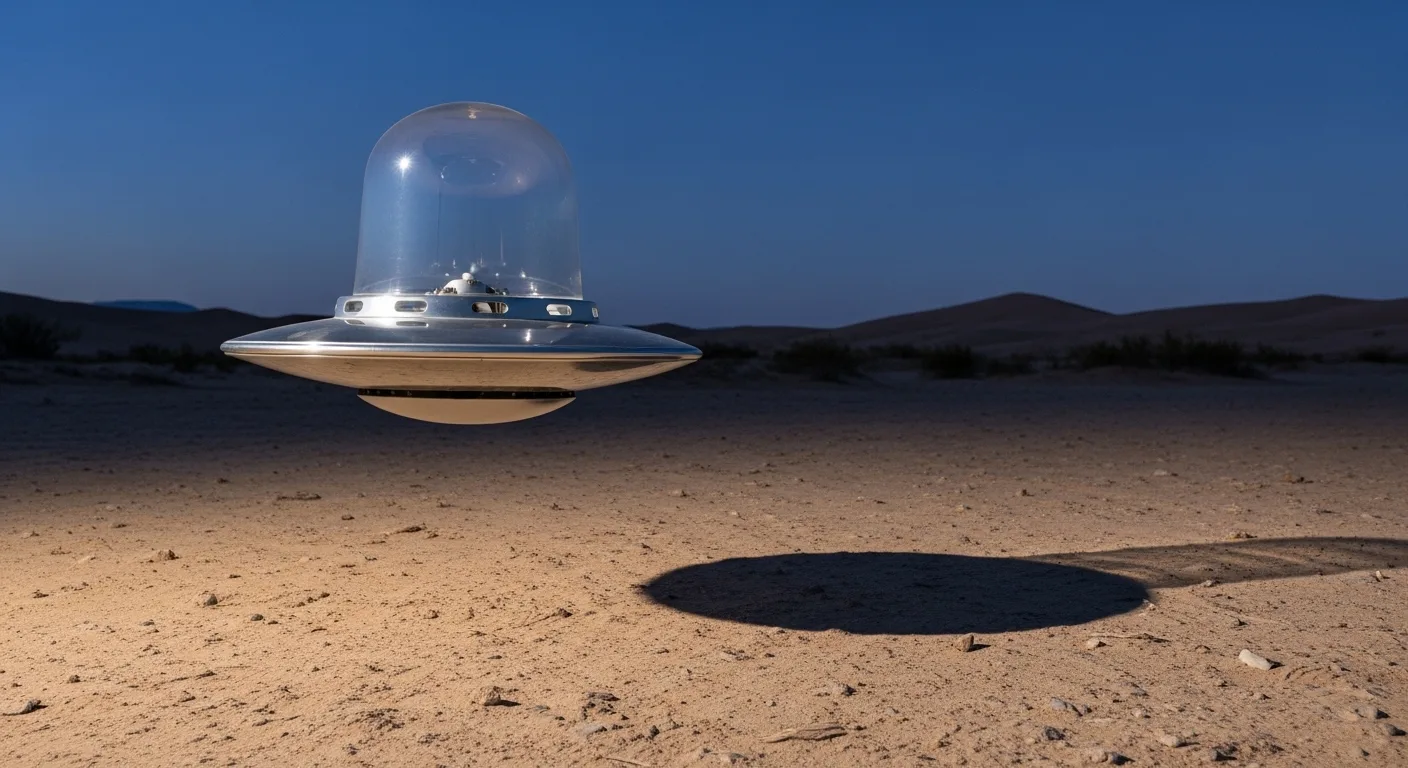
The Rub’ al Khali, the Empty Quarter, is the largest contiguous body of sand on the planet, a near-uninhabited expanse covering most of southern Saudi Arabia and slipping across the borders of Yemen, Oman and the United Arab Emirates. Its remoteness makes it both a natural arena for unusual aerial observation and an unusually difficult one to investigate. A consistent body of UAP reports has nonetheless accumulated over more than seventy years, drawn from sources as varied as British colonial-era explorers, Bedouin oral tradition, Aramco geological survey teams and modern Saudi commercial pilots.
Historical Context
The earliest entry in the European record belongs to Wilfred Thesiger, the British explorer who crossed the Empty Quarter twice in the late 1940s. In a passage of Arabian Sands dated to the spring of 1947, Thesiger described an evening near the wells of Mughshin in which his Bedu companions roused him to watch a “pale star which had wandered from its place” pass slowly south above the dunes for nearly half an hour. Thesiger, sceptical and exact, recorded it as a curiosity. His companions, he noted, treated such appearances as routine and described them in terms drawn from the older tradition of jinn inhabiting waterless places.
The case record began to accumulate in earnest after the establishment of Saudi Aramco’s geological survey programme in the 1950s. Survey teams operating from base camps at Shaybah and Harmaliya filed a number of brief reports through the 1950s and 1960s, most of them describing solitary objects observed at low elevation above the southern dune fields, holding station for periods of ten to forty minutes before either rising vertically out of sight or simply ceasing to be visible.
Witness Account
The most complete single witness account in the modern record was given by an Aramco pilot named Faisal al-Otaibi, whose 1989 encounter near the Yemen border was filed as a routine incident report and later released in summary form by the Saudi General Authority of Civil Aviation. Al-Otaibi was flying a survey aircraft at approximately twelve thousand feet on a clear afternoon when he observed a large lenticular object holding station at his altitude approximately three nautical miles to the north. The object, he wrote, did not match any aircraft he could identify, made no visible contrails, and appeared to absorb rather than reflect sunlight. After approximately seven minutes the object accelerated to a speed his cockpit instruments could not register and was lost from sight in less than two seconds.
Al-Otaibi’s report joined a growing dossier maintained, somewhat informally, by the kingdom’s air traffic services. By the early 2000s the dossier reportedly included more than forty incidents from civilian and military pilots, although none of the underlying records have been formally declassified. A 2021 article in the Saudi daily Asharq Al-Awsat drew on interviews with retired air traffic controllers at Riyadh’s central control to establish the existence and approximate scope of the archive without obtaining its contents.
Investigation
The Empty Quarter is one of the few places on earth where high-altitude observation is genuinely uncluttered by terrestrial radio traffic, light pollution or air corridors, and this combination has made it a recurring site of interest for both astronomers and natural-phenomena researchers. A 2017 paper in the Journal of Atmospheric Optics by the King Abdulaziz City for Science and Technology examined a subset of pilot reports and concluded that approximately two-thirds could be plausibly attributed to atmospheric refraction phenomena, including unusually persistent mirages caused by the desert’s extreme thermal inversions. The remaining one-third, the paper noted, presented characteristics inconsistent with any known atmospheric optical mechanism.
Skeptical commentators have additionally pointed to the Empty Quarter’s proximity to several active military installations, including the King Khalid Air Base and the Yemeni border zone, and have argued that a substantial portion of the more spectacular sightings represent test flights of classified Saudi, American or Israeli aerospace platforms. This explanation accounts for some, but not all, of the historical record, and notably does not address the pre-1960s reports.
Cultural Impact
For the Bedu communities of the Empty Quarter the appearances are absorbed into a long tradition of supernatural travellers in the deep desert. The objects share a folkloric category with the jinn of Islamic and pre-Islamic Arabian belief, and individual witnesses sometimes use the older language and the modern UAP vocabulary interchangeably. The case record bears comparison with the Yemen orb incidents of 2024 on the southern margin of the same desert, and with the Tigray highland lights further west across the Red Sea.
Whether the Empty Quarter sightings represent classified aerospace activity, atmospheric optical phenomena, or something genuinely unexplained, they constitute one of the most sustained and least disturbed UAP traditions in the Arabian peninsula, and their full record will likely remain inaccessible until the underlying Saudi air-traffic dossier is released.
Sources
- Thesiger, Wilfred. Arabian Sands. Longmans, Green & Co., 1959.
- Asharq Al-Awsat, “Riyadh’s Quiet Archive,” 14 March 2021.
- King Abdulaziz City for Science and Technology. “Atmospheric optical phenomena over the southern peninsula.” Journal of Atmospheric Optics 56 (2017).
- Saudi General Authority of Civil Aviation, Incident Report Summary 1989-114.