Wright-Patterson AFB UFO Sighting (Dec. 17, 1953) — FBI Files
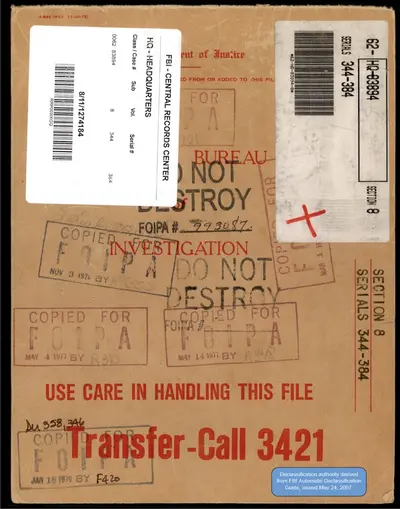
FBI records from December 17, 1953, detail a shift in information control regarding Project Blue Book following an unidentified object incident at…
Historical Context
The early 1950s represented a period of intense atmospheric and aerial scrutiny within the United States. As the Cold War intensified, the presence of unidentified aerial phenomena became a matter of national security, particularly concerning the potential for Soviet incursions into American airspace. During this era, the United States Air Force maintained several investigative programs, most notably Project Blue Book, which sought to scientifically analyze sightings to determine if they posed a threat to national defense. This period was characterized by high levels of secrecy and the mobilization of various intelligence agencies to monitor the skies for everything from experimental reconnaissance technology to potential extraterrestrial visitors.
Wright-Patterson Air Force Base, located in Dayton, Ohio, served as a central hub for much of this activity. As the home of the Air Technical Intelligence Center (ATIC), the base was a focal point for the study of captured foreign technology and the management of aerial intelligence. Because of its strategic importance and its role in investigating anomalous objects, the base was frequently the subject of both official investigations and unauthorized sightings. The geopolitical climate of 1953 necessitated a rigorous classification system, where even the reporting of unidentified objects was subject to strict compartmentalization to prevent the leakage of sensitive aeronautical data.
The December 17 Incident
On December 17, 1953, an unidentified-object incident occurred at Wright-Patterson Air Force Base. The details of the sighting itself were documented by U.S. government investigators, though the specific number of witnesses involved in the observation was not specified in the released documentation. The case was processed through the Federal Bureau of Investigation, following established protocols where various field offices, including those in Knoxville, Albuquerque, and Los Angeles, routed UFO-related reports to FBI headquarters. This routing was a standard procedure designed to ensure the protection of vital military installations and to monitor potential security breaches or espionage related to aerial anomalies.
The released documents, which became available to the public on May 8, 2026, through the Presidential Unsealing and Reporting System for UAP Encounters (PURSUE), highlight a significant shift in the administrative handling of such reports. On the date of the incident, the ATIC at Wright-Patterson informed a correspondent that all information regarding Project Blue Book would be released exclusively through the Department of Defense. This directive indicated a new security ruling that centralized the flow of information, effectively limiting the transparency of UFO investigations by moving the authority for public disclosure away from secondary investigative bodies and strictly into the hands of the Department of Defense. The verbatim record from the file states that, in reference to a specific inquiry, the ATIS had been directed to make all information on Project Blue Book available to the Department of Defense for release from that point only.
Investigation and Classification
The nature of the case is classified as a visual sighting reported by ground or air observers. In the broader context of mid-century aerial phenomena, such sightings were often scrutinized against a backdrop of known technological developments. During the late 1940s and early 1950s, the presence of high-altitude reconnaissance projects, such as the Project Mogul series of weather balloons, provided a frequent conventional explanation for unidentified objects. Additionally, atmospheric optical phenomena, including sundogs, lenticular clouds, and the visual effects of planets like Venus or the Moon near the horizon, were common candidates for misidentification.
Under the current oversight of the All-domain Anomaly Resolution Office (AARO), all records released under the PURSUE program are designated as unresolved by default. The federal government has not reached a definitive conclusion regarding the December 17, 1953, incident, nor has it determined whether the object was of an anomalous nature or a conventional one. The investigation remains open to the possibility of experimental aircraft or other known atmospheric and astronomical objects, maintaining the same state of ambiguity that characterized the original era of investigation.