The Black Volga
Across Cold War Eastern Europe, parents warned their children that a black GAZ-21 with white curtained windows prowled empty streets, taking those who came too close — and the legend persisted long after the model went out of production.
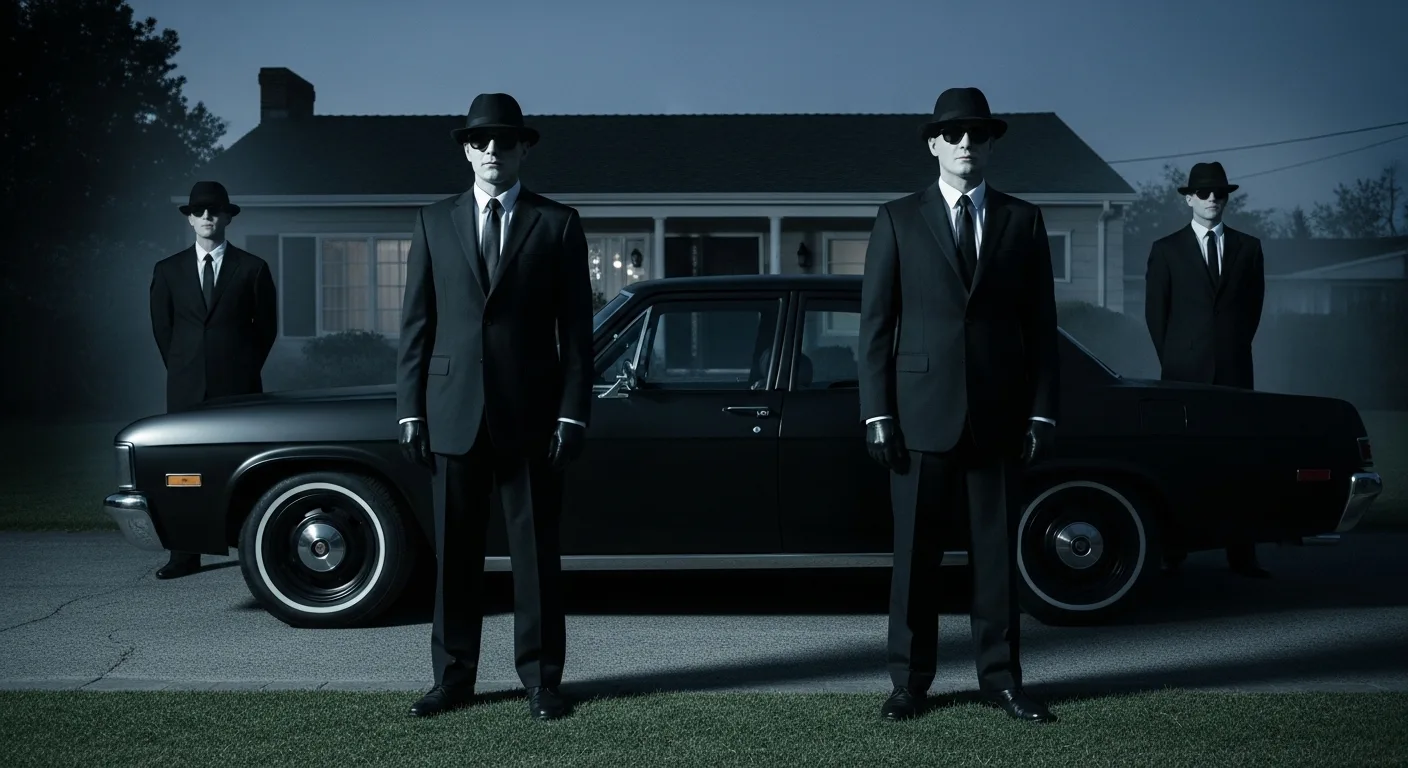
In the small towns and city outskirts of Cold War Eastern Europe, a particular folk-horror story circulated with remarkable consistency from at least the 1960s onward. A black sedan, identified by witnesses as a Soviet GAZ-21 Volga, would appear in the late afternoon or early evening on quiet streets where children were walking home alone. Its windows were sometimes described as fitted with white lace curtains, sometimes as bordered in chrome, sometimes as opaque or impossibly dark. The driver, when seen, was occasionally a priest or nun, occasionally a man in a black suit, and occasionally not human at all. Children who approached the vehicle, the warnings ran, were taken and never seen again. Their blood, in some versions, was harvested for transfusions to wealthy Westerners; their organs, in later versions, were sold abroad. In still other tellings, the Black Volga was driven by Satan himself, or by his agents, gathering souls in the most ordinary territory of postwar life.
The Black Volga is one of the most fully developed urban legends to emerge from the socialist bloc, and its longevity, its geographic spread, and its peculiar resistance to debunking make it a folklore artifact of unusual interest. It also occupies a curious territory in the history of the paranormal, where ordinary criminal anxiety, ideological subversion, and genuine belief in demonic agency were folded together in a single narrative.
A Vehicle Of The State
The GAZ-21 Volga was the Soviet Union’s flagship passenger sedan from 1956 until the mid-1970s, and even after production ended the car remained on the streets for decades, particularly in official use. Within the socialist bloc, the Volga was the car of the senior bureaucrat, the regional party secretary, the security service, and the diplomatic courier. A private citizen rarely owned one, and almost never owned a black one. The Black Volga, in other words, was already a vehicle of authority before any folk legend attached to it. It signaled, on sight, an institution outside the everyday life of the witness.
This baseline cultural meaning is essential to understanding the legend. Children in Warsaw, Prague, Budapest, and Bratislava grew up watching black Volgas pass through their neighborhoods with precise destinations and minimal explanation. The cars belonged to men in suits whose business was not the business of ordinary families. Adding to this real ambiguity a story of disappearance, blood, and demonic agency required only a small imaginative step.
The Earliest Reports
The first identifiable instances of the legend appear in Polish accounts from the early 1960s. In Warsaw and the surrounding voivodeships, parents began telling children to stay clear of black Volgas, particularly those with white curtains in the rear windows. Children who entered such cars, the warnings ran, would be taken to a hidden location where their blood would be drained for the use of foreign customers, often described as Arab oil sheikhs or West German industrialists. Some accounts specified that the blood was needed to treat radiation poisoning or some other illness particular to wealthy Westerners.
By the late 1960s, the legend had spread across the Czechoslovak border and into Hungary, where it adopted local variants. The Czech version sometimes featured nuns at the wheel, dispatched by the church on errands of obscure import. The Hungarian version sometimes substituted a black Mercedes or Tatra, although the canonical vehicle remained the Volga. By the 1970s, the legend was active in the western Soviet Union itself, particularly in Belarus and Ukraine, although in those territories the political sensitivities surrounding any criticism of state-associated vehicles kept the story closer to the level of whispered rumor than published account.
The Curtained Windows
A peculiar feature of the legend is the recurring detail of the white curtains in the rear windows. Real GAZ-21 Volgas, particularly those used by the security services and senior party officials, were sometimes fitted with such curtains for reasons of privacy. The detail was therefore grounded in the real automotive culture of the Eastern Bloc. In the legend, however, the curtains acquired an additional resonance: they were described as the only marker that allowed a child to distinguish the supernatural Black Volga from an ordinary one, and crossing into the interior of a curtained car was treated as a one-way passage of the same kind that, in older European folklore, characterized the threshold of fairy abduction.
In some Polish accounts, the curtains were said to glow faintly in the evening light. In some Czech accounts, the curtains parted of their own accord as the car drew alongside the witness. The motif of an opaque interior concealing an unknown agency runs through the entire body of the legend and connects it to older European stories of carriages driven by Death or by the Devil, of which the Black Volga is, in a real sense, a Cold War transformation.
Skeptical And Scholarly Readings
The Black Volga has attracted the attention of folklorists since the early 1990s, when access to the underlying material became possible across the former bloc. The Polish folklorist Dionizjusz Czubala documented the legend extensively, comparing it with contemporary legends about white slavery, child kidnapping, and organ theft that circulated throughout Europe in the same decades. Czubala and others have argued that the Black Volga functioned as a localized expression of anxiety about the unaccountable power of the state, projected onto the vehicle that was its most visible everyday symbol. The disappearances at the heart of the legend mirrored the very real disappearances of citizens taken by the security services; the wealthy foreign customers mirrored persistent propaganda about the predatory West; the priest or nun at the wheel pointed at the church’s ambiguous accommodation with the regime; and the Devil at the wheel collapsed all of these readings into a single supernatural figure who carried, more honestly than any of the others, the actual moral weight of the situation.
Reported Encounters
A small number of accounts purport to be first-person rather than legendary. A Warsaw woman interviewed in the 1990s described being followed home from school in 1968 by a black Volga whose driver opened the rear door and gestured her toward it; she ran, the car followed her for a block, and then turned away. A man in Brno reported a similar episode in 1972. These accounts may describe ordinary attempted child abductions dressed in inherited imagery, and are reported here for completeness rather than as evidence of supernatural agency.
The legend faded with the disappearance of the GAZ-21 from the streets in the 1990s and with the broader collapse of the Eastern Bloc state apparatus. By the early 2000s the Black Volga had passed into recovered folklore, a story grandparents told grandchildren about a world that no longer existed. It has since been collected and analyzed alongside the various Slavic tales of the Baba Yaga, an item of national folklore whose paranormal core is inseparable from the political anxieties that shaped it.
Sources
- Czubala, Dionizjusz, Współczesne legendy miejskie, Wydawnictwo Uniwersytetu Śląskiego, Katowice, 1993.
- Wójcik, Anna, “The Black Volga: Cold War Folklore in Poland,” Folklore journal, 2007.
- Brunvand, Jan Harold, Encyclopedia of Urban Legends, ABC-CLIO, 2001.
- Ellis, Bill, Aliens, Ghosts, and Cults: Legends We Live, University Press of Mississippi, 2001.