Welsh Triangle UFO Flap
Pembrokeshire, Wales experienced a wave of UFO sightings, landings, and humanoid encounters. School children drew identical craft before comparing notes, and a farmer saw giant silver figures.
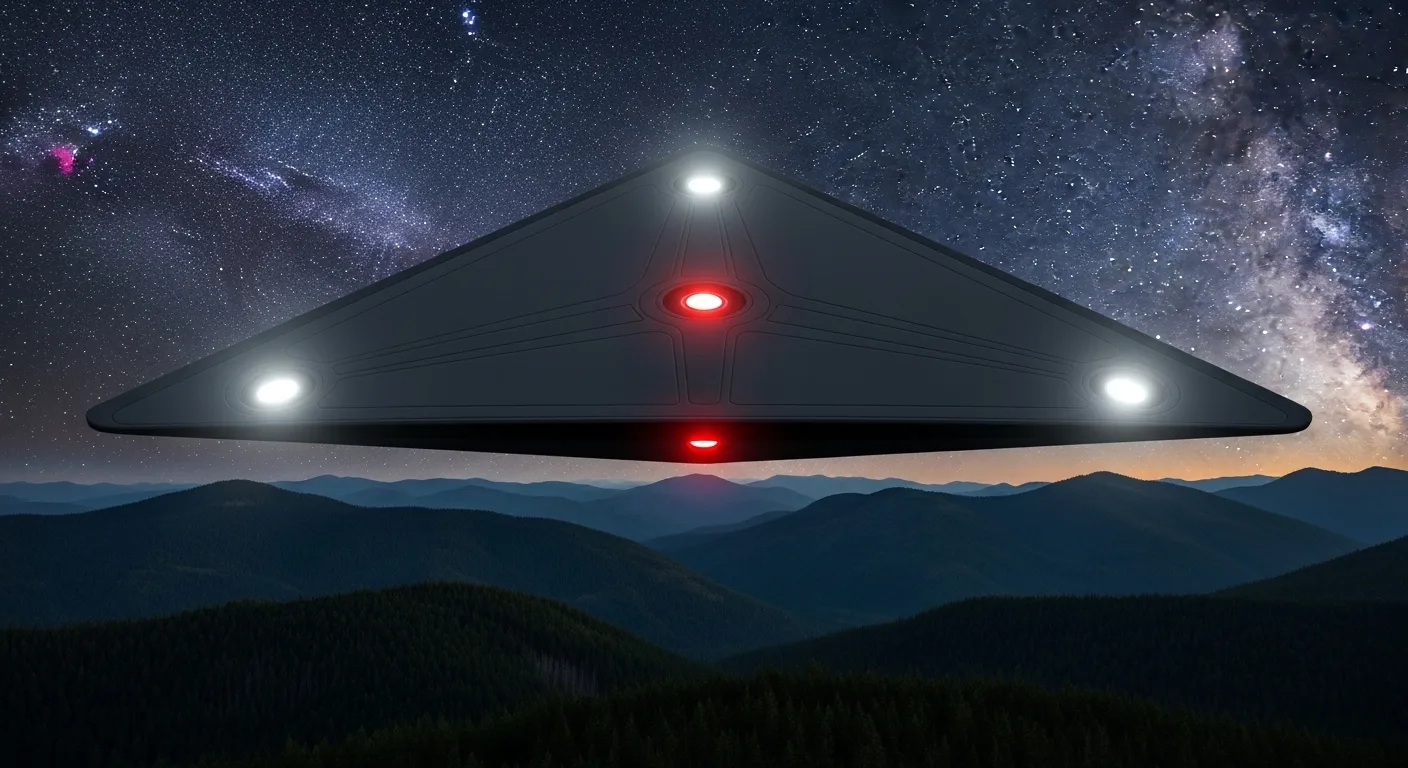
In the early months of 1977, the remote and windswept county of Pembrokeshire in southwest Wales became the center of one of the most concentrated and compelling waves of UFO activity ever recorded in the British Isles. Over a period of several months, hundreds of witnesses across a small geographic area reported sightings of unidentified craft, encounters with tall humanoid figures in silver suits, and a range of associated phenomena that defied conventional explanation. The events centered on a cluster of communities around the village of Broad Haven, and the area quickly became known in the press as “The Welsh Triangle,” a name that captured both the geographic concentration of the sightings and their triangular relationship to certain key locations. What made the Welsh Triangle unique was not merely the volume of reports but their quality: the witnesses included schoolchildren whose independently produced drawings matched with uncanny precision, a hotel proprietor who observed craft and beings on multiple occasions, and a farming family subjected to weeks of persistent and terrifying encounters.
The Landscape of Mystery
Pembrokeshire occupies the southwestern tip of Wales, a peninsula jutting into the Irish Sea where the Atlantic weather systems batter ancient cliffs and the landscape retains a wild, primeval quality that seems to belong to an earlier age. The countryside is a patchwork of small farms, scattered villages, and lonely moorland, dotted with the remnants of a prehistoric past that stretches back thousands of years. Standing stones, burial chambers, and Iron Age hill forts mark the landscape, reminders that this has been a place of human habitation and spiritual significance since long before recorded history.
The area around Broad Haven, where the 1977 wave was most intense, combines coastal cliffs with rolling agricultural land. The villages are small and close-knit, their inhabitants connected by the bonds of rural community, shared work, and the Welsh nonconformist religious tradition. In 1977, this was still a relatively isolated region, served by narrow roads and limited public transport, where most people knew their neighbors and where strangers were noticed and remarked upon. It was precisely the kind of community where a mass hoax would have been difficult to sustain and where the integrity of witnesses could be assessed with some confidence.
The proximity of the Royal Aircraft Establishment at Brawdy, a military facility that included a NATO communications center, has led some researchers to speculate about a connection between military activity and the UFO sightings. Skeptics have suggested that experimental aircraft or military exercises could account for some of the reported phenomena. However, the nature of the sightings, particularly the close encounters with humanoid beings, goes far beyond anything that military technology of the 1970s could explain, and the military authorities denied any connection to the events.
The Children of Broad Haven
The event that first brought the Welsh Triangle to national attention occurred on February 4, 1977, at Broad Haven Primary School. During the afternoon break, a group of fourteen children between the ages of nine and eleven observed an unusual object in a field adjacent to the school grounds. The object was described as silver or metallic in color, roughly cigar-shaped or torpedo-like, and resting on or hovering just above the ground. Near the object, one or more tall figures in silver-colored suits were observed moving about.
The children were excited and frightened by what they had seen, and when they returned to their classroom, they immediately told their teacher about the sighting. The teacher, understandably skeptical, passed the report to the headmaster, Ralph Llewellyn, who recognized that he had a situation requiring careful handling. Llewellyn was aware that children’s accounts could be influenced by discussion and mutual suggestion, and he wanted to establish whether the children had genuinely seen something unusual or whether a single child’s imagination had infected the group.
Llewellyn’s response demonstrated an intuitive understanding of investigative methodology. He separated the children who claimed to have witnessed the object and asked each one, independently and without discussion with the others, to draw what they had seen. The children were given paper and crayons and asked to produce their drawings in isolation, with no opportunity to confer or compare notes.
The results were remarkable. When the drawings were collected and examined side by side, they showed a striking consistency in shape, size, and detail. The children had independently depicted the same object: a rounded or cigar-shaped craft with a dome or protrusion, resting on or near the ground. Some drawings included the silver-suited figure or figures, depicted with consistent proportions and positioning relative to the craft. The variations between the drawings were consistent with what one would expect from different viewing angles and individual artistic abilities, but the fundamental object depicted was unmistakably the same.
These drawings became the most famous pieces of evidence from the Welsh Triangle and have been reproduced in countless books, documentaries, and articles about the case. Their evidential value lies in the methodology of their collection: children separated before drawing, with no opportunity to influence each other’s depictions, producing consistent images of an object that none of them had ever seen before. While skeptics have suggested that the children might have discussed the sighting before being separated, or that Llewellyn’s methodology was less rigorous than reported, the drawings remain one of the most compelling pieces of evidence from any UFO case, precisely because they were produced by witnesses too young to have sophisticated motives for deception.
Rosa Granville and the Haven Fort Hotel
While the Broad Haven school sighting captured the headlines, the most sustained and detailed observations during the Welsh Triangle wave came from Rosa Granville, the proprietor of the Haven Fort Hotel, a clifftop establishment overlooking St. Bride’s Bay. Granville was a practical, no-nonsense businesswoman, not the type of person inclined to flights of fancy or attention-seeking fabrication. Her accounts of what she witnessed during the spring of 1977 are detailed, consistent, and deeply disturbing.
Granville first noticed unusual activity near her hotel in late February 1977. Looking out from the hotel at night, she observed a dome-shaped object in a field below the cliffs, glowing with an otherworldly luminescence. The object appeared to be sitting on the ground, its surface smooth and featureless except for the dome, which pulsated with light. On subsequent nights, the object returned, sometimes accompanied by tall figures in silver suits who moved about the field with a strange, gliding gait.
The figures that Granville described were among the most striking elements of the Welsh Triangle encounters. She estimated their height at seven feet or more, considerably taller than any normal human. They wore what appeared to be one-piece suits of silver or metallic material, with no visible seams, buttons, or other fastening mechanisms. Their movements were described as smooth and deliberate, lacking the natural swing of human walking, as though they were floating just above the ground rather than stepping on it. Granville found the figures deeply frightening, not because they displayed any aggressive behavior but because their appearance and movements were so fundamentally wrong, so utterly unlike anything in her experience, that they inspired a visceral terror.
Over the course of several weeks, Granville observed these phenomena repeatedly, sometimes from the hotel windows and sometimes at closer range. She reported the sightings to the police and to UFO investigators, providing detailed descriptions that remained consistent throughout the many interviews she gave. Her husband and members of her staff corroborated portions of her account, having witnessed some of the phenomena themselves.
The Coombs Family at Ripperston Farm
The most protracted and distressing encounters of the Welsh Triangle wave were experienced by the Coombs family, who lived at Ripperston Farm, a dairy operation located near the coast between Broad Haven and the Haven Fort Hotel. Billy and Pauline Coombs, along with their children, endured weeks of escalating phenomena that transformed their farm from a place of work and security into a site of persistent terror.
The Coombs family’s experiences began with sightings of unusual lights over their farmland. Billy Coombs, returning home from milking, observed a bright object hovering above the fields, moving silently across the landscape before disappearing behind a hill. Similar sightings recurred over the following days, with family members independently observing lights that appeared to be intelligently controlled, moving with purpose rather than drifting with the wind.
The encounters escalated dramatically when the family began seeing figures near the farmhouse. On one occasion, Pauline Coombs was alone in the house with her children when she looked up at the window and saw a face staring in at her. The figure was enormously tall, its head reaching the upper portion of a window that no normal person could look through without a ladder. The figure was dressed in a silver suit and its face, while humanoid in shape, was described as lacking the normal features of a human face, smooth and expressionless, without clear eyes, nose, or mouth. Pauline’s terror was absolute and immediate. She gathered her children and fled the house.
The car that the Coombs family used was also affected. On several occasions, the vehicle stalled without explanation at a particular spot on the road near the farm, its engine cutting out and refusing to restart until the family had waited for a period of time, after which it would start again as though nothing had happened. This phenomenon was consistent enough to suggest a connection to some external force operating in the area, possibly related to the other phenomena being experienced.
The family’s cattle behaved strangely during the period of activity. The animals were restless and difficult to manage, sometimes refusing to enter the barn or breaking free from their enclosures. On one occasion, Billy Coombs found his entire herd had been moved from one field to another during the night, with no sign of how they had been relocated. The fences between the fields were intact and the gates were closed, ruling out simple wandering. The television in the farmhouse experienced persistent interference during the active period, the picture breaking up and the sound distorting at times that sometimes coincided with other phenomena.
Stack Rocks and Underwater Lights
One of the most intriguing aspects of the Welsh Triangle was the repeated observation of unusual activity in the vicinity of the Stack Rocks, a group of small rocky islands just offshore from the coast near Broad Haven. Multiple witnesses reported seeing lights moving between the mainland and the Stack Rocks, traveling at high speed just above the water surface. Others described lights beneath the surface of the sea, glowing objects visible through the water that moved with apparent purpose and control.
These observations led to speculation that whatever was responsible for the Welsh Triangle phenomena might have an underwater component, a base or staging area located beneath the sea from which craft emerged to conduct operations on land. The concept of Unidentified Submerged Objects (USOs) has a long history in UFO research, and the Pembrokeshire coast, with its deep waters and numerous sea caves, provided a plausible environment for such activity.
The military presence at Brawdy added another dimension to the Stack Rocks observations. Some researchers noted that the coastal military facility, with its surveillance capabilities, would have been well positioned to detect any unusual underwater activity in the area. Whether the military investigated the Stack Rocks reports, and what they found if they did, remains unknown, as no official records of such an investigation have been released.
Investigation and Media Attention
The Welsh Triangle attracted significant media attention from the outset, with local newspapers reporting the Broad Haven school sighting and subsequent events in considerable detail. As the wave continued and the volume of reports increased, national newspapers and television programs picked up the story, transforming Broad Haven from an obscure Welsh village into a place of national and international interest.
The UFO research community responded with investigations of varying quality. Several experienced researchers visited the area, interviewing witnesses, examining physical evidence, and attempting to correlate the various sightings into a coherent picture. Randall Jones Pugh, a veterinary surgeon and UFO investigator based in Pembrokeshire, conducted the most thorough investigation, spending months documenting cases and interviewing witnesses. His work, published in the book “The Dyfed Enigma” co-authored with F.W. Holiday, remains the most comprehensive account of the Welsh Triangle events.
Some attempts at debunking the sightings produced mixed results. A local businessman later claimed to have staged some of the sightings near the school by wearing a silver suit and walking through the field, but this claim was disputed by witnesses who argued that the figure they had seen was far taller and moved differently from any human in a costume. Moreover, the businessman’s alleged prank could not account for the metallic craft that the children had also observed and drawn.
The Evidence Endures
The Welsh Triangle wave gradually subsided as 1977 progressed, with sightings becoming less frequent and eventually ceasing. The community returned to its normal rhythms, though the events left a lasting impression on those who had experienced them. The children of Broad Haven carried their memories into adulthood, and several have spoken publicly about their experiences in the decades since, maintaining the same accounts they gave as schoolchildren.
The case’s significance lies in several factors that distinguish it from less compelling UFO reports. The geographic concentration of the sightings, occurring within a small area over a defined period, suggests a localized phenomenon rather than random misidentifications. The diversity of witnesses, from schoolchildren to hotel proprietors to farming families, makes coordinated hoaxing extremely unlikely. The children’s drawings, produced independently and matching in essential details, provide a form of physical evidence that goes beyond mere testimony. And the associated phenomena, from humanoid encounters to vehicle interference to animal disturbance, paint a picture of a complex event that affected multiple aspects of the physical environment.
The Welsh Triangle remains one of the most important UFO cases in British history, a concentrated burst of activity that affected an entire community and produced evidence that continues to challenge conventional explanations. Whatever descended upon Pembrokeshire in the spring of 1977, whether visitors from elsewhere, an unknown natural phenomenon, or something beyond current human understanding, it left marks on the landscape and on the people who lived there that decades have not been able to erase. The children who drew those matching pictures are adults now, but the questions their drawings raised remain as vivid and as unanswered as they were on that February afternoon when something silver and strange appeared in a field beside a Welsh primary school.
Sources
- CIA UFO/UAP Reading Room — Declassified CIA documents on UAP
- UK National Archives — UFO Files — MoD UFO investigation records
- British Newspaper Archive — UK press archive