Pascagoula Abduction Complete Account
Charles Hickson and Calvin Parker were fishing when robotic beings took them aboard a craft. Their immediate report to police, recorded interrogation, and separate polygraphs make this a compelling abduction case.
Among the thousands of UFO encounters reported throughout history, few have generated the documentation, investigation, and lasting credibility of what occurred on the Pascagoula River on October 11, 1973. When Charles Hickson and Calvin Parker reported their abduction to local authorities that night, they set in motion an investigation that would produce polygraph verifications, expert evaluations, and most compellingly, a secret recording that captured two men in genuine distress, with no idea their words were being preserved for history.
The Witnesses and Their Background
Charles Hickson brought to that October evening forty-two years of life experience that had prepared him for difficult situations. A World War II veteran who had seen combat, he worked as a foreman at the Ingalls Shipyard, responsible for managing crews and maintaining production. His reputation was that of a reliable, practical man, not given to fantasy or exaggeration. He had no interest in UFOs, no history of unusual claims, nothing in his background that suggested he would fabricate such a story.
Calvin Parker was Hickson’s opposite in many ways: young, inexperienced, and still finding his way in the adult world. At nineteen, he worked under Hickson’s supervision, learning the shipyard trade while earning his living through honest labor. The relationship between the two was that of mentor and student, older worker and younger, a bond built on shared labor rather than deep personal friendship. Neither man could have anticipated that their evening of fishing would transform that relationship into something neither would ever escape.
The Evening Begins
October 11, 1973 had been a long day at the shipyard, and both men sought the relaxation that fishing provided. The Pascagoula River offered familiar territory, quiet spots where a man could cast his line and forget the demands of work. They selected a pier they knew, set up their equipment, and settled into the peaceful rhythm of evening fishing.
The river was calm, the October air comfortable, the fading daylight giving way to darkness without incident. For perhaps an hour, the two men fished in companionable silence, enjoying the simple pleasure of lines in the water and the possibility of a good catch. Nothing suggested that the evening would become anything other than an unremarkable excursion, soon forgotten in the routine of working life.
The Approach
The first indication of something unusual came as a sound, a zipping or buzzing that neither man could identify with anything in their experience. Looking toward the source, they observed a blue light approaching from across the water, moving with purpose and growing larger as it neared. The light was too bright for navigation beacons, too low for aircraft, too steady for any natural phenomenon either man could name.
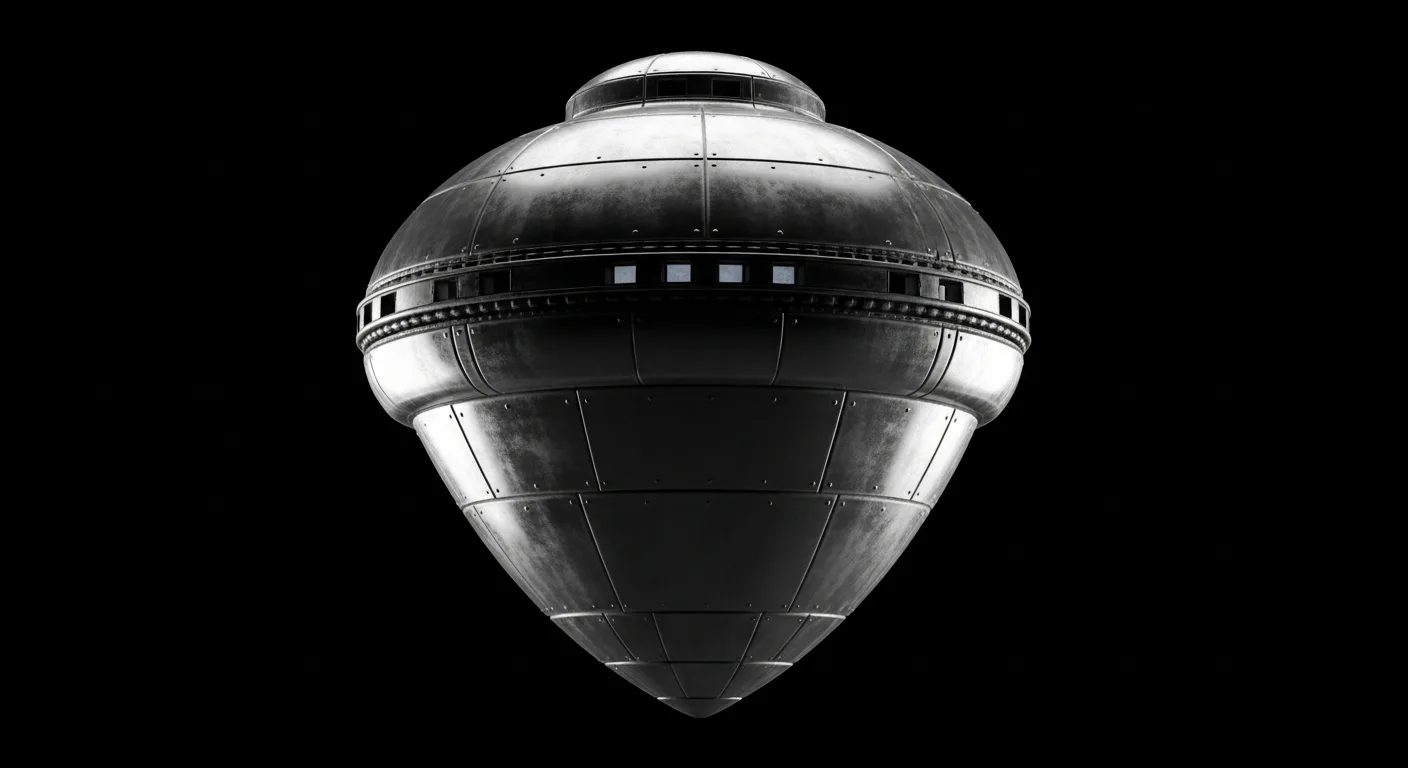
As the light drew closer, its source became apparent: a craft, oval-shaped and clearly structured, unlike anything manufactured by known aviation technology. The object descended toward the pier, approaching within a short distance of where Hickson and Parker sat frozen in disbelief. Then it opened, and beings emerged.
The Beings Emerge
What came out of the craft represented something beyond the vocabulary either man possessed to describe. They were humanoid only in the crudest sense: approximately five feet tall, with two arms and two legs, standing upright. But there the resemblance to anything human ended. Their skin was gray and wrinkled, suggesting great age or simply an origin beyond earthly biology. Where faces should have displayed eyes, they showed only slits or ridges. Their hands ended not in fingers but in claw-like appendages, cruel and mechanical.
The beings moved by floating rather than walking, gliding toward the two fishermen without any visible means of propulsion. Their approach was silent, purposeful, utterly unhuman. And when they reached Hickson and Parker, both men found themselves suddenly paralyzed, conscious but completely unable to move or resist.
The Examination
The beings lifted their captives effortlessly, floating them toward and into the waiting craft. Inside, Hickson found himself in a brightly lit space, subjected to examination by an instrument unlike anything in his experience. The device seemed to move around him on its own, studying him with an eye-like apparatus at its tip. The examination was thorough but not painful, clinical in its efficiency.
Parker’s experience was more fragmented. The younger man appears to have lost consciousness at some point, whether from terror or deliberate action by the beings. His memories of the interior of the craft and the examination would remain incomplete, emerging only through later hypnotic regression. What he retained was enough to traumatize him for decades.
The Return
After what seemed like an eternity but was probably around twenty minutes, the beings returned their captives to the pier. The craft rose and departed, disappearing into the night sky with the same impossible movement that had brought it. Hickson and Parker found themselves alone, their fishing equipment forgotten, their minds reeling from what had just occurred.
For some time, they simply sat in shock, each trying to process an experience that refused to fit into any framework they possessed. Eventually, Hickson suggested they report to authorities. Parker initially resisted, fearful of ridicule, but eventually agreed. Whatever they had encountered, it seemed too significant to conceal.
At the Sheriff’s Office
The officers who received Hickson and Parker that night expected to hear something they could dismiss: a fishing story gone wrong, or men seeking attention for reasons of their own. What they encountered instead were two deeply shaken individuals, visibly trembling, their voices unsteady, their eyes carrying the look of men who had seen something terrible.
Standard procedure called for separating the witnesses and interviewing them independently. The officers did so, expecting inconsistencies that would reveal fabrication. Instead, they received the same account from both men: the craft, the beings, the paralysis, the examination. The details aligned in ways that suggested not rehearsal but shared experience.
The Hidden Recorder
The decision that would define the Pascagoula case came when officers left Hickson and Parker alone in a room, ostensibly to compose themselves. Unknown to the witnesses, a tape recorder had been concealed in the room, capturing whatever the men might say when they believed themselves unobserved.
What the tape revealed was not the conversation of successful hoaxers. There was no celebration, no coordination of details, no suggestion of what to say next. Instead, the recording captured two genuinely terrified men struggling to understand what had happened to them. Parker is heard praying and weeping, calling on God for protection. Hickson expresses bewilderment and shock. The private conversation matched their public testimony: whatever these men had experienced, they believed it to be real.
Investigation by Experts
The case attracted attention from serious researchers, including Dr. J. Allen Hynek, the astronomer who had spent years evaluating UFO reports for the U.S. Air Force. Hynek traveled to Mississippi to interview the witnesses personally. His conclusion: both men were credible, their account was consistent, and they showed no signs of fabrication or mental instability.
Polygraph examinations were administered to both witnesses, not once but repeatedly over the following years. Different examiners, different times, but consistent results: both Hickson and Parker showed no indicators of deception. Whatever the limitations of polygraph technology, the tests could not identify any intentional lying.
Two Different Responses
The years following the abduction saw Hickson and Parker take divergent paths. Hickson eventually embraced his role as a UFO witness, speaking at conferences, granting interviews, and writing about his experience. He maintained his account without variation until his death in 2011, never recanting or admitting to fabrication of any kind.
Parker suffered more severely from the experience and sought to avoid the spotlight. For decades, he lived quietly, declining interview requests and trying to process his trauma privately. It was not until 2018, with the publication of his own book, that Parker fully emerged to share his perspective on events that had shaped his entire adult life.
The Evidence Assembled
The Pascagoula case rests on multiple pillars of evidence that collectively create an unusually strong foundation. Two witnesses reported immediately to authorities, before any opportunity for coordination or fabrication. Their separate interviews produced consistent accounts. The secret recording captured genuine distress rather than hoax celebration. Polygraph examinations consistently indicated truthfulness. Expert investigators found both men credible.
Against this evidence, skeptics have offered various explanations: shared hallucination, elaborate hoax, misidentified natural phenomena. None of these alternatives adequately explains all the evidence, particularly the secret recording. The Pascagoula case remains what it was the night Hickson and Parker walked into the sheriff’s office: an encounter that defies conventional explanation.
Legacy of an Encounter
More than fifty years after that October evening, the Pascagoula abduction continues to generate discussion and research. The case demonstrates what rigorous investigation can reveal when applied to UFO reports: not proof of extraterrestrial visitation, perhaps, but evidence of something genuinely unusual that affected two ordinary men in profound ways.
Charles Hickson and Calvin Parker did not seek their experience. They did not profit from it in any meaningful way. They simply went fishing one evening and returned with memories that would never leave them. The robotic beings, the blue light, the paralysis, and the examination became defining moments of their lives, preserved not only in their testimony but in a recording made when they thought no one was listening.
Sources
- CIA UFO/UAP Reading Room — Declassified CIA documents on UAP