Grand Blanc, Michigan UFO Sighting (March 1960) — FBI Files
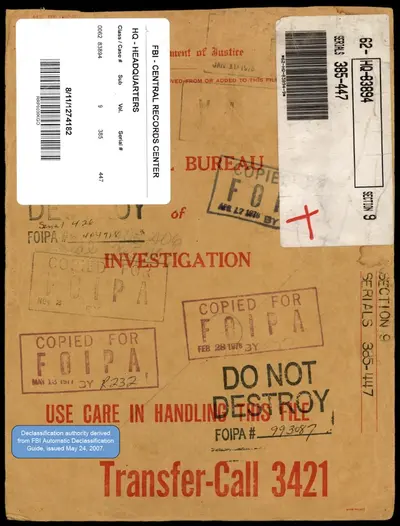
In March 1960, an individual submitted photographic evidence of an unidentified flying object to the FBI, as revealed by the PURSUE program unsealing.
Historical Context
The month of March 1960 occurred during a period of heightened global tension and intense scrutiny regarding the upper atmosphere. As the Cold War progressed, the United States and the Soviet Union engaged in an era of rapid technological advancement, particularly concerning reconnaissance capabilities and aerospace engineering. During this era, unidentified flying object sightings were frequently investigated through various government channels, most notably the United States Air Force’s Project Blue Book. While Blue Book served as the primary repository for aerial anomaly data, the Federal Bureau of Investigation maintained its own protocols for processing reports that intersected with national security interests.
The bureaucratic handling of such reports often involved a decentralized network of field offices. In the late 1950s and early 1960s, FBI offices in cities such as Knoxville, Albuquerque, and Los Angeles were tasked with routing sightings to headquarters, particularly when the reported objects were seen in proximity to vital installations or sensitive military sites. This systemic approach ensured that any potential intelligence-gathering threats from foreign adversaries were documented and analyzed by central authorities.
The Grand Blanc Incident
In March 1960, an incident involving an unidentified object was recorded in Grand Blanc, Michigan. The details of this specific case were made available to the public on May 8, 2026, following the implementation of the Presidential Unsealing and Reporting System for UAP Encounters (PURSUE). The documentation reveals that Edward Strehe submitted a colored transparency to the FBI for the purpose of identification. This transparency contained images of both the moon and an unidentified flying object.
The submitted material was of particular importance to the submitter, as Strehe noted the transparency held potential financial value related to his photography hobby. Accompanying the submission, Strehe expressed significant concern regarding the status of the evidence, noting that he had not received any information regarding the progress of the identification process and feared the material would not be returned to him. The official response from the Bureau reflected a-noted lack of confidence in the return of such materials, stating that based on past experience with photographic evidence, the Bureau considered it unlikely that the picture would ever be seen again.
The released documentation does not specify the total number of witnesses present during the sighting. The case remains categorized as a visual sighting reported by ground or air observers, centered on the photographic evidence provided by Strehem.
Analytical Classification
The status of the Grand Blanc sighting is officially designated as unresolved by the All-domain Anomaly Resolution Office (AARO). Under the current mandates of the PURSUE program, all released records are classified as unresolved by default. The federal government has maintained a position of neutrality regarding this specific event, neither concluding that the object was anomalous nor confirming that it was a conventional phenomenon.
In the broader context of mid-century aerial sightings, investigators frequently considered several conventional candidates. These included experimental aircraft testing, atmospheric optical phenomena such as sundogs or lenticular clouds, and astronomical bodies like Venus or meteors near the horizon. During the preceding decade, the presence of high-altitude weather balloons, specifically those associated with the Project Mogul series, also served as a frequent explanation for unidentified aerial tracks. The Grand Blanc case remains part of this larger body of unverified aerial phenomena, awaiting further technological or archival clarity.