Adamski contactee claim Case (1959) — FBI Files (D1P80)
US investigators documented a 1959 incident at Soestdijk Palace involving California contactee George Adamski during a royal audience with Queen Juliana.
Background
On May 18, 1959, an unidentified-object incident occurred at Soestdijk Palace in Utrecht, Holland, an event that was later documented by United States government investigators. The details of this encounter were eventually released to the public on May 8, 2026, through the Presidential Unsealing and Reporting System for UAP Encounters (PURSUE). This case emerged during the height of the Cold War, a period characterized by intense global surveillance and heightened sensitivity regarding aerial incursions. During this era, reports of unidentified flying objects were frequently investigated under the auspices of the United States Air Force’s Project Blue Book or its predecessor programs.
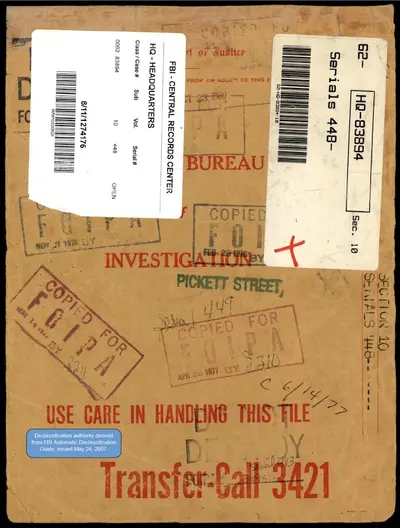
The administrative handling of the report followed established federal protocols of the time. The Federal Bureau of Investigation (FBI) maintained a systematic approach to processing such reports, particularly when they involved potential threats to national security or vital installations. Field offices in cities such as Knoxville, Albuquerque, and Los Angeles were tasked with routing UFO reports to headquarters according to standing procedures. This centralized oversight ensured that any sighting that could be interpreted as a breach of airspace or a technological anomaly was scrutinized by federal authorities.
The Soestdijk Palace Incident
The specific event recorded in the FBI files centered on a high-profile meeting at the Dutch royal residence. Queen Juliana of the Netherlands granted an audience to George Adamski, a well-known contactee from California. Adamski had gained notoriety for his claims of having established communication with extraterrestrial beings, a phenomenon known as “contactee” culture that gained significant traction in the mid-20th century. The intersection of a royal diplomatic event and a figure associated with unconventional aerial phenomena drew significant scrutiny from the contemporary media.
The press coverage of the meeting was notably critical. The Catholic People’s Party newspaper, Die Volkskrant, specifically targeted the event, dismissing Adamski and the validity of his claims. Such media skepticism was common during the 1950s, as the scientific community and mainstream journalism often viewed contactee narratives as fringe or pseudoscientific. While the released documents do not specify the exact number of witnesses present during the incident, the presence of the Queen and the international attention surrounding Adamski ensured the event was documented within the Bureau’s archives.
Classification and Analysis
The incident is classified as a visual sighting reported by ground or air observers. In the context of mid-century aerial phenomena, visual sightings were the most frequent type of report, often involving observations of lights or metallic objects moving in patterns inconsistent with known aeronautical flight.
Under the current oversight of the All-domain Anomaly Resolution Office (AARO), all records released via the PURSCO program are designated as unresolved by default. The federal government has maintained a neutral stance regarding this specific case, neither concluding that the event was anomalous nor confirming that it was the result of conventional technology. The investigation has not ruled out either possibility.
When analyzing sightings from this period, investigators often consider a variety of conventional candidates. These include experimental aircraft developed during the arms race, weather balloons such as the Project Mogul series used for detecting nuclear tests, and atmospheric optical phenomena like sundogs or lenticular clouds. Additionally, astronomical objects such as Venus, the Moon, or meteors appearing near the horizon are frequently evaluated as potential sources for reported unidentified objects. The Adamski contactee claim remains a documented part of the historical record of aerial anomalies investigated by the United States.