Kearney, Nebraska UFO Sighting (November 6, 1957) — FBI Files
A grain buyer reported encountering a crashed spacecraft and its occupants in a Nebraska field, according to declassified FBI records from 1957.
Background
On November 6, 1957, in Kearney, Nebraska, U.S. government investigators recorded an unidentified-object incident that remained classified for decades. The details of this encounter were released to the public on May 8, 2026, as part of the Presidential Unsealing and Reporting System for UAP Encounters (PURSUE). This case originated during the height of the Cold War, a period characterized by intense atmospheric surveillance and heightened anxiety regarding aerial incursions. The incident was investigated under the framework of the Air Force’s Project Blue Book or its predecessors, which served as the primary repository for Unidentified Flying Object reports during the mid-twentieth century.
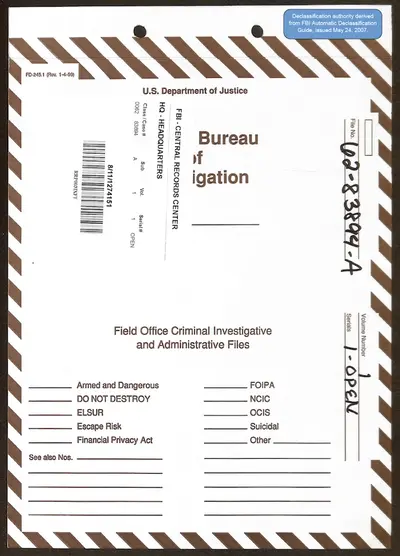
The documentation for the Kearney event was filed with the Federal Bureau of Investigation. During this era, the Bureau maintained specific standing protocols for the protection of vital installations and national security interests. Consequently, various field offices, including those in Knoxville, Albuquerque, and Los Angeles, were responsible for routing UFO reports to FBI headquarters. This administrative process ensured that any aerial phenomenon that could potentially represent a breach of domestic airspace or a technological threat from a foreign adversary was centralized for federal review.
The Incident
The primary account of the event was provided by R.O. Schmidt, a grain buyer operating in the Kearney region. According to the released documents, Schmidt reported the sighting of a wrecked “space ship” situated within a field near Kearney, Nebraska. Unlike many contemporary reports that focused solely on distant aerial lights or transient streaks of motion, Schmidt’s account described a physical crash and a direct encounter with the craft’s inhabitants. He claimed to have encountered six occupants from the vessel and engaged in what he described as amicable conversation with them.
Following the report, authorities conducted an investigation of the site described by Schmidt. Investigators identified physical evidence in the form of oil drippings on the ground, which provided a tangible element to the claim of a mechanical crash. Despite this physical finding, the official investigation concluded with a lack of corroboration for the more extraordinary elements of the report. Authorities ultimately expressed the belief that Schmidt’s story was weakening, suggesting a loss of consistency or detail in his testimony as the investigation progressed. While the specific number of witnesses present during the event is not specified in the released document, the primary testimony rests with Schmidt.
Classification and Context
The Kearney case is classified as a visual sighting reported by ground or air observers. In the context of 1950s aeronautics, such reports were often analyzed against a backdrop of rapid technological advancement and the proliferation of high-altitude surveillance. During this period, the phenomenon of unidentified objects was frequently scrutinized through the lens of potential Soviet technological breakthroughs or secret American aerospace programs.
The status of the Kearney incident remains officially unresolved. All records released under the PURSUE program are designated as unresolved by the All-domain Anomaly Resolution Office (AARO) by default. The federal government has maintained a neutral stance, having neither concluded that the events were anomalous nor confirmed that they were the result of conventional means. This lack of a definitive ruling leaves the possibility of both extraterrestrial or non-human intelligence and terrestrial origins open.
Conventional candidates for sightings during this specific era include experimental aircraft and the various weather balloons utilized in programs such as the Project Mogul series. Other common explanations investigated by researchers include atmospheric optical phenomena, such as sundogs or lenticular clouds, as well as astronomical objects like Venus, the Moon, or meteors appearing near the horizon. The presence of oil at the Kearney site remains one of the few documented physical traces, though it was insufficient to confirm the presence of a spacecraft.