Washington, D.C. UFO Sighting (July 29, 1954) — FBI Files
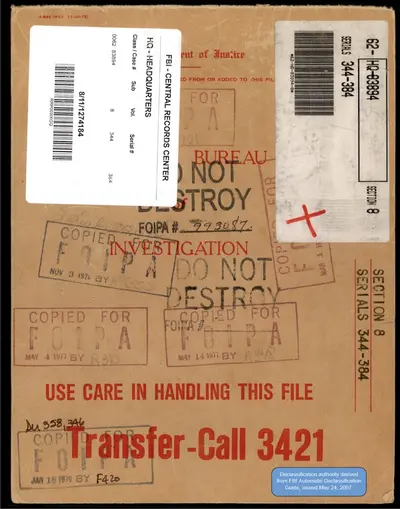
FBI records from July 1954 document reports of alleged thought transmissions originating from unidentified flying objects over Washington, D.C.
Historical Context
The mid-twentieth century represented a period of heightened atmospheric and geopolitical tension in the United States. During the early years of the Cold War, the presence of unidentified aerial phenomena became a significant concern for national security agencies. The era was defined by the rapid advancement of aerospace technology and the pervasive fear of Soviet surveillance capabilities. This climate led to the establishment of various investigative programs, most notably the United States Air Force’s Project Blue Book, which sought to analyze and categorize reports of unidentified flying objects.
At this time, the federal government maintained strict protocols regarding the reporting of aerial anomalies, particularly those occurring near the nation’s capital. The Federal Bureau of Investigation (FBI) played a secondary but vital role in this ecosystem. While the Air Force focused on the physical nature of the objects, the FBI monitored reports that could potentially involve espionage, domestic security threats, or psychological disturbances that might impact the stability of vital installations. The bureaucratic structure of the era relied on a network of field offices, including those in Knoxville, Albuquerque, and Los Angeles, to funnel significant intelligence to headquarters in Washington, D.C.
The July 1954 Incident
On July 29, 1954, an incident occurred in Washington, D.C., involving reports that moved beyond simple visual sightings into the realm of anomalous communication. The details of this specific case remained restricted from public view for decades, eventually being released on May 8, 2026, through the Presidential Unsealing and Reporting System for UAP Encounters (PURSUE). The released documentation reveals that the investigation involved high-ranking naval and federal officials.
According to the records, FBI Special Agent in Charge (SAC) Laughlin conducted interviews with John Hutson and Commander McQuiston of the Bureau of Aeronautics. These interviews were prompted by information relayed from Admiral Knowles. The core of the report centered on the experiences of a Mrs. Swan, who was allegedly receiving messages via thought transmission. According to the claims presented to the Bureau, these telepathic communications were believed to originate from unidentified flying saucers.
Despite the involvement of the Bureau of Aeronautics and the scrutiny of the FBI, the investigation reached a definitive conclusion regarding the necessity of further action. Both the FBI and the Navy determined that there was no definite evidence to warrant a more extensive or prolonged investigation into the claims of thought transmission. The specific number of witnesses to the phenomena or the alleged communications is not specified within the released document.
Analytical Framework and Classification
The 1954 case is classified as a visual sighting reported by ground or air observers, though the specific nature of the reported phenomenon involved an alleged psychological or telepathic component. In the broader context of mid-century UAP studies, such cases often presented challenges to investigators because they lacked the physical debris or radar tracks necessary for conventional scientific analysis.
Under the current administrative framework of the All-domain Anomaly Resolution Office (AARO), all records released via the PURSUE program are designated as unresolved by default. The federal government maintains a neutral stance regarding the 1954 incident, having neither concluded that the events were anomalous nor confirmed that they were the result of conventional phenomena.
When evaluating sightings from this period, investigators typically consider several conventional candidates. These include experimental high-altitude aircraft, weather balloons—specifically those associated with the Project Mogul series active in the late 1940s—and various atmospheric optical phenomena such as lenticular clouds or sundogs. Additionally, astronomical objects like Venus, the Moon, or meteors appearing near the horizon are frequently scrutinized as potential sources for unidentified lights. The 1954 Washington, D.C. case remains a unique entry in the archive due to its focus on the intersection of aerial phenomena and alleged cognitive interference.