Washington, D.C. UFO Sighting (February 1951) — FBI Files
An investigation into unidentified objects over Washington, D.C., in February 1951, involving claims of secret Navy balloon programs.
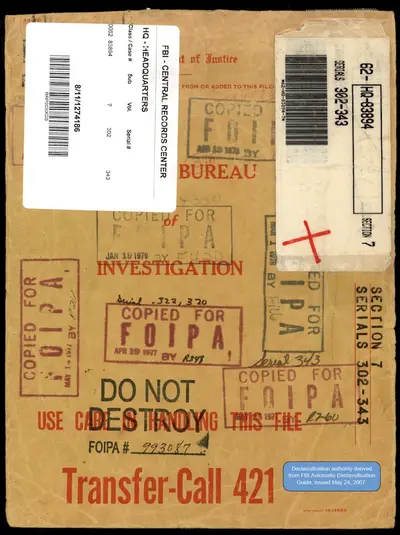
Historical Context
The early 1950s represented a period of heightened atmospheric anxiety within the United States, characterized by the onset of the Cold War and the rapid advancement of aerospace technology. Following the 1947 Kenneth Arnold sighting and the subsequent Roswell incident, the American public and government agencies were gripped by a phenomenon often referred to as the “flying saucer” era. During this time, the sudden appearance of unidentified aerial phenomena (UAP) was frequently interpreted through the lens of national security, as the possibility of Soviet technological breakthroughs loomed over the domestic landscape.
In this era, the Federal Bureau of Investigation (FBI) played a significant role in the monitoring of unidentified objects. Under established Bureau protocols, field offices in cities such as Knoxville, Albuquerque, and Los Angeles were tasked with routing UFO reports to headquarters. This centralized approach was driven by the necessity to protect vital installations, including nuclear facilities and military bases, from potential aerial incursions. The bureaucratic handling of these reports treated unidentified sightings not merely as astronomical curiosities, but as potential intelligence threats that required rigorous documentation and investigation.
The February 1951 Incident
In February 1951, an unidentified-object incident occurred over Washington, D.C., which was officially recorded by U.S. government investigators. The details of this specific encounter remained shielded from public view for decades, only becoming accessible on May 8, 2026, through the Presidential Unsealing and Reporting System for UAP Encounters (PURSUE). The documentation preserved in the FBI files provides a rare glimpse into the internal scientific debates regarding the nature of these sightings during the height of the early Cold War.
The released files contain a specific claim made by Dr. Liddel, a nuclear physicist, who sought to provide a conventional explanation for the observed phenomena. Dr. Liddel asserted that the mystery of flying saucers could be solved by identifying the objects as “skyhooks.” He described these as large balloons, approximately one hundred feet in diameter, which he claimed the Navy had been secretly deploying to study cosmic rays. This theory suggested that the sightings were not the result of extraterrestrial or advanced adversary technology, but rather a byproduct of clandestine domestic scientific research.
However, this assertion was not met with consensus. The document indicates that Dr. Liddel’s identification of the objects as Navy-operated cosmic ray balloons was immediately disputed by another scientist involved in Project Saucer. While the number of witnesses to the Washington, D.C. event is not specified in the released documentation, the presence of high-level scientific disagreement highlights the complexity of the era’s investigations.
Analytical Status and Classification
The case is categorized as being associated with a military installation or nuclear facility, reflecting the heightened sensitivity of the Washington, D.C. airspace during the period. Because the records were released under the PURSUE program, the All-domain Anomaly Resolution Office (AARO) has designated the incident as unresolved by default. This designation signifies that the federal government has not reached a definitive conclusion regarding whether the objects were anomalous in nature or attributable to conventional technology.
In the broader context of mid-century UAP studies, investigators often weighed the possibility of secret atmospheric research against other known phenomena. During this period, the Project Mogul series of high-altitude balloons was active, providing a historical precedent for the “skyhook” theory proposed by Dr. Liddel. Other conventional candidates considered by investigators for sightings of this era include experimental aircraft, atmospheric optical phenomena such as lenticular clouds or sundogs, and the visibility of bright astronomical objects like Venus or the Moon near the horizon. The 1951 Washington, D.C. file remains a significant piece of the archival record, representing the intersection of scientific inquiry and national security protocols.