Tucson, Arizona UFO Sighting (December 9, 1954) — FBI Files
FBI files reveal a 1954 inquiry from a London investigator seeking data on disc-shaped objects sighted over Tucson, Arizona.
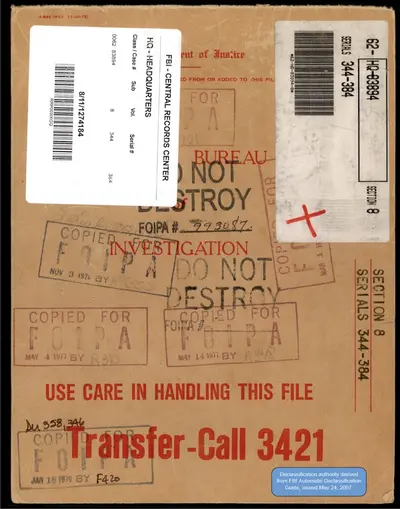
Background
On December 9, 1954, in Tucson, Arizona, U.S. government investigators recorded an unidentified-object incident later released to the public on May 8, 2026, as part of the Presidential Unsealing and Reporting System for UAP Encounters (PURSUE). This incident occurred during the height of the Cold War, a period characterized by intense atmospheric surveillance and heightened public anxiety regarding aerial incursions. The case was investigated under the framework of the Air Force’s Project Blue Book or its predecessors, which served as the primary official mechanism for analyzing Unidentified Flying Object reports. The documentation was filed with the Federal Bureau of Investigation, following established bureaucratic procedures where various field offices, including those in Knoxville, Albuquerque, and Los Angeles, routed UFO reports to headquarters. This routing was part of the Bureau’s standing protocols designed to monitor and protect vital installations and national security interests from potential aerial threats.
The mid-1950s represented a significant era for aerial phenomena documentation. Following the 1947 Kenneth Arnold sighting, the phenomenon of “flying saucers” became a staple of global news, prompting both military and civilian efforts to categorize unknown aerial events. During this time, the distinction between classified aerospace technology and truly anomalous phenomena was often blurred in public discourse. The geographic location of Tucson, situated in the Sonoran Desert, provided a vast, clear airspace that was frequently subject to astronomical observation and military activity, making it a common site for reports of unusual lights or moving objects.
What the document records
The released FBI documentation details a specific administrative inquiry rather than a direct eyewitness account of a single event. The FBI received a letter from the Mayor of Tucson regarding a request for information about flying saucer sightings. This request originated from Harold Mattan, an Aerial Phenomena Investigator based in London, England, who was in the process of updating his personal and professional records. Mattan’s inquiry sought specific, quantifiable data points to assist in his longitudinal study of aerial anomalies, including the time, size, shape, speed, and altitude of any observed objects within the Tucson area.
While the correspondence indicates a search for data related to sightings, the number of witnesses involved in the specific phenomena being queried is not specified in the released document. The nature of the document is investigative and administrative, reflecting the international interest in documenting the frequency and characteristics of these objects during the mid-twentieth century. Such inquiries were common as independent researchers sought to compile global datasets to identify patterns in unidentified aerial phenomena.
Type of case
The descriptions provided within the context of the inquiry and the broader era of the report characterize the observed objects as being disc- or saucer-shaped. This terminology was standard for the period, reflecting the prevailing cultural and scientific nomenclature used to describe objects that did not conform to the known aerodynamic profiles of contemporary fixed-wing aircraft or helicopters.
Status
All records released under the PURSUE program are designated unresolved by the All-domain Anomaly Resolution Office (AARO) by default. The federal government has not concluded that the events were anomalous, has not concluded that they were conventional, and has not ruled out either possibility. In the context of 1954, many such sightings were later attributed to conventional candidates. These included experimental aircraft testing, weather balloons—specifically the Project Mogul series utilized in the late 1940s for detecting Soviet nuclear tests—and various atmospheric optical phenomena such as sundogs or lenticular clouds. Additionally, astronomical objects like Venus, the Moon, or meteors appearing near the horizon were frequent sources of misidentification. The Tucson file remains part of the unclassified historical record of the era’s ongoing investigation into the nature of unidentified aerial objects.